
Roll of Thunder Hear My Cry Quiz
How the Scales are Structured
Who Usually Takes This Test?
See How You Compare
Below is a preview of how scores are typically distributed across each scale.
Example Questions From the Test
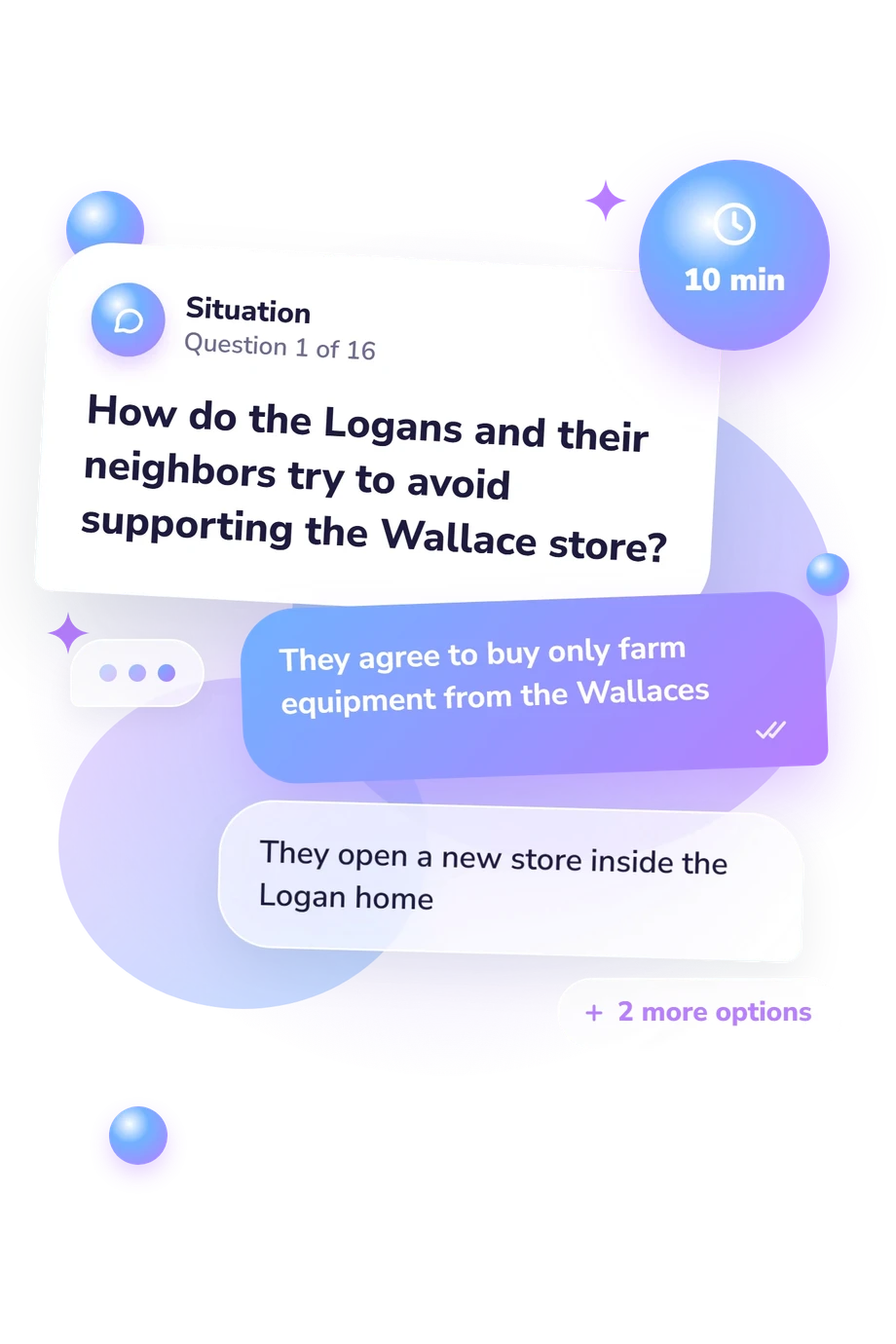
- They agree to buy only farm equipment from the Wallaces
- They open a new store inside the Logan home
- They persuade the county to revoke the Wallaces’ business license
- They organize purchases on credit from a store in Vicksburg
- Urban Georgia during Reconstruction
- Rural Mississippi during the Great Depression
- Rural Alabama during World War II
- Urban Tennessee during the Harlem Renaissance
- He becomes the children’s teacher at Great Faith School
- He serves as Harlan Granger’s lawyer in the land dispute
- He manages the Wallace store during the boycott
- He works on the farm and helps protect the family
Roll of Thunder Hear My Cry Quiz - Description and methodology of the test
Students, book-club members, and returning readers may take the Roll of Thunder Hear My Cry Quiz when they want a focused check before discussion, study, or rereading. The Roll of Thunder quiz offers a practical way to test how securely the novel’s reading experience has been understood. Its result distinguishes a foundation to revisit from developing or strong knowledge.
What This Assessment Explores
The questionnaire checks how accurately you can identify events, motives, and connections in Taylor’s novel. Questions about Roll of Thunder, Hear My Cry combine factual recall with interpretation, covering the Logan family, the boycott, school segregation, land ownership, and the escalating danger around T.J. It suits students, book-club readers, and anyone revisiting the story.
The result appears on the Roll of Thunder, Hear My Cry Knowledge scale (0-16): Foundation to revisit (0-6), Developing knowledge (7-12), or Strong knowledge (13-16). These bands indicate the depth of your knowledge of the novel’s plot and meaning. The main dimensions are:
- Plot and sequence show whether you can connect major events and their consequences.
- Characters and relationships reflect recognition of motives, loyalties, and changing alliances.
- Context and themes indicate how well you link segregation, land, family, and resistance.
Methodology and Evidence Base
Each item presents four answer choices and asks you to select the response that best fits the novel. Some prompts test direct details, while others ask why an event matters or what a repeated image reveals. The questionnaire does not state a separate weighting rule for individual responses, so interpretation should follow the named result bands rather than an assumed point formula.
Roll of Thunder, Hear My Cry (Taylor, 1976) is the primary literary source for the content. The questionnaire is not an adaptation of McDowell’s (2002) analysis or Santoso and Nugraheni’s (2023) study. Its questions are conceptually consistent with their discussions of child agency, counter-hegemonic action, racial hierarchy, and resistance, but those publications do not validate this online quiz.
The test functions as a structured reading check on Roll of Thunder, Hear My Cry. No standardized norms, reliability coefficients, or validation sample are stated for the questionnaire, and quiz performance can vary with memory, rereading, attention, and current familiarity with the novel.
- Mildred D. Taylor. Roll of Thunder, Hear My Cry. New York: Dial Press, 1976.
- Kelly McDowell. “Roll of Thunder, Hear My Cry”: A Culturally Specific, Subversive Concept of Child Agency. Children’s Literature in Education, 33(3), 213-225, 2002. 10.1023/A:1019634116385.
- Heri Dwi Santoso and Yunita Nugraheni. Black American Counter Hegemony in Mildred Taylor’s Roll of Thunder, Hear My Cry (1976). In Proceedings of the 1st Lawang Sewu International Symposium on Humanities and Social Sciences 2022 (LEWIS 2022), Advances in Social Science, Education and Humanities Research, 206-220, Atlantis Press, 2023. 10.2991/978-2-38476-078-7_22.
Updated: