
Philately Quiz
How the Scales are Structured
Who Usually Takes This Test?
See How You Compare
Below is a preview of how scores are typically distributed across each scale.
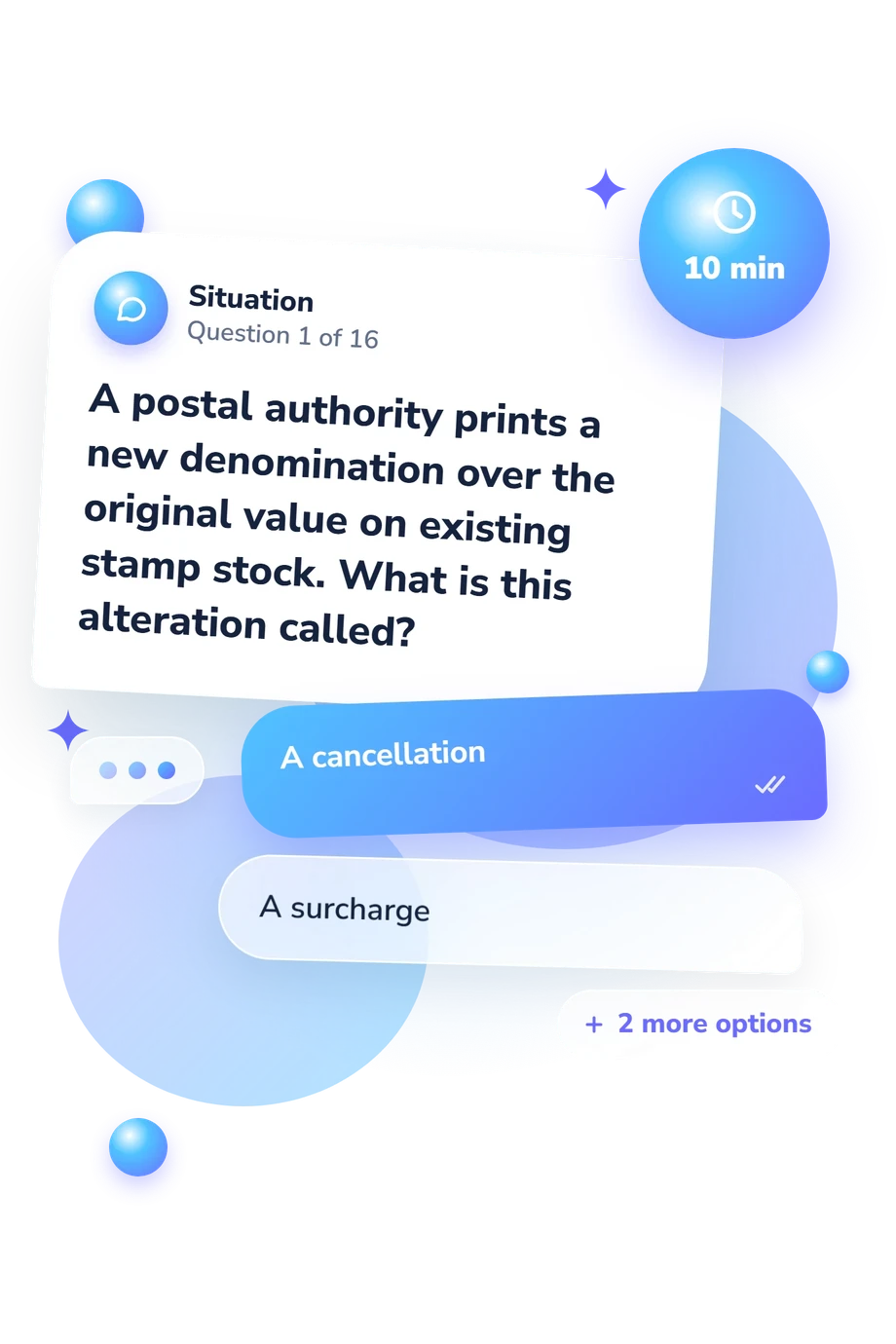
Example Questions From the Test
- A cancellation
- A surcharge
- A watermark
- An essay
- The British Two Penny Blue
- The United States 1847 five-cent Franklin
- The British Penny Black
- The Basel Dove
- To certify that the envelope contains the correct address
- To guarantee that the mail will arrive by a certain date
- To identify the company that printed the stamp
- To show that the stamp has been used and discourage reuse
Philately Quiz - Description and methodology of the test
For anyone beginning a collection or refining established habits, this quiz focuses on practical knowledge of stamps and postal history. This philately quiz helps readers identify familiar concepts, notice terminology needing review, and choose topics for further study. Reviewing philately questions and answers can clarify which areas deserve attention. It suits curious collectors seeking a snapshot of current understanding without reducing the hobby to one specialty.
What This Assessment Explores
Designed for readers beginning, resuming, or broadening a collection, the questionnaire checks philatelic knowledge. It functions as a stamp collecting test for learning basic terms or refreshing hobby experience. Items move from definitions to observations on stamps and covers, so the result reflects terminology, postal functions, condition clues, and collecting practice rather than one specialty.
The main themes are:
- Stamp structure and production show how perforations, watermarks, surcharges, margins, and issue types affect identification.
- Postal use and evidence show how covers, cancellations, postage due, and transit marks explain mail history.
- Condition and collecting practice show how gum, hinges, plate blocks, and thematic organization affect classification.
Together, these themes produce the displayed Philately Knowledge scale, scored 0-16. Foundation covers 0-6, Developing Collector covers 7-12, and Strong Knowledge covers 13-16. Highest band reflects a confident grasp of stamps, collecting practices, and postal-history evidence.
Methodology and Evidence Base
Each item presents a short situation or definition with four answer choices, asking the respondent to identify a term, postal function, condition clue, or collecting practice. Respondents select one answer for each item and receive a result on the displayed 0-16 scale.
The content is conceptually consistent with Steven J. Rod (1989), whose treatment supports its focus on stamp anatomy, postal markings, issue types, and collecting terminology. Related explanations align with John D. Apfelbaum and David Lidman (1981) and L. N. Williams (1990). The online quiz is conceptually consistent with these philatelic references, but it is not a published standardized instrument or a validated adaptation of them.
Interpret this philately assessment as a snapshot of recognition during one attempt. Performance can vary with prior exposure, attention, wording, and ability to inspect or recall postal evidence. The bands are descriptive categories for this questionnaire, not population-based estimates of expertise.
- Rod, Steven J. An Introduction to Stamp Collecting. Sidney, OH: Amos Press, 1989.
- Apfelbaum, John D., and David Lidman. The World of Stamps and Stamp Collecting. New York: Charles Scribner's Sons, 1981.
- Williams, L. N. Fundamentals of Philately. Revised ed. State College, PA: American Philatelic Society, 1990.
- Gelber, Steven M. “Free Market Metaphor: The Historical Dynamics of Stamp Collecting.” Comparative Studies in Society and History 34, no. 4 (1992): 742-769. 10.1017/S0010417500018077
Updated: