
International Women's Day Quiz
How the Scales are Structured
Who Usually Takes This Test?
See How You Compare
Below is a preview of how scores are typically distributed across each scale.
Example Questions From the Test
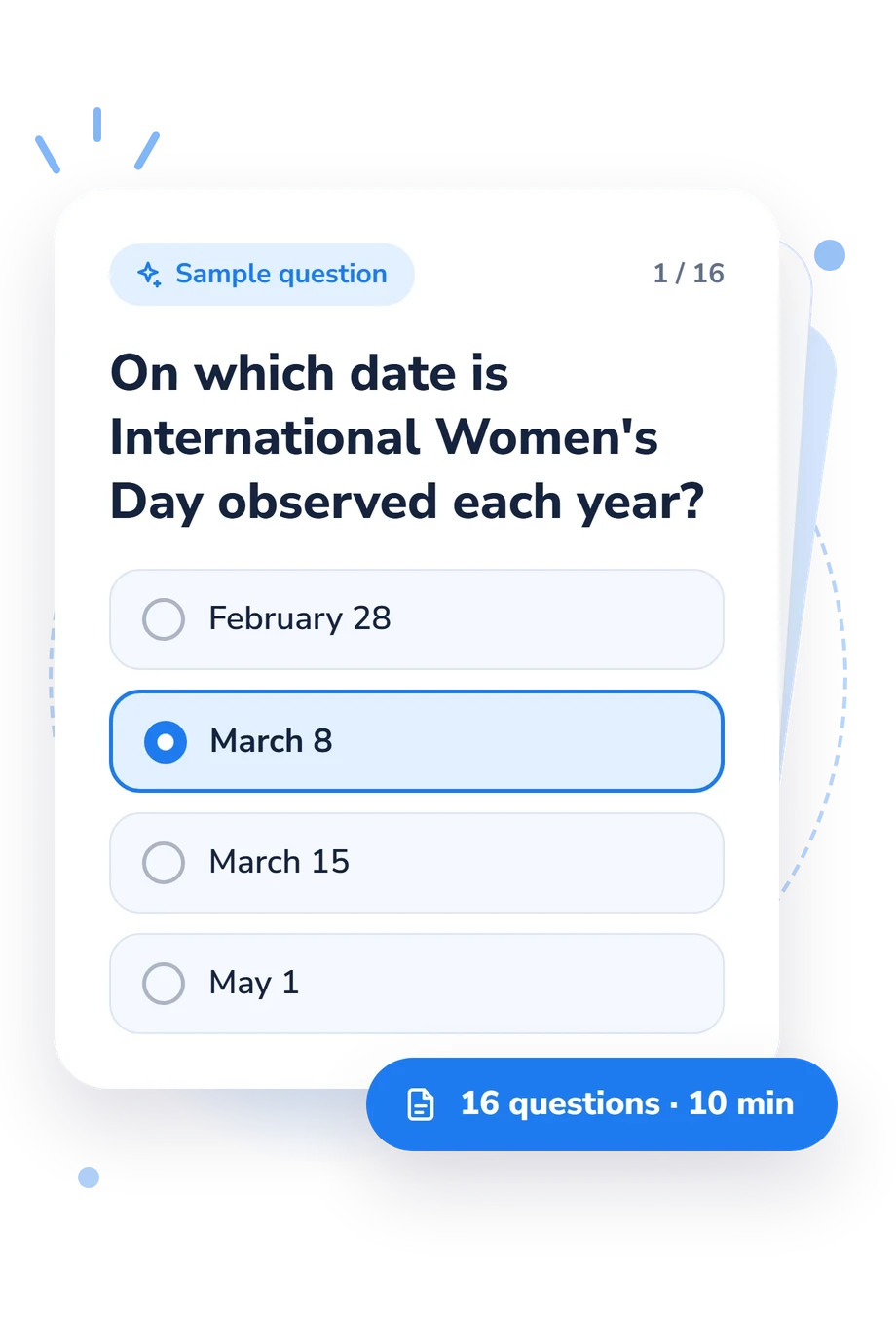
- February 28
- March 8
- March 15
- May 1
- 1945
- 1975
- 1965
- 1985
- Temperance campaigns and international tourism
- Postwar environmentalism and wildlife conservation
- Labor organizing and campaigns for women’s political rights
- Consumer protection and digital privacy activism
International Women's Day Quiz - Description and methodology of the test
For readers who want to connect a global observance with its history and present-day purpose, the International Women's Day Quiz offers a focused knowledge check rather than a personality profile. This Women's Day quiz suits learners, educators, allies, and anyone preparing an event or discussion. The result indicates how well you recognize major milestones, equality themes, and practical examples of participation.
What This Assessment Explores
This assessment checks knowledge of International Women's Day as a historical observance and an equality-focused activity. Its coverage of International Women's Day history includes labor and women's-rights movements, Zetkin's 1910 proposal, early events, the 1917 Petrograd strike, and United Nations milestones.
Several items ask for interpretation rather than recall, including achievement alongside barriers, allyship without self-centering, workplace equality, and intersectionality.
The questions draw on three thematic areas:
- Historical development traces origins, early events, and later international milestones.
- Equality in practice connects barriers in work, pay, representation, and opportunity.
- Informed participation tests listening, amplification, and support for structural action.
The result appears on International Women's Day Knowledge (0-16), with Foundations to build (0-6), Developing knowledge (7-12), or Strong knowledge (13-16) indicating how broadly the respondent connects major facts with current equality aims.
Methodology and Evidence Base
Each item uses multiple choice with one of four alternatives. The set combines dates, places, people, and milestones with scenarios about allyship, workplace action, official messaging, economic equality, and intersectionality. This structure tests knowledge of International Women's Day facts and practical application of the observance's purpose.
The result is presented on the displayed knowledge scale, without a separate subscale or topic-level score. Its single aggregate result describes overall command rather than identifying which historical area needs review.
Historical context and themes draw on Kaplan (1985) on socialist and labor origins. Zetkin and Duncker provide the 1910 proposal for an annual day on women's rights and suffrage. LeSavoy and Jordan examine tensions between political aims and commercial celebration, and United Nations General Assembly Resolution 32/142 supports the 1977 milestone. These sources support content and themes, not validation.
As an online educational questionnaire, it has no stated normative sample or reliability estimate; performance can shift with prior exposure, wording interpretation, and current context. The aggregate result reflects current knowledge rather than lived experience, personal commitment, or a detailed profile of topic-level understanding.
- Kaplan, Temma. "On the Socialist Origins of International Women's Day." Feminist Studies 11, no. 1 (1985): 163-171. 10.2307/3180144
- Zetkin, Clara, and Käthe Duncker. "International Women's Day." Die Gleichheit, August 29, 1910. Reprinted in Philip S. Foner, ed., Clara Zetkin: Selected Writings. New York: International Publishers, 1984, p. 108.
- LeSavoy, Barbara, and Garrett Jordan. "The Capitalist Hijacking of International Women's Day: Russian and American Considerations." Journal of International Women's Studies 14, no. 3 (2013): 244-258, Article 17.
- United Nations General Assembly. "Women's Participation in the Strengthening of International Peace and Security and in the Struggle against Colonialism, Racism, Racial Discrimination, Foreign Aggression and Occupation and All Forms of Foreign Domination." A/RES/32/142, December 16, 1977.
Updated: