
Noun and Verb Quiz
How the Scales are Structured
Who Usually Takes This Test?
See How You Compare
Below is a preview of how scores are typically distributed across each scale.
Example Questions From the Test
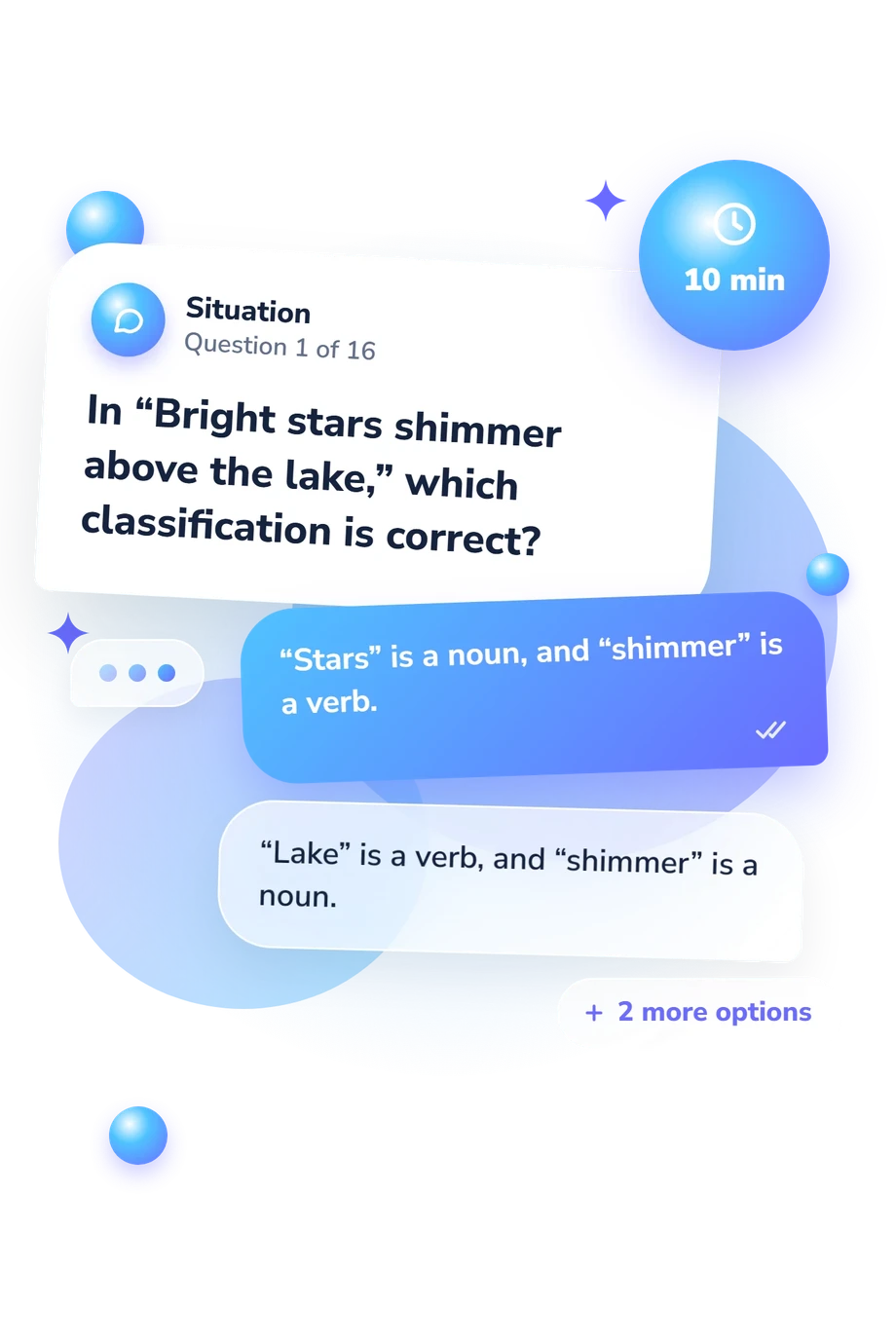
- “Stars” is a noun, and “shimmer” is a verb.
- “Lake” is a verb, and “shimmer” is a noun.
- “Bright” is a noun, and “stars” is a verb.
- “Stars” is a verb, and “lake” is an adjective.
- soup
- the
- delicious
- smells
- The river curves around the hill.
- Our teacher opened the window.
- Maya visited Brazil in July.
- A planet appeared above the horizon.
Noun and Verb Quiz - Description and methodology of the test
Students who want a clearer grasp of basic English grammar can use this noun and verb quiz to check how well they distinguish the two word classes in ordinary sentences. Its focused format makes this quiz on nouns and verbs useful for learners reviewing terminology, teachers assigning a quick practice activity, and adults refreshing skills for writing or study. The result points to concepts that merit more attention.
What This Assessment Measures
The questionnaire uses sentences, definitions, and individual words to assess noun-and-verb knowledge in context. The items cover definitions, proper, concrete, and abstract nouns, main verbs, verb phrases, context-dependent word classes, fragments, and subject-verb agreement. As an English noun and verb test, it shows whether basic recognition remains accurate when grammar is applied to practical examples.
The questions group the learning targets into three areas:
- Noun recognition shows how well you identify names of people, places, things, and ideas.
- Verb analysis shows whether you can locate actions or states, including multiword verb phrases.
- Sentence application shows how context guides classifying a word, completing a fragment, or choosing agreement.
The Noun and Verb Knowledge scale (0-16) reports the overall result: Foundations to Build (0-6), Developing Knowledge (7-12), or Strong Knowledge (13-16). These bands show increasing consistency across the tested tasks.
Methodology and Scientific Basis
Each item presents a short sentence or definition with four answer choices. You select the option that correctly identifies a noun or verb, recognizes a verb phrase, completes a fragment, or fits the required agreement form. This selected-response format tests grammatical decisions without requiring extended writing.
The result is condensed into one displayed total rather than separate noun and verb scores. The displayed bands describe performance on this questionnaire; they are descriptive levels here, not population norms or clinical thresholds.
Its terminology is conceptually consistent with Huddleston, Pullum, and Reynolds (2022), which explains nouns, verbs, phrases, and agreement for learners. It also aligns with the broader framework associated with Huddleston and Pullum. Those grammar books provide the linguistic framework but do not establish the online questionnaire’s reliability, validity, or norms.
The result can guide targeted review of word-class definitions, shifting functions, and agreement, making grammar review of nouns and verbs more focused. Recent instruction, attention, and familiarity with terminology may affect performance, so the result is a focused learning indicator rather than a complete measure of English ability.
- Rodney Huddleston, Geoffrey K. Pullum, and Brett Reynolds. A Student's Introduction to English Grammar. 2nd ed. Cambridge University Press, 2022. 10.1017/9781009085748
- Rodney Huddleston and Geoffrey K. Pullum, with Laurie Bauer, Betty Birner, Ted Briscoe, Peter Collins, David Denison, David Lee, Anita Mittwoch, Geoffrey Nunberg, Frank Palmer, John Payne, Peter Peterson, Lesley Stirling, and Gregory Ward. The Cambridge Grammar of the English Language. Cambridge University Press, 2002. 10.1017/9781316423530
Updated: