
Otaku Quiz
How the Scales are Structured
Who Usually Takes This Test?
See How You Compare
Below is a preview of how scores are typically distributed across each scale.
Example Questions From the Test
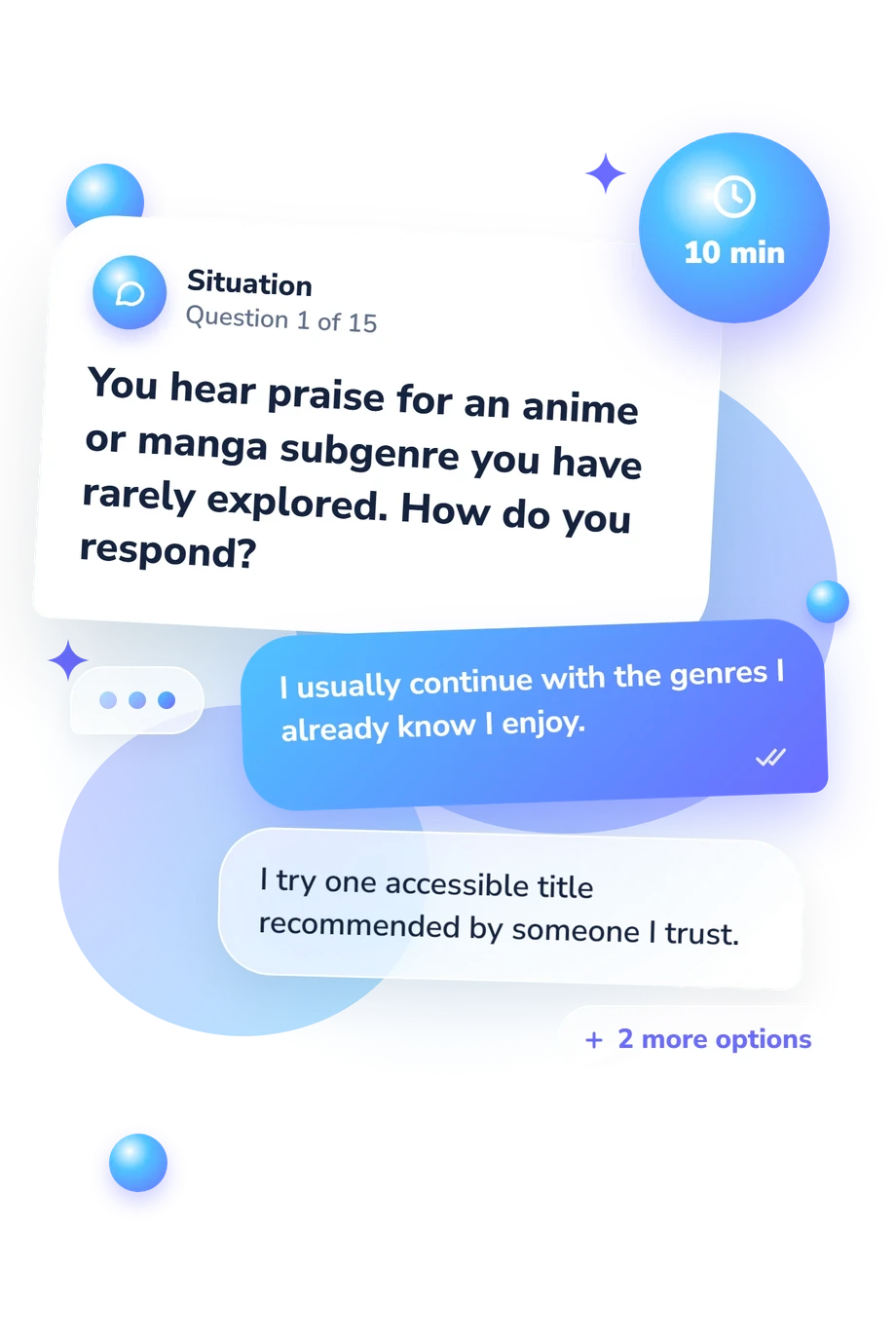
- I usually continue with the genres I already know I enjoy.
- I try one accessible title recommended by someone I trust.
- I sample several titles to understand the subgenre's range.
- I explore titles from different eras or creators and learn how the subgenre developed.
- I alternate between familiar interests and occasional recommendations.
- I deliberately vary genres, formats, creators, or time periods.
- I mostly return to favorites or very similar titles.
- I keep a varied list and regularly try something outside my usual choices.
- A subtle symbol or color that mainly has meaning to me.
- A recognizable piece of official or fan-made merchandise.
- I generally keep fandom separate from how I dress.
- A coordinated, customized, handmade, or cosplay-inspired look.
Otaku Quiz - Description and methodology of the test
For people who enjoy anime, manga, games, or related fan culture, this anime fandom test can clarify which parts of their engagement deserve closer attention. The otaku quiz gives a structured profile that can inform reflection on how they spend time, respond to fan spaces, and express enthusiasm. It may help you choose language for discussing your interests and decide which parts of your fandom you want to explore further.
What This Assessment Explores
Fandom is treated as a varied pattern rather than a single level of commitment. Questions cover media choices, discussion, collecting, styling, making, research, and shared events. By asking about these situations, this anime fan questionnaire shows which forms of fandom engagement are more prominent for you. Its three result dimensions are:
- Community Connection (0-15) measures social exchange, shared events, and ongoing fan relationships: Independent Fan (0-5), Small-Circle Connector (6-10), or Community Participant (11-15).
- Creative Expression (0-15) measures visible engagement through making, collecting, styling, displaying, or sharing: Private Enjoyment (0-5), Selective Expression (6-10), or Active Creator (11-15).
- Media Curiosity (0-15) measures breadth and depth of exploration across stories, creators, genres, adaptations, and context: Focused Explorer (0-5), Selective Investigator (6-10), or Deep-Dive Discoverer (11-15).
These bands describe preference and engagement style, not popularity, authenticity, or correct knowledge.
Methodology and Scientific Basis
Each prompt presents a situation with four response options. Choices span enjoyment, small-circle sharing, wider discussion, creative expression, and media-context investigation. Results are displayed as three scores ranging from 0 to 15 rather than one fandom grade; a higher band indicates greater prominence of that pattern, not a better profile.
The approach is conceptually consistent with Ray and colleagues’ 2017 study distinguishing identification with a fan interest from identification with other fans and examining needs linked to anime fandom. Gonçalves and colleagues’ 2021 work provides comparison on anime-viewing motivations, while Vinney and colleagues’ 2019 research treats fan identity as a multidimensional relationship with media and fan activity. This questionnaire gives an otaku engagement profile, not a reproduction or validated adaptation of one instrument.
Read the result as a snapshot of current preferences. Self-report may shift with mood, time, recent media, or willingness to disclose, and this questionnaire is a profile system without stated population norms or clinical cutoffs. It is best used for within-profile reflection, not diagnosis or judgments about the quality of your fandom.
- Ray, Adam, Plante, Courtney N., Reysen, Stephen, Roberts, Sharon E., & Gerbasi, Kathleen C. (2017). Psychological needs predict fanship and fandom in anime fans. The Phoenix Papers, 3(1), 56-68.
- Gonçalves, João, Navio, Catarina, & Moura, Pedro. (2021). The occidental otaku: Portuguese audience motivations for viewing anime. Convergence: The International Journal of Research into New Media Technologies, 27(1), 247-265. 10.1177/1354856520923966
- Vinney, Cynthia, Dill-Shackleford, Karen E., Plante, Courtney N., & Bartsch, Anne. (2019). Development and validation of a measure of popular media fan identity and its relationship to well-being. Psychology of Popular Media Culture, 8(3), 296-307. 10.1037/ppm0000188
Updated: