
Isaiah Quiz
How the Scales are Structured
Who Usually Takes This Test?
See How You Compare
Below is a preview of how scores are typically distributed across each scale.
Example Questions From the Test
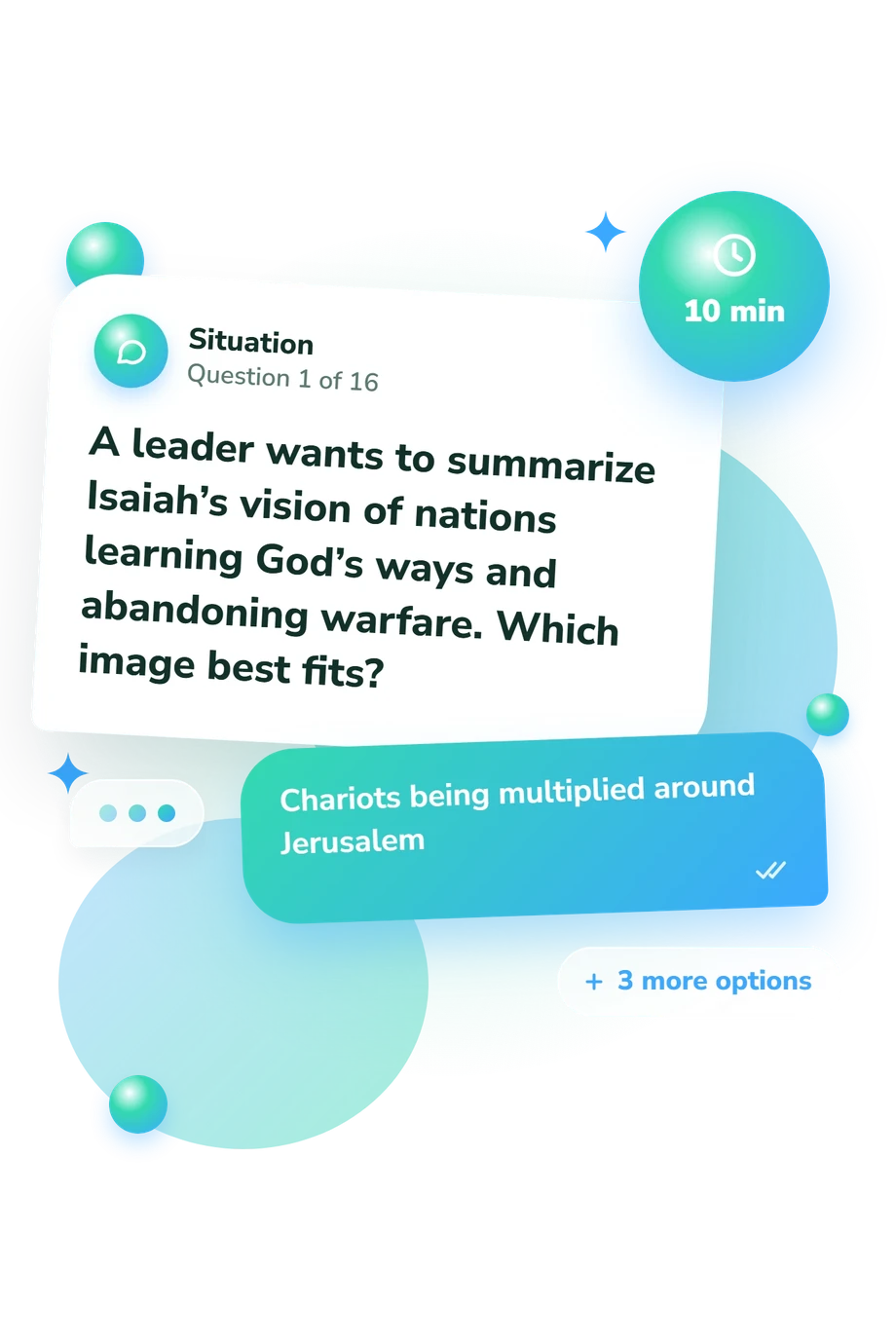
- Chariots being multiplied around Jerusalem
- City walls being raised higher than the mountains
- Swords being beaten into plowshares and spears into pruning hooks
- Warriors exchanging their armor for priestly garments
- A cornerstone removed from the temple
- A shoot growing from the stump of Jesse
- A ladder rising from Bethel
- A golden branch growing beside the Euphrates
- Uzziah, Jotham, Ahaz, and Hezekiah of Judah
- Saul, David, Solomon, and Rehoboam of Israel and Judah
- Josiah, Jehoiakim, Jehoiachin, and Zedekiah of Judah
- Jeroboam II, Zechariah, Shallum, and Menahem of Israel
Isaiah Quiz - Description and methodology of the test
Readers who want to move beyond a chapter summary can use the Isaiah Quiz to check how securely they recognize the book’s major scenes, historical moments, and theological ideas. As a bible quiz on Isaiah, it can support focused reading by helping readers connect individual passages with wider patterns. The result can help you choose passages and themes to revisit next.
What This Assessment Explores
The questions move across prophetic calling, kings and empires, servant imagery, justice, worship, comfort, restoration, and visions of renewal. As an Isaiah study quiz, it asks about links between images and their interpretive setting rather than vocabulary. It is intended for readers studying the biblical book, whether they are beginning a first reading or reviewing passages.
The result is organized around the displayed Isaiah Knowledge scale (0-16) and three interpretation bands:
- Foundations to build (0-6) indicates recognition of some elements while pointing to useful areas for review.
- Developing understanding (7-12) indicates familiarity with important passages and ideas, with more work needed to connect them across the book.
- Strong understanding (13-16) indicates a well-developed grasp of context, imagery, messages, and major theological themes.
These levels describe quiz performance on the selected content; they do not measure faith, devotion, or spiritual standing.
Methodology and Evidence Base
The format is a knowledge assessment rather than a self-report of feelings or faith. Each item presents a biblical situation, image, historical detail, or thematic claim with four answer choices, and the respondent selects the option that best fits the passage. The total summarizes performance across responses.
Sweeney and Tolley (2023) provide the scholarly anchor for Isaiah’s historical setting, literary shape, and major interpretive themes. The 2021 NRSVue supplies the biblical wording, while Tiemeyer (2020) and Heffelfinger (2024) offer academic treatments. These sources support the content coverage. The questionnaire is a content-focused online assessment whose result summarizes performance on the included questions, rather than a norm-referenced estimate.
As an Isaiah knowledge test, it reflects biblical scholarship rather than a psychological scale with population norms. Results indicate what the respondent recognized in this question set. Translation familiarity, memory, prior study, and attention can influence performance, so each band should guide reflection on passages to revisit rather than serve as a complete measure of biblical expertise.
- Sweeney, Marvin A., and Kevin Tolley. “Isaiah.” Oxford Bibliographies in Biblical Studies. Oxford University Press, 2010; updated November 6, 2023. 10.1093/obo/9780195393361-0058
- National Council of the Churches of Christ in the United States of America. The Holy Bible: New Revised Standard Version Updated Edition. Friendship Press, 2021.
- Tiemeyer, Lena-Sofia, editor. The Oxford Handbook of Isaiah. Oxford University Press, 2020. 10.1093/oxfordhb/9780190669249.001.0001
- Heffelfinger, Katie. Isaiah 40-66. New Cambridge Bible Commentary. Cambridge University Press, 2024. 10.1017/9781316694336.003
Updated: