
Transfiguration Quiz
How the Scales are Structured
Who Usually Takes This Test?
See How You Compare
Below is a preview of how scores are typically distributed across each scale.
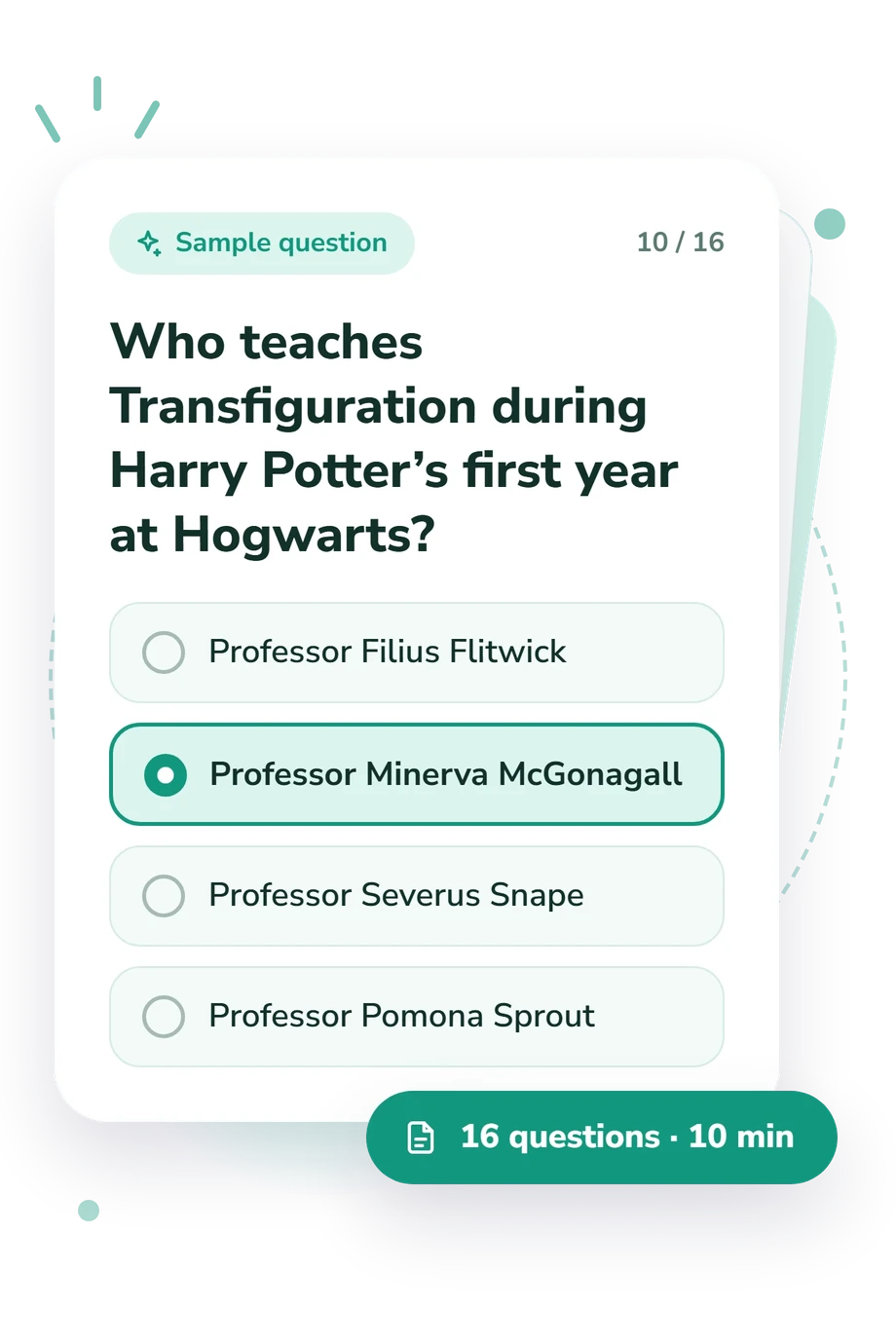
Example Questions From the Test
- A tabby cat
- A pig
- A large tortoise
- A stone statue
- A sealed chamber inside the Ministry of Magic
- The nearest location hidden from view
- Into non-being—which is to say, everything
- A permanent storage space inside the caster’s wand
- It enabled her to hide nearby and overhear private conversations
- It let her understand every animal language
- It allowed her to Apparate through Hogwarts protections
- It made her immune to truth-telling magic
Transfiguration Quiz - Description and methodology of the test
Readers who want to check how well they remember the rules and examples of magical transformation can use this transfiguration quiz as a focused knowledge exercise. Fans of the Harry Potter novels can use this Harry Potter quiz focused on transfiguration to distinguish related ideas such as Polyjuice, Animagi, Vanishing, Conjuration, and Metamorphmagi. Its outcome is an overall level of knowledge across the tested material, not a multidimensional profile.
What This Assessment Explores
The questions examine knowledge rather than attitudes or imagination. They ask readers to distinguish forms of magic, recall classroom demonstrations and school requirements, and connect characters with their transformations. The result from this transfiguration knowledge test indicates broad performance across the tested material, rather than showing which details are secure.
These thematic groups show what the result covers:
- Transformation distinctions test whether you can separate Polyjuice, Animagus, Metamorphmagus, and related changes.
- Spell mechanics show whether you understand Vanishing, Conjuration, Gamp’s Law, and limits on magical creation.
- Classroom details measure recall of McGonagall’s lessons, O.W.L. expectations, and Hogwarts examples.
- Animagus lore shows how well you recognize registration, animal forms, human traits, and voluntary transformation.
The displayed scale, Transfiguration Knowledge: 0-16, describes performance as Foundation 0-6, Developing Command 7-12, or Strong Command 13-16. These labels indicate remembered detail, not intelligence or fandom.
Methodology and Evidence Base
Each item presents a short scenario or factual prompt with four answer choices. The format rewards selecting the most accurate distinction, outcome, or character association; it is a knowledge-recall method rather than an attitude inventory or open-ended interpretation. The scoring presents an overall total on the displayed scale, and no separate weighting is described.
Content comes from the Harry Potter novels, especially lessons, spells, magical exceptions, and transformations. This Harry Potter transformation quiz tests recall of that canon rather than literary interpretation. The novel canon supplies the quiz’s subject matter, but not a psychological measurement framework; its scoring is not standardized, and no population norms, reliability coefficients, or diagnostic cutoffs accompany the result.
Interpret the outcome as a snapshot of recalled canon. A strong band suggests accurate coverage of the tested material, while a lower band suggests that rereading may help reinforce it. Recognition, attention, familiarity, recency, and momentary concentration can all affect performance, so the result should not be generalized beyond the tested canon knowledge.
- Rowling, J. K. Harry Potter Box Set: The Complete Collection (Children's Paperback). Bloomsbury Children's Books, 2014. ISBN 9781408856772.
- Skipper, Alicia L., and Kate Fulton. "Out from the Shadows into the Light: Persona and Shadow in Harry Potter." In The Alchemical Harry Potter: Essays on Transfiguration in J. K. Rowling's Novels, edited by Anne J. Mamary, McFarland, 2021, pp. 79-96.
- Orgelfinger, Gail. "J. K. Rowling's Medieval Bestiary." In Studies in Medievalism XVII: Defining Medievalism(s), edited by Karl Fugelso, Boydell & Brewer, 2009, pp. 141-160. DOI 10.1515/9781846157639.
Updated: