
Telepathy Quiz
How the Scales are Structured
Who Usually Takes This Test?
See How You Compare
Below is a preview of how scores are typically distributed across each scale.
Example Questions From the Test
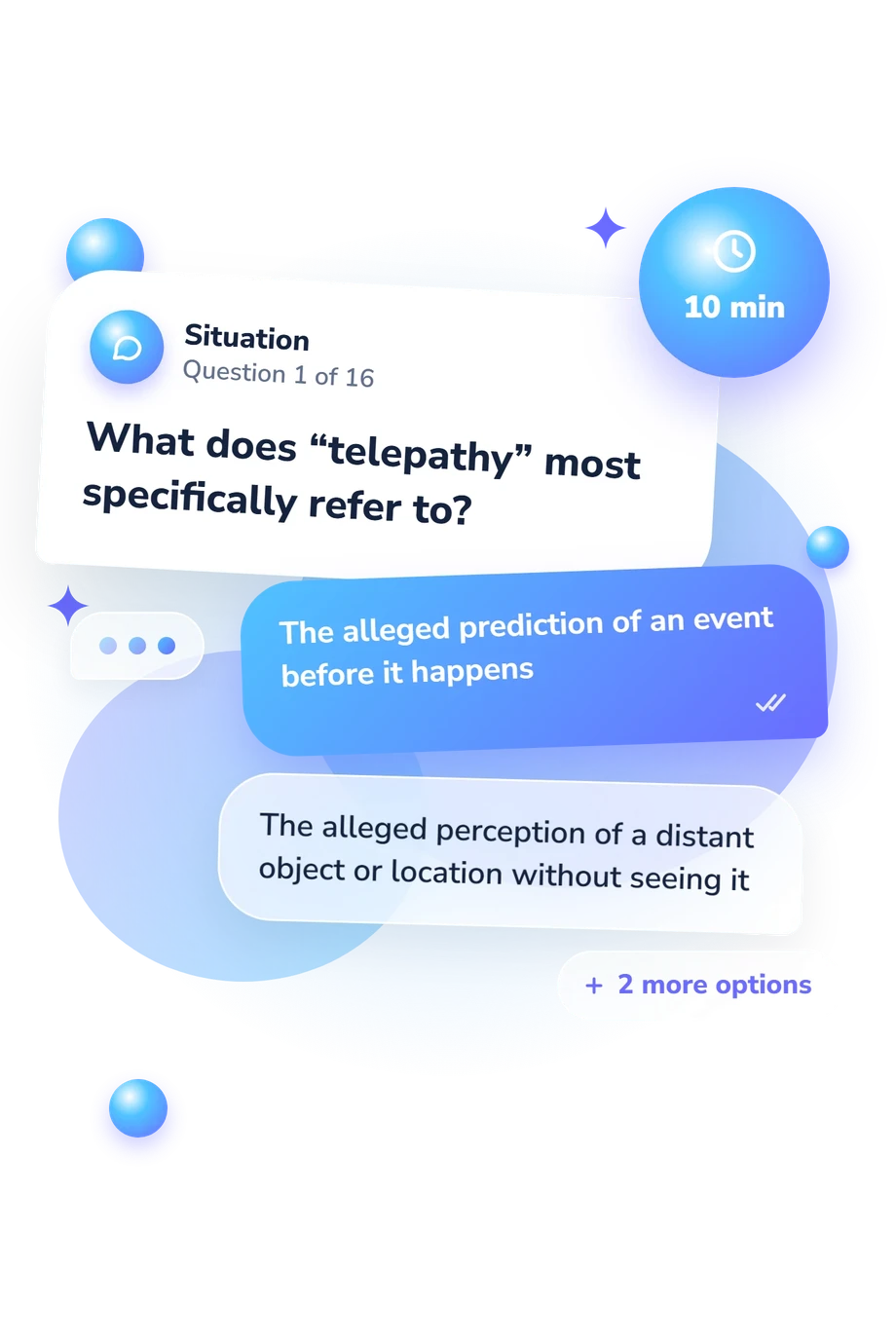
- The alleged prediction of an event before it happens
- The alleged perception of a distant object or location without seeing it
- The alleged transfer of thoughts or information between minds without known sensory communication
- The interpretation of involuntary movements as meaningful signals
- It ensures that every participant has the same level of concentration
- It helps distinguish planned tests from choices made after researchers have seen the data
- It allows researchers to replace random targets with more successful ones
- It demonstrates that the proposed telepathic mechanism is physically possible
- Precognition
- Telepathy
- Clairvoyance
- Psychokinesis
Telepathy Quiz - Description and methodology of the test
People who want to examine how they judge extraordinary claims may find this telepathy quiz useful. It is designed for readers interested in scientific reasoning, not for identifying a supposed paranormal talent. This quiz about telepathy shows how well you recognize definitions, controls, chance, and replication when assessing mind-to-mind claims.
What This Assessment Measures
Rather than estimating psychic power, this telepathy test measures conceptual knowledge about what telepathy is claimed to be and how such claims can be examined. The items distinguish telepathy from precognition, clairvoyance, and ordinary communication, while asking what counts as a cautious conclusion when an unusual result appears.
The questions cover these themes and contribute to one overall knowledge result:
- Definitions and distinctions show whether you separate telepathy from precognition, clairvoyance, and ordinary communication.
- Experimental controls show whether you recognize blinding, randomization, preregistration, and sensory leakage.
- Chance and replication show whether you weigh statistical caution and independent confirmation.
- Telepathy Knowledge (0-16) measures knowledge of telepathy concepts, research methods, and evidence-not telepathic ability: Foundations to build (0-6) marks basic concepts to review; Developing understanding (7-12) indicates many core ideas with some gaps; Strong understanding (13-16) reflects stronger evaluation of telepathy claims.
Methodology and Evidence Base
Each item uses four answer choices and asks you to select the response that best fits a definition, experimental safeguard, statistical principle, or evidence-based conclusion. Topics include preregistration, blinding, random target selection, the Ganzfeld procedure, cold reading, sensory leakage, chance expectation, and replication. As a telepathy knowledge test, it is a structured knowledge check rather than a report of unusual experiences.
The displayed result provides one overall knowledge score with three interpretation bands. Because the scoring information does not specify item weighting or a correction formula, no additional rule should be inferred from the range. Performance can reflect prior exposure, attention, and familiarity with scientific vocabulary, so it describes understanding at completion rather than a stable capacity.
Milton and Wiseman (1999) address reproducibility; Bem and Honorton (1994) report positive evidence, Hyman (1994) examines artifacts, and Rouder, Morey, and Province (2013) offer a Bayesian critique of ESP evidence. These studies are conceptual comparators for the replication, artifact, and evidence-evaluation issues addressed by the questions, not sources establishing that this questionnaire was adapted from or validated by any one of them.
- Milton, J., & Wiseman, R. (1999). Does psi exist? Lack of replication of an anomalous process of information transfer. Psychological Bulletin, 125(4), 387-391. 10.1037/0033-2909.125.4.387
- Bem, D. J., & Honorton, C. (1994). Does psi exist? Replicable evidence for an anomalous process of information transfer. Psychological Bulletin, 115(1), 4-18. 10.1037/0033-2909.115.1.4
- Hyman, R. (1994). Anomaly or artifact? Comments on Bem and Honorton. Psychological Bulletin, 115(1), 19-24. 10.1037/0033-2909.115.1.19
- Rouder, J. N., Morey, R. D., & Province, J. M. (2013). A Bayes factor meta-analysis of recent extrasensory perception experiments: Comment on Storm, Tressoldi, and Di Risio (2010). Psychological Bulletin, 139(1), 241-247. 10.1037/a0029008
Updated: