
Sewing Quiz
How the Scales are Structured
Who Usually Takes This Test?
See How You Compare
Below is a preview of how scores are typically distributed across each scale.
Example Questions From the Test
- A darning foot
- A blind-hem foot
- A button-sewing foot
- A zipper foot
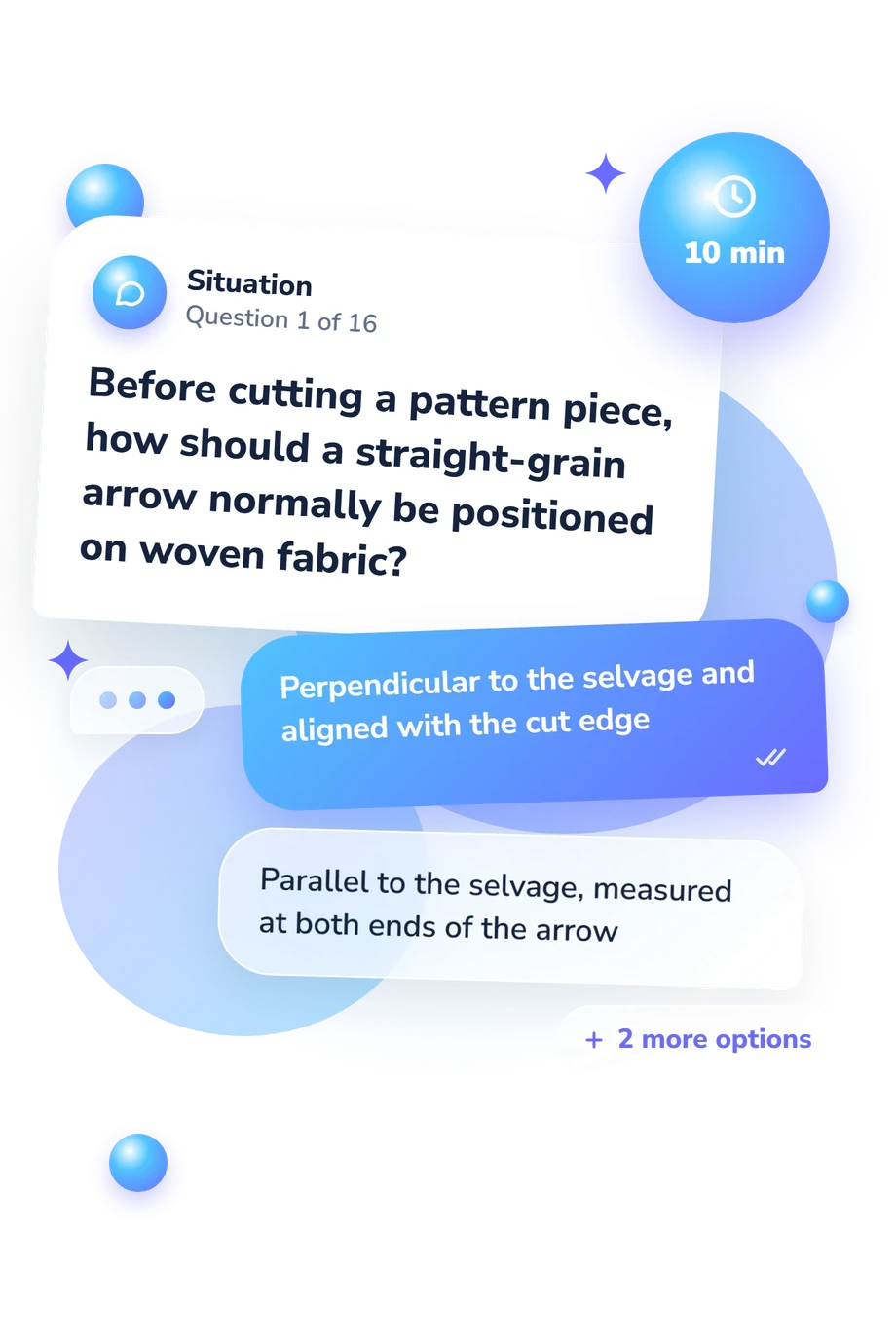
- Parallel to the selvage
- Perpendicular to the selvage
- Approximately 45 degrees to the lengthwise and crosswise grain
- Along the fabric fold only
- The distance between two rows of topstitching
- The extra fabric folded into a hem only
- The fabric between the stitching line and the cut edge
- The amount added to a pattern for garment ease
Sewing Quiz - Description and methodology of the test
Designed for beginners, hobbyists, and anyone refreshing garment-making knowledge, this assessment examines practical decisions about fabric, tools, seams, and machine technique. The sewing quiz helps learners identify foundations worth practising and connect concepts with independent projects. The format treats sewing-quiz questions and answers as practical choices rather than mere vocabulary recall.
What This Assessment Explores
The test works as a basic sewing skills quiz for learners building or refreshing foundational knowledge. It reflects understanding of essential concepts rather than hand speed, artistic style, or finished-garment quality.
The questions examine three connected areas:
- Fabric preparation and grain awareness show how the result reflects straight grain, bias, prewashing, and handling.
- Construction and seam control indicate understanding of seam allowances, pressing, gathering, curves, facings, and secure stitching.
- Tools and machine technique reveal how the result reflects suitable presser feet, needles, tension checks, stitch security, and seam removal.
One scale is reported: Sewing Knowledge (0-16). Foundation Builder (0-6) signals that basic ideas may need review; Developing Stitcher (7-12) indicates broader everyday understanding with room to strengthen precision; Skilled Sewing Knowledge (13-16) indicates strong understanding of essential principles and their practical application.
Methodology and Evidence Base
Each item uses a selected-response format: a practical scenario is followed by four alternatives, and the respondent chooses the action or explanation that best fits. Topics include grain placement, staystitching, curved seams, zipper feet, gathering, tension, pressing, fabric preparation, needles, and seam removal. This structure tests recognition of appropriate methods rather than physical stitch execution.
The scoring display condenses responses into one overall result. Because no separate weighting or item-level scoring rule is stated, the result should be read as a summary of technical understanding, not speed, dexterity, creativity, or finished-garment quality.
Its evidence context is closest to the A-Line Skirt Sewing Skills Assessment (Zulfa et al., 2025), a published educational assessment of sewing skills. This questionnaire is conceptually consistent with that work, not presented as its adaptation or validation study. Brackelsberg and Marshall provide practical reference points for grain, seams, pressing, closures, and finishing.
As a sewing knowledge test, this online version has no stated norms, reliability estimates, or standardized administration. Results can reflect guessing, previous exposure, current self-confidence, and differences in interpretation; they describe reported knowledge rather than observed sewing performance.
- Zulfa Zulfa, Supriyadi Supriyadi, and Adi Nur Cahyono. "Development and Psychometric Evaluation of an A-Line Skirt Sewing Skills Assessment Instrument for Vocational Students." Journal of Research and Educational Research Evaluation, vol. 14, no. 1, 2025, article 41149. 10.15294/jere.v14i1.41149.
- Phyllis Brackelsberg and Ruth Marshall. Unit Method of Clothing Construction. 7th ed., Waveland Press, 1999. ISBN 9781577660545.
Updated: