
Should I Drink Tonight Quiz
How the Scales are Structured
Who Usually Takes This Test?
See How You Compare
Below is a preview of how scores are typically distributed across each scale.
Example Questions From the Test
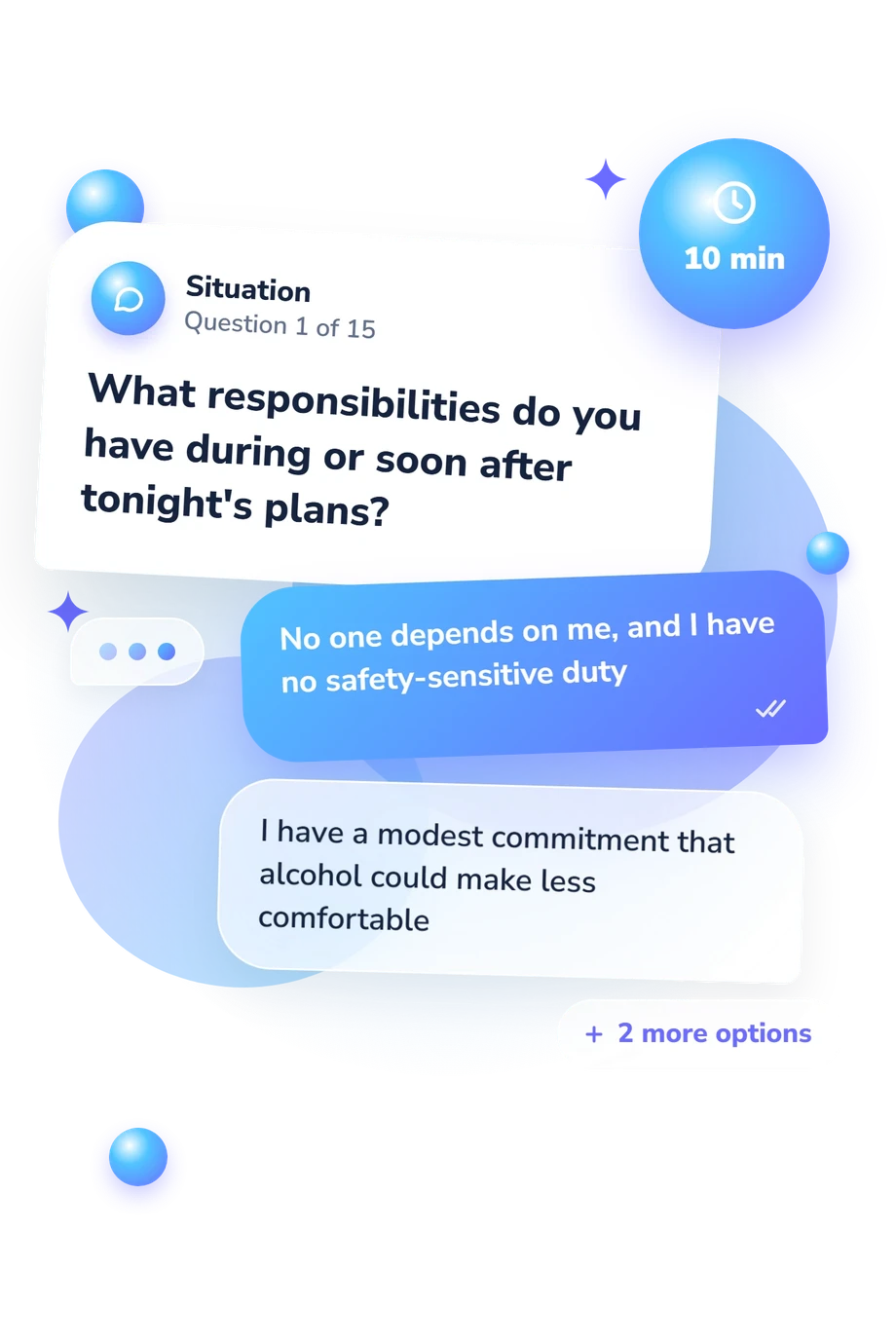
- No one depends on me, and I have no safety-sensitive duty
- I have a modest commitment that alcohol could make less comfortable
- I need to be reliably alert for work, caregiving, an early journey, or another important duty
- I am currently responsible for a child, vulnerable person, emergency response, driving, or hazardous equipment
- I am calmly choosing it for taste or as part of a meal or occasion
- It is mostly habit, boredom, or a way to make the evening feel different
- I want relief from stress, loneliness, anger, or sadness
- I want to become numb, escape overwhelming feelings, or feel able to act on dangerous thoughts
- I feel comfortable choosing either alcohol or no alcohol
- There is a social expectation to join in, though I could decline
- Someone keeps pressuring me after I have hesitated or said no
- I am being threatened, forced, manipulated, or made to fear consequences if I refuse
Should I Drink Tonight Quiz - Description and methodology of the test
People who feel pressured, distressed, unwell, responsible for others, or uncertain about transport can use a structured pause before deciding about alcohol. The Should I Drink Tonight Quiz is designed for situational self-reflection. As an alcohol decision quiz, it identifies concerns that may call for delaying drinking, changing the plan, or contacting support rather than recommending a beverage.
What This Assessment Explores
Viewed as an alcohol safety questionnaire, the assessment examines whether emotional urgency, coercion, physical or substance-related risk, or practical danger is shaping the choice. Questions cover motives, prior reactions, current impairment, medical guidance, pregnancy, boundaries, support, transport, surroundings, and responsibilities. The three result domains are:
- Choice and Emotional Context (0-15) flags pressure, distress, dangerous thoughts, or loss of control; bands: No choice-related caution selected (0), Caution indicated (1-2), and Protect your choice (3-15).
- Physical and Substance Cautions (0-15) flags symptoms, interactions, prior reactions, or medical instructions; bands: No caution selected (0), Caution indicated (1-2), and Act on the concern (3-15).
- Plans, Surroundings, and Responsibilities (0-15) flags duties, transport, boundaries, support, or hazards; bands: No practical caution selected (0), Caution indicated (1-2), and Change the plan (3-15).
Methodology and Scientific Basis
Each item offers four ordered responses, from low concern to a serious warning. The chosen response is grouped into one of three domains and summarized on a 0-15 scale; the questionnaire does not publish validated point values for individual choices.
The questionnaire is conceptually consistent with Protective Behavioral Strategies Survey (Martens et al., 2005), which addresses behaviors that reduce alcohol-related harm. Cooper (1994) provides a framework for social, enhancement, coping, and conformity motives. AUDIT (Saunders et al., 1993) supports attention to consumption-related risk, while Walters et al. (2009) is relevant to possible reactivity in alcohol assessment. These sources clarify themes but do not make this online version an adaptation or standardized instrument.
The bands are reflective summaries, not clinical or legal cutoffs. A zero does not establish that drinking is advisable, and one red-flag response scored 3 overrides the total. As a drink safety questionnaire, it helps translate concern into action: postpone alcohol, arrange sober transport, leave an unsafe setting, or seek urgent help for severe symptoms, threats, injury, or self-harm thoughts. Mood, memory, honesty, and self-awareness can affect self-report.
- Martens MP, Ferrier AG, Sheehy MJ, Corbett K, Anderson DA, Simmons A. Development of the Protective Behavioral Strategies Survey. Journal of Studies on Alcohol. 2005;66(5):698-705. 10.15288/jsa.2005.66.698
- Walters ST, Vader AM, Harris TR, Jouriles EN. Reactivity to alcohol assessment measures: an experimental test. Addiction. 2009;104(8):1305-1310. 10.1111/j.1360-0443.2009.02632.x
- Saunders JB, Aasland OG, Babor TF, de la Fuente JR, Grant M. Development of the Alcohol Use Disorders Identification Test (AUDIT): WHO Collaborative Project on Early Detection of Persons with Harmful Alcohol Consumption-II. Addiction. 1993;88(6):791-804. 10.1111/j.1360-0443.1993.tb02093.x
- Cooper ML. Motivations for Alcohol Use Among Adolescents: Development and Validation of a Four-Factor Model. Psychological Assessment. 1994;6(2):117-128. 10.1037/1040-3590.6.2.117
Updated: