
Using Online Banking Math Quiz
How the Scales are Structured
Who Usually Takes This Test?
See How You Compare
Below is a preview of how scores are typically distributed across each scale.
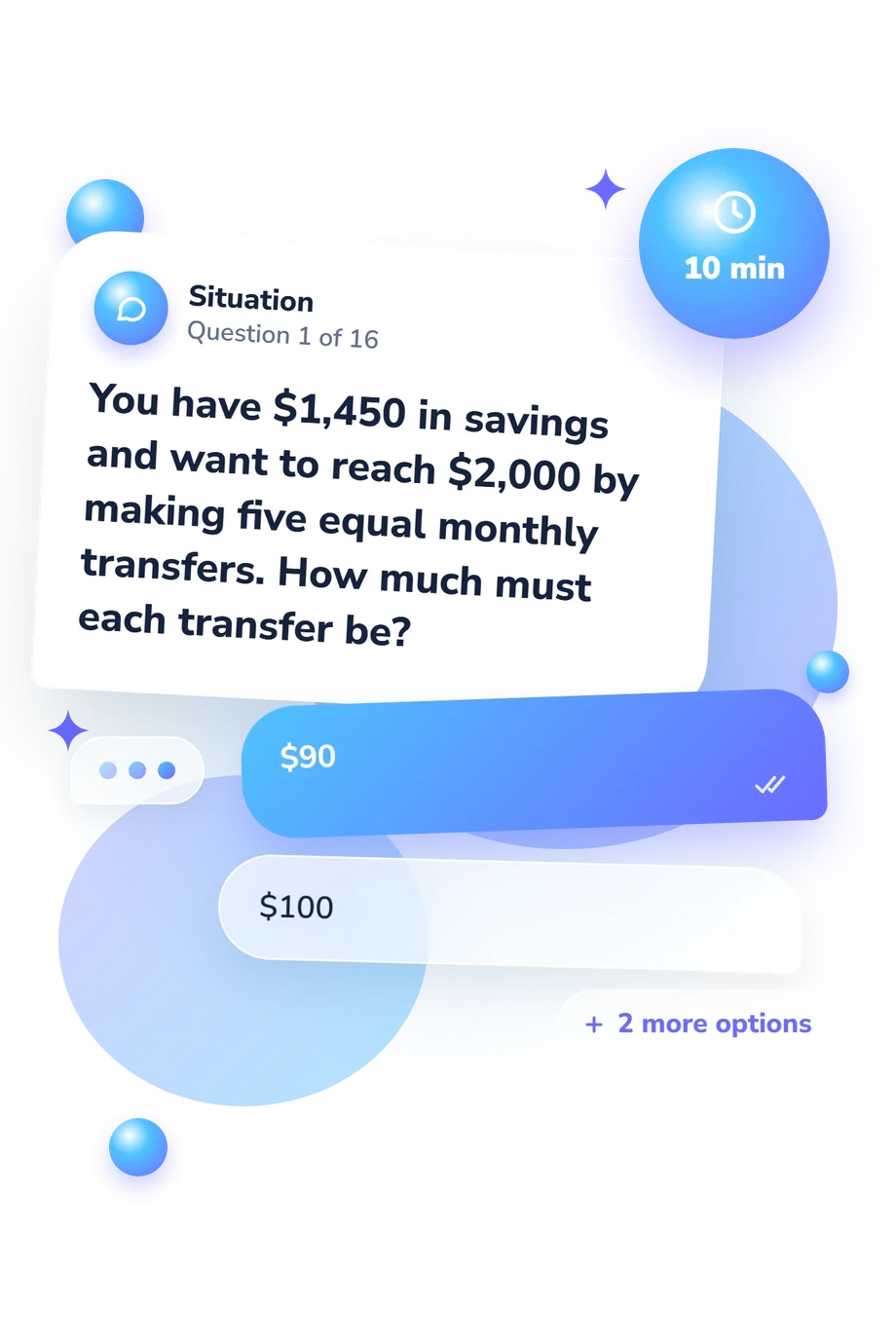
Example Questions From the Test
- $90
- $100
- $110
- $400
- $724.75
- $715.25
- $714.75
- $966.25
- $394.00
- $400.00
- $406.00
- $424.00
Using Online Banking Math Quiz - Description and methodology of the test
For anyone who wants a clearer check on everyday money calculations, the using online banking math quiz turns familiar account tasks into a focused self-assessment. It is suited to people who review balances, schedule transfers, compare fees, or inspect loan statements and want to see which calculations feel secure. As an online banking math test, it highlights practical areas for review without presenting the result as financial advice.
What This Assessment Measures
This questionnaire examines numerical reasoning in everyday online banking situations, not personal financial choices. It asks respondents to calculate balances, compare transactions, and work out how a posting changes an account. As a banking math practice quiz, it suits anyone assessing which calculations feel secure and which deserve more practice. The result summarizes performance on these tasks.
The main situations are grouped as follows:
- Balance and transaction arithmetic shows how deposits, purchases, fees, and pending activity change an account.
- Transfers and shared payments show how well you divide amounts, check limits, and calculate required contributions.
- Percentages, interest, cash back, and principal show how accurately you apply rates and separate payment components.
Using Online Banking Math Knowledge runs 0-16: Foundation to Build (0-6), Developing Knowledge (7-12), and Strong Knowledge (13-16). It measures these calculations, not overall financial capability.
Methodology and Scientific Basis
Each item presents a short banking scenario with four answer choices. The respondent selects the calculation that fits the balances, transfers, fees, rates, or payment components described. The displayed score is the number of correct responses, so it reports task performance rather than future financial behavior.
The questionnaire is conceptually consistent with the numerical-reasoning approach discussed by Sunderaraman et al. (2022), which links numerical-task performance with insight into financial literacy. It also fits Lusardi and Tufano’s (2015) distinction between debt-related knowledge and financial experience, while Lusardi and Mitchell (2014) explain the broader importance of financial knowledge. These sources support the construct; they do not show that this online questionnaire is an adaptation or validated version of their instruments.
Because the result uses instructional bands rather than published population norms, read it as an educational snapshot. The answers you receive by using this online banking math quiz can help locate an arithmetic or interpretation mistake. Current familiarity with online transactions, attention, and honest responding affect performance, so the score is best considered alongside actual habits and further learning.
- Sunderaraman, Preeti, Megan Barker, Silvia Chapman, and Stephanie Cosentino. "Assessing numerical reasoning provides insight into financial literacy." Applied Neuropsychology: Adult 29, no. 4 (2022): 710-717. 10.1080/23279095.2020.1805745
- Lusardi, Annamaria, and Peter Tufano. "Debt literacy, financial experiences, and overindebtedness." Journal of Pension Economics & Finance 14, no. 4 (2015): 332-368. 10.1017/S1474747215000232
- Lusardi, Annamaria, and Olivia S. Mitchell. "The Economic Importance of Financial Literacy: Theory and Evidence." Journal of Economic Literature 52, no. 1 (2014): 5-44. 10.1257/jel.52.1.5
Updated: