
Neonatal Quiz
How the Scales are Structured
Who Usually Takes This Test?
See How You Compare
Below is a preview of how scores are typically distributed across each scale.
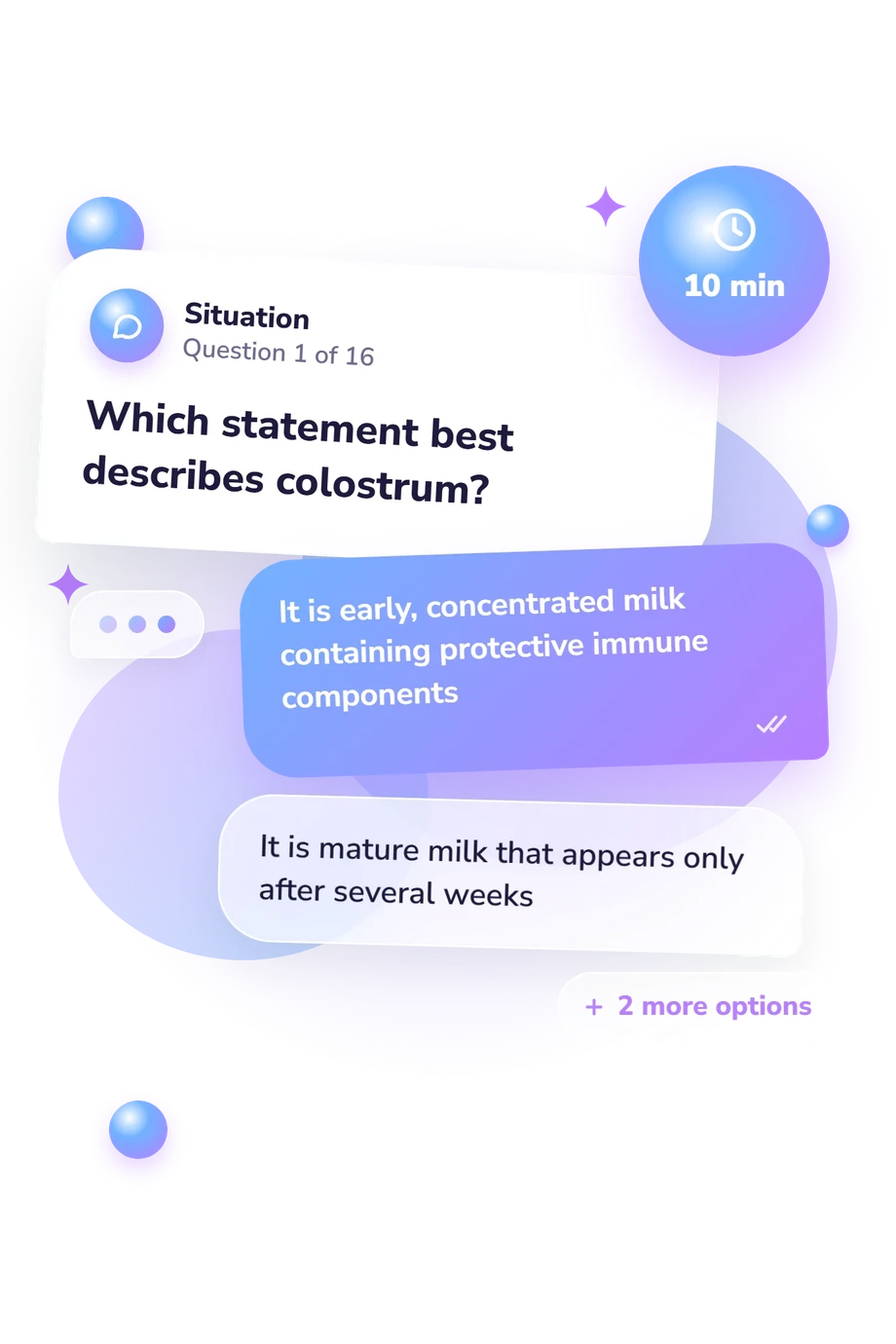
Example Questions From the Test
- The final trimester of pregnancy through birth
- Birth through the first six completed months of life
- The period from 28 days through one year of age
- Birth through the first 28 completed days of life
- Conduction
- Evaporation
- Convection
- Radiation
- A birth before 40 completed weeks of pregnancy
- A birth occurring between 37 and 41 completed weeks
- A birth before 37 completed weeks of pregnancy
- A birth after 42 completed weeks of pregnancy
Neonatal Quiz - Description and methodology of the test
People preparing to care for a newborn, teach early-life health, or revise basic clinical knowledge can use this questionnaire to check recognition of everyday care principles and warning signs. This assessment uses neonatal quiz questions and answers to test newborn-care knowledge and recognition of warning signs. As a newborn care quiz, it helps readers see which topics merit closer study and which distinctions they already understand.
What This Assessment Explores
The questions measure recognition of foundational newborn-care knowledge, especially whether a learner can distinguish normal transition from situations that warrant prompt attention. They cover feeding, the first 28 days, temperature regulation, prematurity, jaundice, breathing, circulation, screening, cord care, vitamin K, glucose risk, and safe sleep. Its introductory neonatology quiz format combines factual recall with brief newborn-care scenarios, asking learners to apply concepts to common observations and urgent warning signs; the result reflects knowledge of the covered topics.
The result is reported on the Neonatal Knowledge scale (0-16), with three catalogue-defined bands:
- Foundations to build (0-6) indicates that core terms, routine care, or warning signs need review.
- Developing knowledge (7-12) shows that many essentials are understood, while some care and assessment concepts may need revisiting.
- Strong knowledge (13-16) reflects broad understanding of the neonatal topics covered.
Methodology and Evidence Base
Each of the 16 items presents four response options and asks for the best answer. Some test recall, while others use short scenarios about feeding, jaundice, breathing, safe sleep, or assessment. Together, these formats check factual recognition and selection of an appropriate response to a newborn-care situation. These bands describe educational knowledge and guide review of covered topics.
Gozali et al. (2020) is the closest published comparison because it examines newborn-care knowledge in a parenting-education setting. This questionnaire is conceptually consistent with that work, but is not an adaptation of it. The World Health Organization’s guidance on essential newborn care provides a framework for routine care and danger signs. Safe-sleep content is consistent with Moon et al. (2022), and the vitamin K item reflects the prevention focus in Hand et al. (2022).
The online questionnaire is a multiple-choice neonatal knowledge test; attention to wording, prior knowledge, and scenario details can affect performance. The displayed educational score is not a validated clinical cutoff and does not establish competence or diagnose a newborn; concerning symptoms require professional assessment regardless of the result.
- Gozali A, Gibson S, Lipton LR, Pressman AW, Hammond BS, Dumitriu D. Assessing the effectiveness of a pediatrician-led newborn parenting class on maternal newborn-care knowledge, confidence and anxiety: A quasi-randomized controlled trial. Early Human Development. 2020;147:105082. 10.1016/j.earlhumdev.2020.105082
- World Health Organization. Essential newborn care course, second edition. Geneva: World Health Organization; 2025. ISBN 978-92-4-011269-8.
- Moon RY, Carlin RF, Hand I; Task Force on Sudden Infant Death Syndrome; Committee on Fetus and Newborn. Evidence Base for 2022 Updated Recommendations for a Safe Infant Sleeping Environment to Reduce the Risk of Sleep-Related Infant Deaths. Pediatrics. 2022;150(1):e2022057991. 10.1542/peds.2022-057991
- Hand I, Noble L, Abrams SA. Vitamin K and the Newborn Infant. Pediatrics. 2022;149(3):e2021056036. 10.1542/peds.2021-056036
Updated: