
Types of Nouns Quiz
How the Scales are Structured
Who Usually Takes This Test?
See How You Compare
Below is a preview of how scores are typically distributed across each scale.
Example Questions From the Test
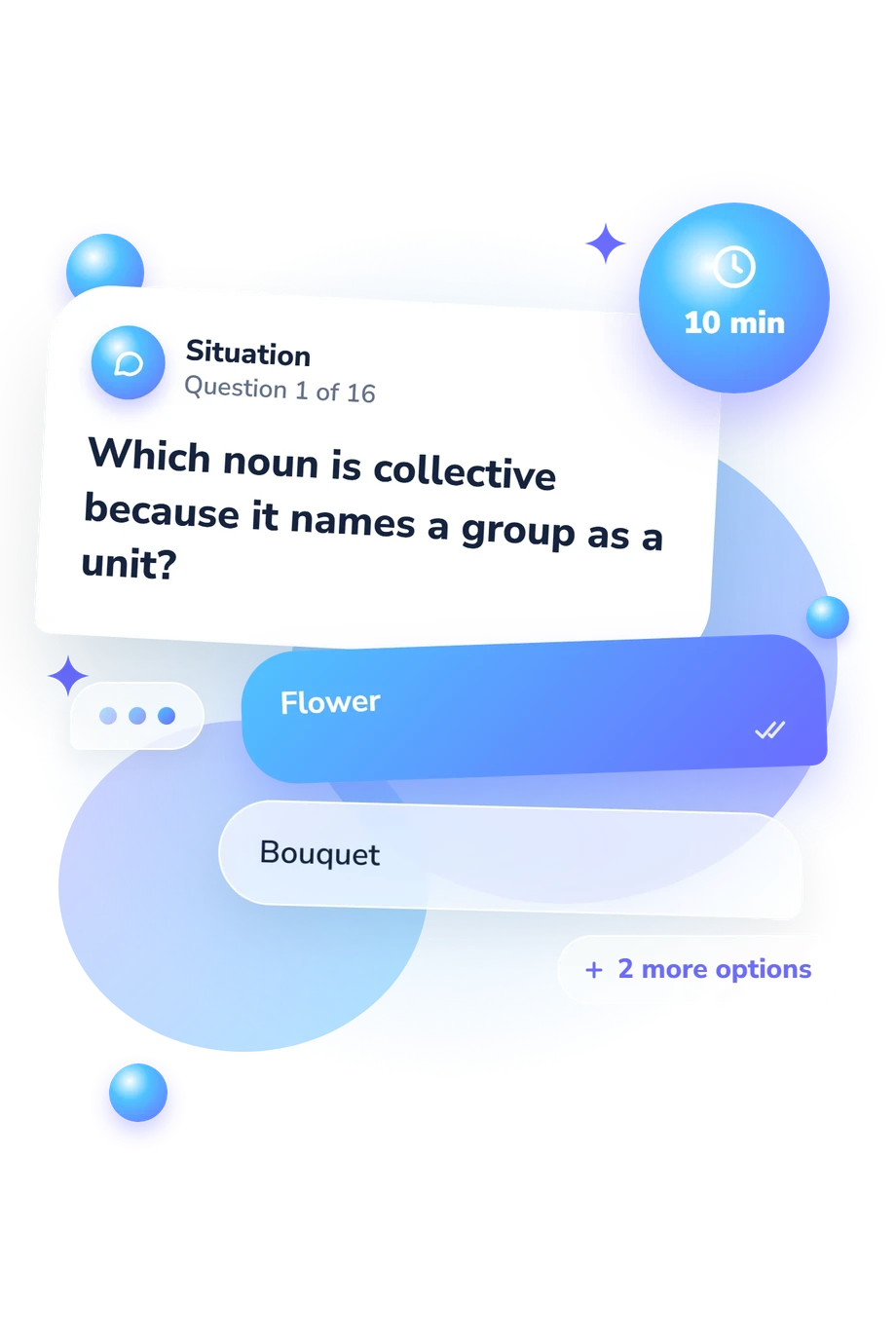
- Flower
- Bouquet
- Garden
- Fragrance
- The musicians tuned their instruments separately.
- Several players entered at different times.
- The committee reached its decision.
- Each juror reviewed a personal set of notes.
- Luggage
- Equipment
- Suitcase
- Traffic
Types of Nouns Quiz - Description and methodology of the test
For learners who want to sharpen grammar accuracy, the Types of Nouns Quiz offers a focused way to examine how noun categories work in sentences. It suits students, writers, editors, and anyone revising English. As a quiz about kinds of nouns, it reveals areas for practice in classification, capitalization, possession, countability, and precise word choice.
What This Assessment Explores
The questions examine how nouns are classified, formed, capitalized, and used in context. They connect labels with words, phrases, and sentences, so the result reflects practical recognition as well as terminology. These classification questions show which distinctions deserve review in this noun types quiz.
The result brings together four areas:
- Classification separates common and proper nouns and distinguishes concrete, abstract, and collective meanings.
- Structure examines compound nouns and whether their parts are written together or separately.
- Possession checks whether apostrophes and singular or plural forms show ownership accurately.
- Countability evaluates count and noncount nouns in ordinary English usage.
Together, these tasks produce Types of Nouns Knowledge (0-16). Building Foundations (0-6) signals that definitions need review; Developing Knowledge (7-12) shows understanding of familiar categories with some confusion; Strong Knowledge (13-16) indicates accurate identification across varied tasks.
Methodology and Scientific Basis
The method is a multiple-choice grammar assessment. Each item offers four choices and asks the learner to identify a noun type, select a correct possessive, distinguish countability, or choose a sentence that uses a category appropriately. This noun classification quiz tests recognition and application.
The content framework is conceptually consistent with Huddleston and Pullum (2002), whose account supports distinctions involving noun classes, possession, compounds, and grammatical behavior. Quirk and colleagues add descriptive coverage of common and proper nouns, abstract and concrete meaning, and usage patterns. Allan (1980) is especially relevant to countability, because whether a noun is count or noncount can depend on context. Together, these sources provide a conceptual grammar framework, not evidence that this online format has been standardized or validated.
The result summarizes performance across classification, possession, countability, and usage tasks on the displayed scale; individual answer weights are not specified. Prior instruction, familiarity with grammar terms, attention, and intended meaning can affect performance, so use the result to target review and check uncertain examples in context, not as a complete measure of English ability.
- Huddleston, Rodney, and Geoffrey K. Pullum. The Cambridge Grammar of the English Language. Cambridge University Press, 2002. 10.1017/9781316423530
- Quirk, Randolph, Sidney Greenbaum, Geoffrey Leech, and Jan Svartvik. A Comprehensive Grammar of the English Language. Longman, 1985.
- Allan, Keith. Nouns and countability. Language, 56(3), 541-567, 1980. 10.2307/414449
Updated: