
Should I Get a Husky Quiz
How the Scales are Structured
Who Usually Takes This Test?
See How You Compare
Below is a preview of how scores are typically distributed across each scale.
Example Questions From the Test
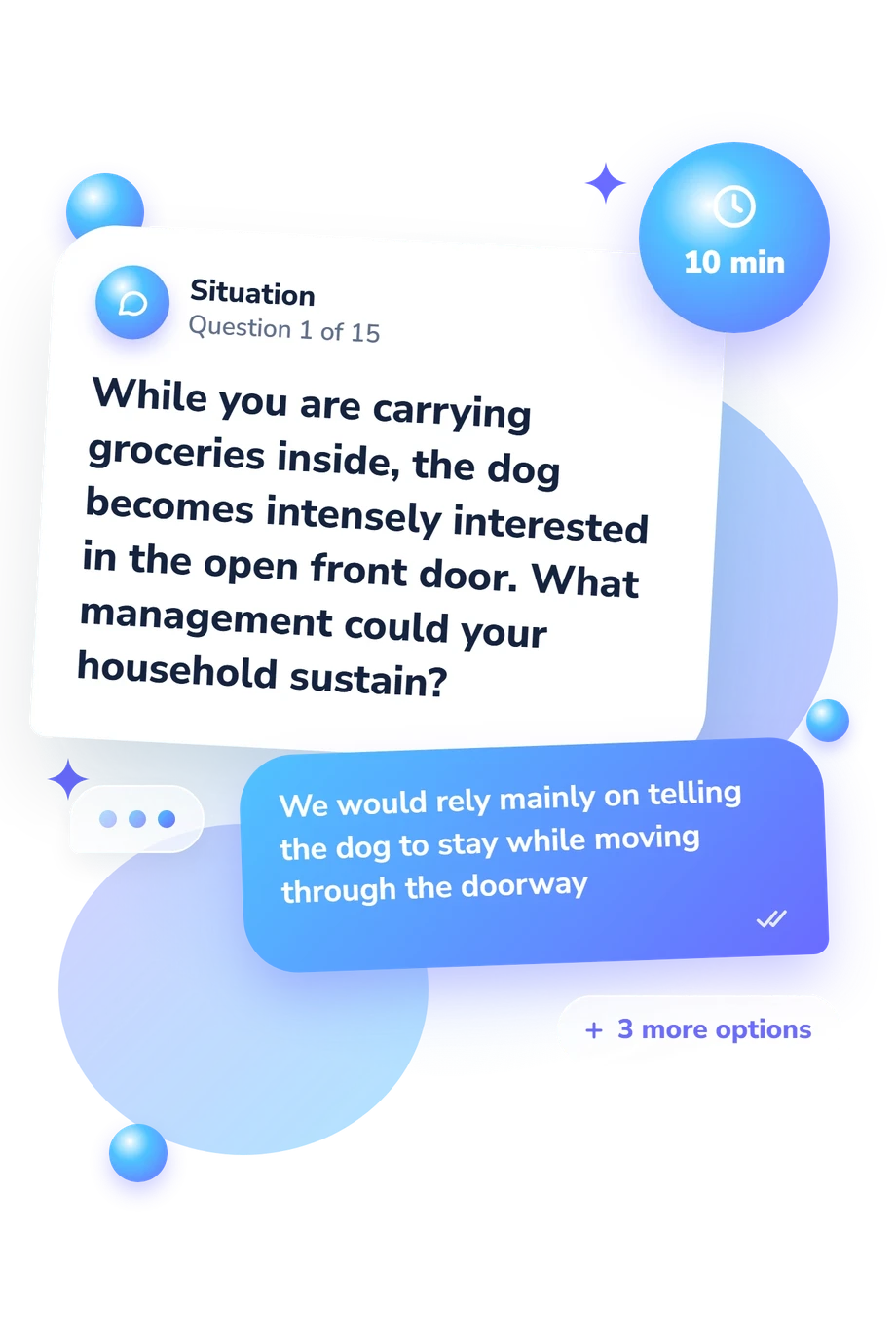
- We would rely mainly on telling the dog to stay while moving through the doorway
- We could close the dog in another room when we expected a busy arrival
- We could practice doorway cues and use a barrier during higher-risk moments
- We could combine trained cues, gates or closed doors, household rules, and ID safeguards
- I prefer a dog that adapts quickly without much ongoing repetition
- I can repeat rules for a while, but prolonged negotiation would wear me down
- I am prepared for patient repetition if everyone shares the work
- I enjoy consistent training and can keep responses calm and coordinated across the household
- I would focus on cues the dog performs naturally and avoid repeating the difficult one
- I would keep practicing in the same outdoor setting and give the dog more time
- I would return to an easier setting and gradually add distance and distractions
- I would use gradual practice, high-value rewards, secure equipment, and qualified training help if progress stalled
Should I Get a Husky Quiz - Description and methodology of the test
Choosing an active, independent dog requires more than liking the breed's appearance or energy; daily exercise, secure handling, household cooperation, and long-term flexibility all matter. The Should I Get a Husky Quiz gives prospective owners, adopters, and involved households a structured way to examine those practical demands. This husky quiz emphasizes practical readiness rather than predicting the personality of one individual animal.
What This Assessment Explores
Rather than rating an owned dog, the assessment examines whether circumstances can accommodate Husky demands. Items address exercise, enrichment, weather, shedding, household rules, smaller pets, costs, secure handling, and future changes. It suits people considering purchase, rescue, or adoption.
The result separates readiness into three dimensions:
- Activity and Enrichment Capacity (0-15) shows whether your routine can sustain physical and mental activity: Significant mismatch (0-5), Conditional capacity (6-10), or Strong capacity (11-15).
- Long-Term Household Care (0-15) indicates practical fit for shedding, climate, household composition, expenses, and commitment: Substantial constraints (0-5), Possible with planning (6-10), or Strong practical foundation (11-15).
- Training and Escape Management (0-15) reflects preparation for training, secure handling, and escape prevention: Major setup gap (0-5), Developing plan (6-10), or Strong management readiness (11-15).
The profile helps a household plan Husky ownership by identifying strengths and gaps in exercise, containment, training, and continuity.
Methodology and Scientific Basis
Each item presents an ownership situation with four response choices, moving from minimal adjustment toward shared rules, planned backup, secure equipment, gradual training, or robust care. The format asks what you could sustain during disruptions, not only what sounds ideal.
The result reports three thematic scale scores, each with its own result band, rather than a pass-or-fail judgment. The questionnaire is an online self-report readiness assessment. It is conceptually consistent with Powell et al. (2022), whose work connects owner expectations, dog behavior, and guardianship; this tool is not an adaptation of that study. O'Connor et al. (2016) likewise supports considering lifestyle and animal-care knowledge before taking responsibility for a companion animal.
Hsu and Serpell (2003) describe variation in dog behavior and temperament, a useful reminder that owner preparation cannot predict every individual dog's needs. The bands describe Husky readiness as planning guidance about the situations covered. Self-report may shift with current stress, confidence, or knowledge, and a dog's age, health, temperament, prey drive, and history can change the fit.
- Lauren Powell, Brittany Lee, Chelsea L. Reinhard, Margaret Morris, Donya Satriale, James Serpell, and Brittany Watson. (2022). Returning a Shelter Dog: The Role of Owner Expectations and Dog Behavior. Animals, 12(9), 1053. 10.3390/ani12091053
- Rachel O'Connor, Jason B. Coe, Lee Niel, and Andria Jones-Bitton. (2016). Effect of Adopters' Lifestyles and Animal-Care Knowledge on Their Expectations Prior to Companion-Animal Guardianship. Journal of Applied Animal Welfare Science, 19(2), 157-170. 10.1080/10888705.2015.1125295
- Yuying Hsu and James Serpell. (2003). Development and validation of a questionnaire for measuring behavior and temperament traits in pet dogs. Journal of the American Veterinary Medical Association, 223(9), 1293-1300. 10.2460/javma.2003.223.1293
Updated: