
Israel Quiz
How the Scales are Structured
Who Usually Takes This Test?
See How You Compare
Below is a preview of how scores are typically distributed across each scale.
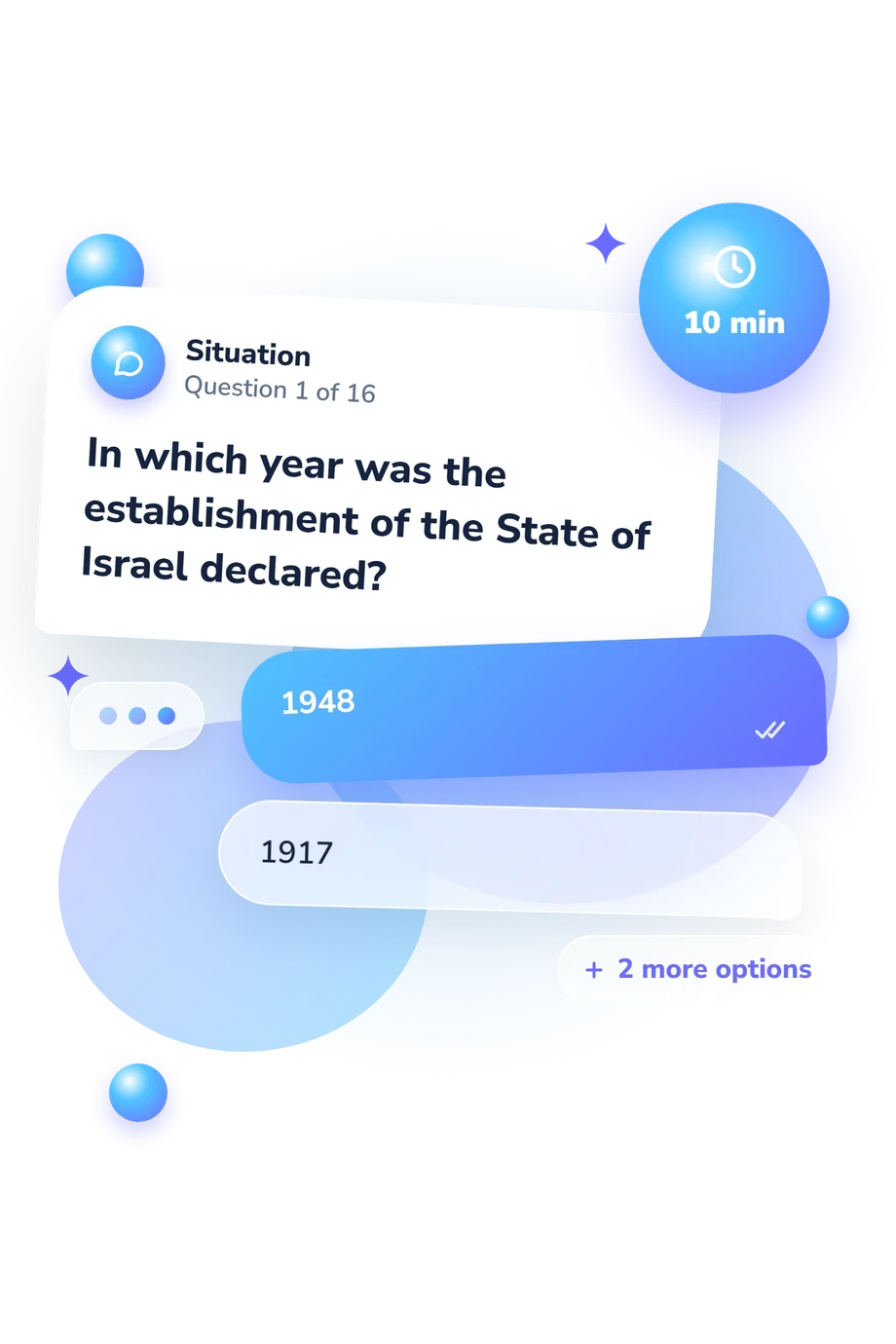
Example Questions From the Test
- 1948
- 1917
- 1956
- 1967
- The euro
- The dinar
- The new Israeli shekel
- The pound sterling
- The Mediterranean Sea
- The Dead Sea
- Lake Hula
- The Red Sea
Israel Quiz - Description and methodology of the test
People seeking a structured way to check their understanding of Israel can use the Israel Quiz as a focused learning activity, not a test of identity or opinion. It suits visitors, students, travelers, and anyone revisiting foundational facts. A quiz about Israel can indicate overall breadth and accuracy across the covered content, while its performance band suggests whether general review may be useful for self-reflection.
What This Assessment Explores
The questionnaire measures factual knowledge across parts of Israeli life. Items address history, geography, civic institutions, national symbols, language, religion, climate, currency, and social organization. Everyday scenarios test recognition in context rather than recall of isolated names.
It suits readers building general knowledge, preparing for travel or study, or selecting topics to revisit. An Israel knowledge test of this kind describes performance on selected content, not political attitudes, religious commitment, identity, or personal experience.
These are the main content areas:
- Geography and environment cover locations, waterways, landscapes, directions, and climate.
- History and memory indicate familiarity with major events, heritage sites, and institutions.
- Civic and national life reflect public bodies, symbols, currency, and everyday systems.
- Culture and society capture language, Shabbat, kibbutzim, and related practices.
Israel Knowledge (0-16) counts correct answers: Foundations to build (0-6), Developing knowledge (7-12), and Strong knowledge (13-16).
Methodology and Evidence Base
Each item presents alternatives and asks for an answer. The total reflects keyed responses, producing one knowledge score rather than separate scores for geography, history, or culture. Distractors require choosing the best-supported option.
The questionnaire is conceptually consistent with the Israel Literacy Measurement Project (Koren et al., 2015), which treats knowledge of Israel as broad, multidimensional literacy. This comparison identifies a related construct; it does not claim that the online questionnaire directly adapts or reproduces that project.
Guidance from Haladyna, Downing, and Rodriguez (2002) supports attention to clear alternatives and plausible distractors. The AERA, APA, and NCME (2014) standards support careful interpretation, evidence, and fairness. This online version has no stated population norms, reliability estimates, or validation results; its bands describe performance on these questions, not a standardized comparison.
The result is a snapshot of performance on selected content. Scores may vary with prior study, wording, attention, and current context, so they indicate demonstrated knowledge on these questions rather than complete knowledge of Israel. The activity can serve as an Israel trivia quiz, pointing to useful next steps without claiming comprehensive mastery.
- Koren, Annette, Shira Fishman, Janet Krasner Aronson, and Leonard Saxe. The Israel Literacy Measurement Project: 2015 Report. Cohen Center for Modern Jewish Studies, Brandeis University, 2015.
- Haladyna, Thomas M., Steven M. Downing, and Michael C. Rodriguez. "A Review of Multiple-Choice Item-Writing Guidelines for Classroom Assessment." Applied Measurement in Education 15, no. 3 (2002): 309-333. 10.1207/S15324818AME1503_5
- American Educational Research Association, American Psychological Association, and National Council on Measurement in Education. Standards for Educational and Psychological Testing. Washington, DC: American Educational Research Association, 2014.
Updated: