
Syllables Quiz
How the Scales are Structured
Who Usually Takes This Test?
See How You Compare
Below is a preview of how scores are typically distributed across each scale.
Example Questions From the Test
- Two
- One
- Three
- Four
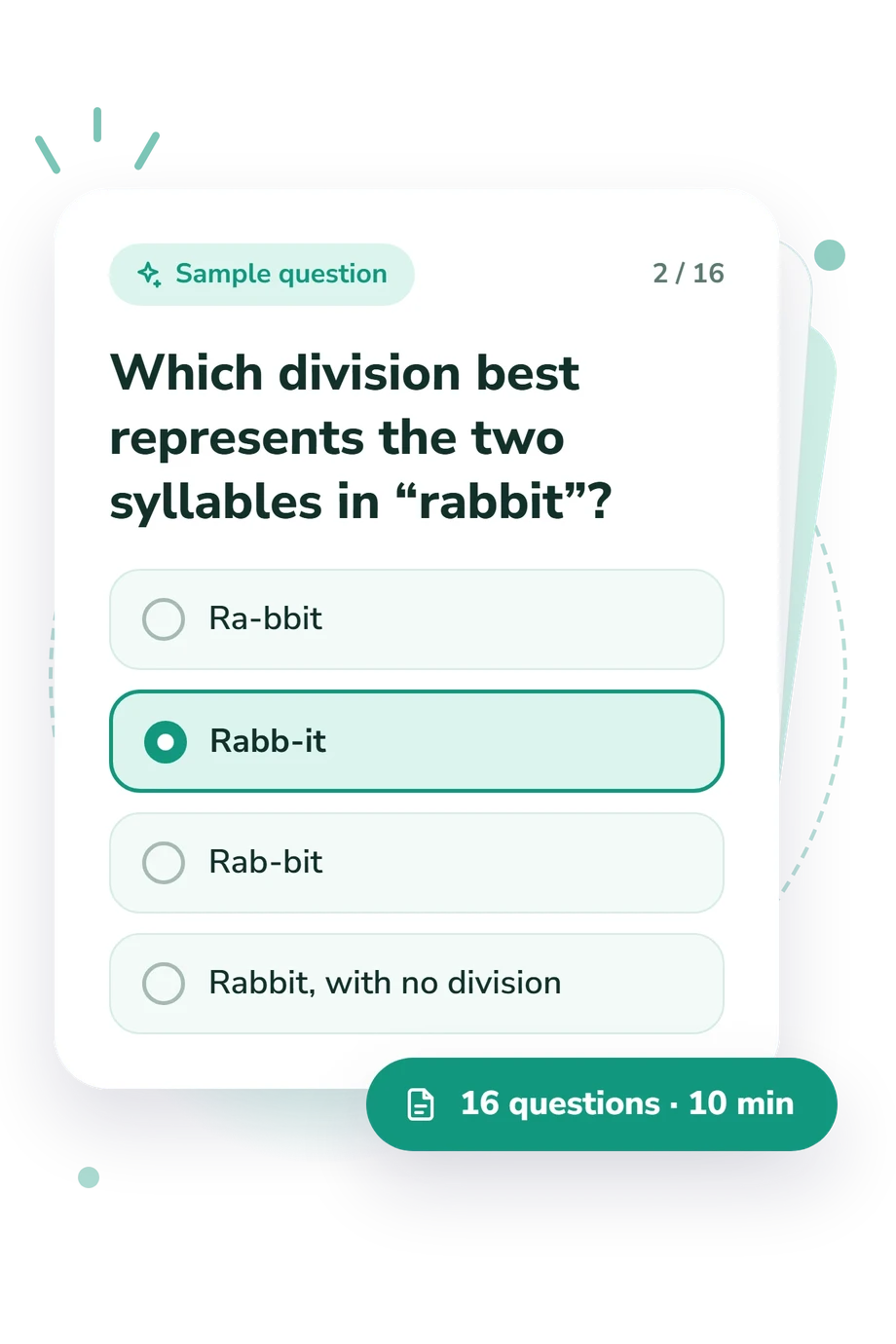
- Ra-bbit
- Rabb-it
- Rab-bit
- Rabbit, with no division
- The sound /p/
- The sound /l/
- All the sounds in “plant”
- The consonant cluster /pl/
Syllables Quiz - Description and methodology of the test
For learners who want to check their grasp of spoken language structure, this assessment offers a focused way to examine core syllable concepts. The syllables quiz is suited to students, teachers, language learners, and curious readers who want feedback on how accurately they analyze pronunciation. In this syllable test, technical terms become practical decisions about real words and short sentences.
What This Assessment Explores
The questions examine how spoken syllables are built and heard, rather than treating spelling as a complete guide. They cover counting, division, onset, rime, nucleus, coda, open and closed syllables, syllabic consonants, diphthongs, compound words, and stress.
Across its tasks, this syllabication quiz moves between isolated words, short sentences, phonetic transcription, and explanations of why an answer works. The result shows whether foundational structures are secure or finer distinctions need review.
The result is reported on the Syllables Knowledge scale (0-16), with three interpretive bands:
- Foundations to build (0-6) indicates recognition of basic features while spoken syllable counting and structure may need review.
- Developing knowledge (7-12) indicates understanding of many core concepts, with finer distinctions still needing practice.
- Strong knowledge (13-16) indicates accurate analysis of most structures, divisions, and pronunciation patterns covered by the assessment.
Methodology and Scientific Basis
Each item uses four answer options, and the respondent selects the analysis that best fits a word, sentence, or transcription. The tasks test recognition and application rather than opinion: a response may depend on identifying a nucleus, locating a coda, counting spoken syllables, or assigning primary stress.
The assessment reports one overall result, indicating the level of syllable knowledge demonstrated across the covered concepts. The bands describe increasing command of the tested concepts and whether broad review of those concepts may be useful.
The terminology is conceptually consistent with Roach (2009), Clark, Yallop, and Fletcher (2007), and Giegerich (1992), whose texts explain syllable constituents, syllabic consonants, vowel nuclei, stress, and pronunciation. This questionnaire is not an adaptation of those works; they provide the framework for interpreting the concepts tested here.
Accent, classroom terminology, attention, and familiarity with phonetic notation can influence performance. Guessing and uneven background knowledge may also affect the score, so interpret the outcome alongside your own experience with pronunciation and notation. It is a focused educational snapshot, not a diagnosis.
- Roach, Peter. English phonetics and phonology: a practical course. 4th ed. Cambridge University Press, 2009. ISBN 9780521717403.
- Clark, John, Colin Yallop, and Janet Fletcher. An introduction to phonetics and phonology. 3rd ed. Blackwell Publishing, 2007. ISBN 9781405130837.
- Giegerich, Heinz J. English phonology: an introduction. Cambridge University Press, 1992. ISBN 9780521336031. 10.1017/CBO9781139166126
Updated: