
Soldier Poet King Quiz
How the Scales are Structured
Who Usually Takes This Test?
See How You Compare
Below is a preview of how scores are typically distributed across each scale.
Example Questions From the Test
- A routine that lets me continue even when motivation is quiet.
- Finding a new meaning or story within the experience.
- Remembering who could benefit if I finish.
- Reassessing whether the goal still deserves my energy.
- Help them name what the transition means emotionally.
- Ask them to choose which kind of support would be most useful.
- Take charge of packing, lifting, or another immediate task.
- Make a practical plan with them and cover the hardest part.
- What needs to be repaired, cleared, or made easier to cross.
- The altered light, sounds, and mood of a place I thought I knew.
- How people are adjusting their plans around the weather.
- The contrast between the disruption and the fresh atmosphere.
Soldier Poet King Quiz - Description and methodology of the test
People who want a reflective way to examine how they act, interpret experience, and take responsibility may find the Soldier Poet King Quiz useful. This soldier poet or king quiz offers a structured look at three complementary affinities without forcing a fixed identity. The questionnaire asks whether a person leans toward soldier, poet, or king, rather than assigning a label that fixes identity.
What This Test Measures
Situations cover decisions, persistence, meaning, and help.
It suits focused reflection without a fixed identity.
Its soldier poet king profile reflects relative affinities, not personality types; the displayed bands are:
- King (0-15) reflects stewardship, direction, shared order, and responsibility for the whole-not status, dominance, or gender: Independent Course (0-5) favors a focused role; Situational Steward (6-10) considers the group when needed; Guiding Steward (11-15) accepts wider responsibility.
- Poet (0-15) reflects imagination, emotional language, and symbolism-not writing skill or artistic status: Concrete Lens (0-5) favors direct or literal meaning; Reflective Voice (6-10) notices nuance; Vivid Interpreter (11-15) gives subtle feelings expression.
- Soldier (0-15) reflects purposeful action, perseverance, discipline, and practical protection-not aggression or military ability: Deliberate Reserve (0-5) favors reflection before action; Ready Resolve (6-10) acts when purpose is clear; Purposeful Vanguard (11-15) meets challenges through committed effort.
Methodology and Evidence Base
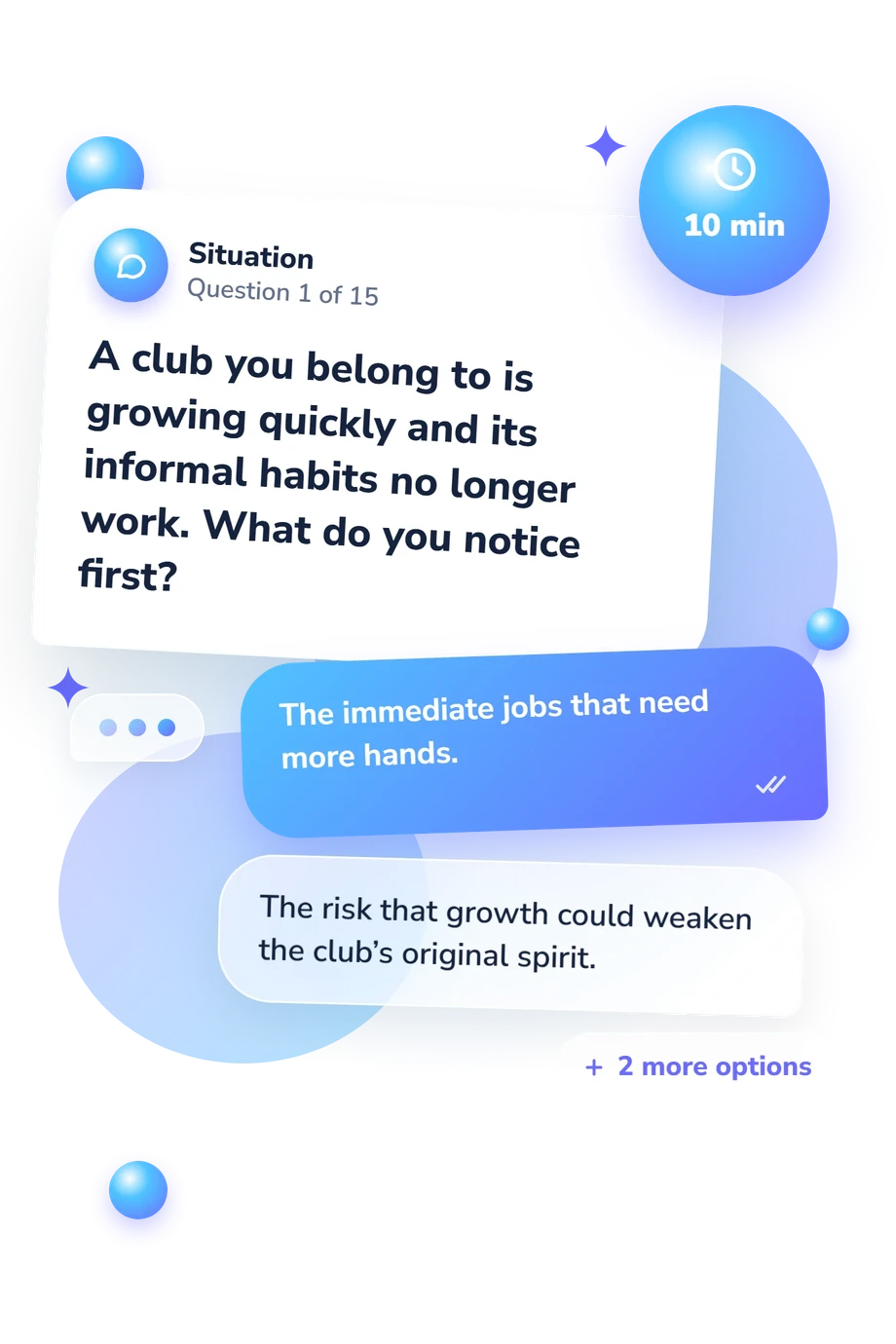
Each item presents a situation and four response options; the respondent chooses the reaction that feels most natural, so no answer is correct.
Responses are scored across three dimensions, but the point value assigned to each option is not published. The highest total marks the strongest affinity, while totals within one point form a blended result.
The Soldier, Poet, King motif supplies the symbolic frame. Jung's archetypal theory provides a broader theoretical comparison for recurring patterns in meaning and behavior; it is not an instrument administered here. The questionnaire is conceptually consistent with those ideas.
The result from this soldier poet king assessment is best used as a structured prompt for noticing how action, imagination, and responsibility interact in your own choices.
The questionnaire has no documented standardization evidence, so its bands are interpretive descriptions rather than clinical norms, and self-report answers can shift with current circumstances, self-awareness, and impression management; the result does not establish a diagnosis.
- Tyler Heath and Maggie Heath. "Soldier, Poet, King." Dear Wormwood. The Oh Hellos, 2015.
- Jung, Carl Gustav. The Archetypes and the Collective Unconscious. 2nd ed., translated by R. F. C. Hull, Princeton University Press, 1968.
Updated: