
Signs You Need to Go to a Mental Hospital Quiz
How the Scales are Structured
Who Usually Takes This Test?
See How You Compare
Below is a preview of how scores are typically distributed across each scale.
Example Questions From the Test
- No, I can manage basics
- Some difficulty
- Significant difficulty
- I cannot manage basics
- Not at all
- A little
- Moderately
- Extremely
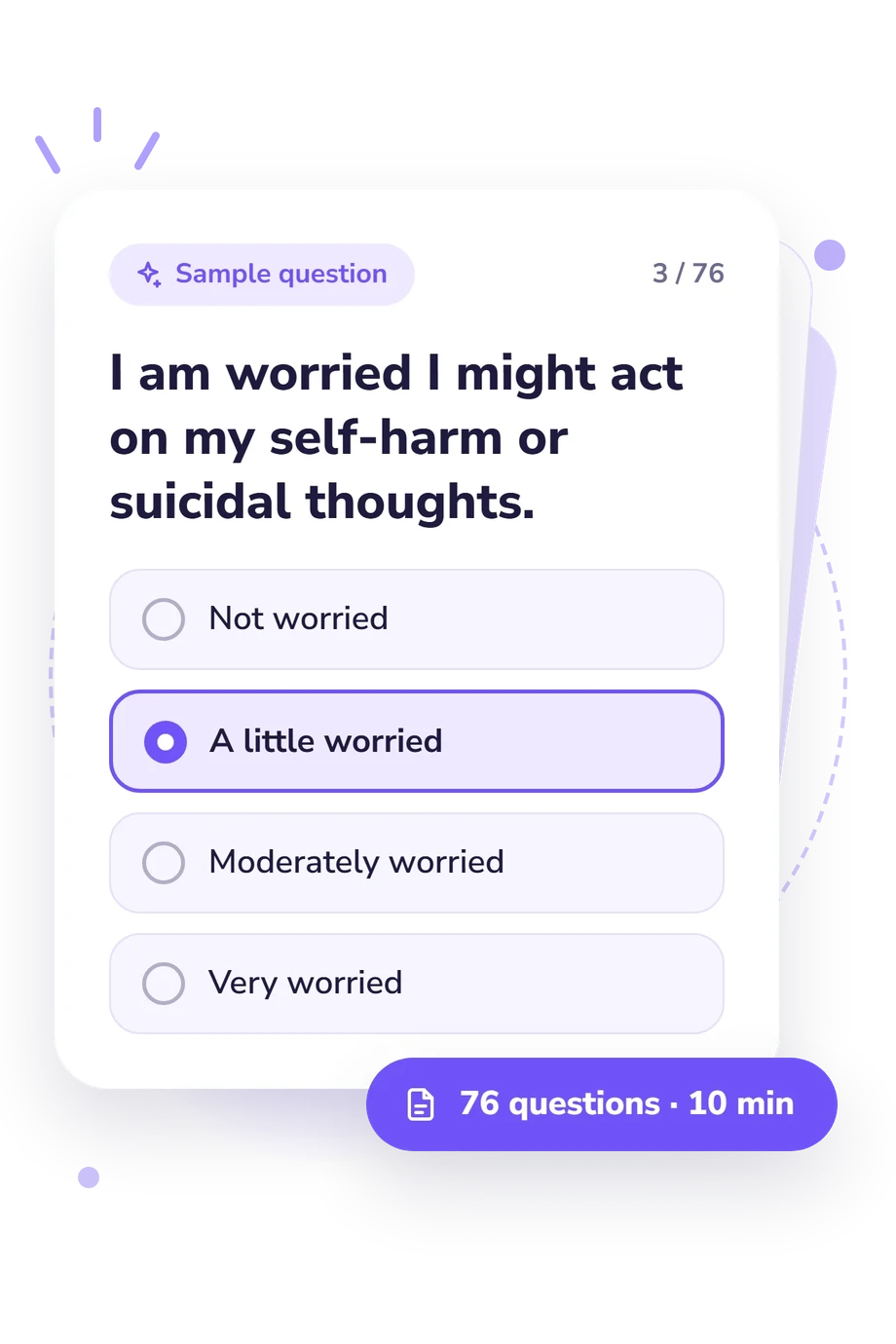
- Not worried
- A little worried
- Moderately worried
- Very worried
Signs You Need to Go to a Mental Hospital Quiz - Description and methodology of the test
People dealing with a sharp decline in safety, thinking, or everyday functioning may use this assessment to sort urgent warning signs from less immediate distress. The Signs You Need to Go to a Mental Hospital Quiz is intended for a person deciding whether emergency mental-health support deserves prompt attention. When the question is whether to go to a mental hospital, it helps organize that decision around observable domains rather than one isolated symptom.
What This Assessment Explores
The questions focus on current safety, reality contact, and daily functioning. They cover self-care, medication changes, confusion, unusual perceptions, agitation, rapid worsening, dangerous impulsivity, and self-harm or harm to others. This is relevant when someone is wondering whether they should check themselves into a mental hospital because several warning signs are occurring together.
The result separates three dimensions:
- Crisis Risk Level (0-20) measures overall current crisis likelihood; Lower concern 0-6, Moderate concern 7-13, and High concern 14-20 show urgency.
- Reality & Function Impairment (0-20) measures disruption in reality contact and daily tasks; Low impairment 0-6, Moderate impairment 7-13, and High impairment 14-20 show severity.
- Self-Harm & Safety Concern (0-20) measures safety risks involving self-harm, suicide, or others; Low concern 0-6, Moderate concern 7-13, and High concern 14-20 show concern.
Methodology and Scientific Basis
Four ordered response choices move from no or manageable difficulty toward severe, immediate, or escalating risk. Items address intensity, loss of control, access to means, planning, preparation, and basic responsibilities. Scoring is directional: more severe selections contribute to greater concern in the relevant scale, but a range alone does not reveal each answer’s weight.
The closest conceptual source is the Crisis Triage Rating Scale (Bengelsdorf et al., 1984), which frames urgency and possible hospitalization. Safety content is conceptually consistent with the Columbia-Suicide Severity Rating Scale (Posner et al., 2011); unusual perceptions parallel PANSS (Kay et al., 1987); and daily-activity disruption connects with WHODAS 2.0 (Ustun et al., 2010). These are conceptual parallels, not proof that this online questionnaire is an adaptation, validated administration, or standardized version.
Broad distress may be described through signs of a nervous breakdown, but the result separates safety, functioning, and reality-contact indicators. Current context, self-awareness, and response bias can affect self-report, so inability to stay safe takes priority over any score and calls for immediate local crisis or emergency support.
- Bengelsdorf, Herbert, Lawrence E. Levy, Rosa Lee Emerson, and Frank A. Barile. "A Crisis Triage Rating Scale: Brief Dispositional Assessment of Patients at Risk for Hospitalization." The Journal of Nervous and Mental Disease, 172(7), 424-430, 1984. 10.1097/00005053-198407000-00009
- Posner, Kelly, Gregory K. Brown, Barbara Stanley, David A. Brent, Kseniya V. Yershova, Maria A. Oquendo, Glenn W. Currier, Glenn A. Melvin, Laurence Greenhill, Sa Shen, and J. John Mann. "The Columbia-Suicide Severity Rating Scale: Initial Validity and Internal Consistency Findings From Three Multisite Studies With Adolescents and Adults." American Journal of Psychiatry, 168(12), 1266-1277, 2011. 10.1176/appi.ajp.2011.10111704
- Kay, Stanley R., Abraham Fiszbein, and Lewis A. Opler. "The Positive and Negative Syndrome Scale (PANSS) for Schizophrenia." Schizophrenia Bulletin, 13(2), 261-276, 1987. 10.1093/schbul/13.2.261
- Ustun, T. Bedirhan, Somnath Chatterji, Nenad Kostanjsek, Jürgen Rehm, Cille Kennedy, Joanne Epping-Jordan, Shekhar Saxena, Michael von Korff, and Charles Pull. "Developing the World Health Organization Disability Assessment Schedule 2.0." Bulletin of the World Health Organization, 88(11), 815-823, 2010. 10.2471/BLT.09.067231
Updated: