
Sex Ed Quiz
How the Scales are Structured
Who Usually Takes This Test?
See How You Compare
Below is a preview of how scores are typically distributed across each scale.
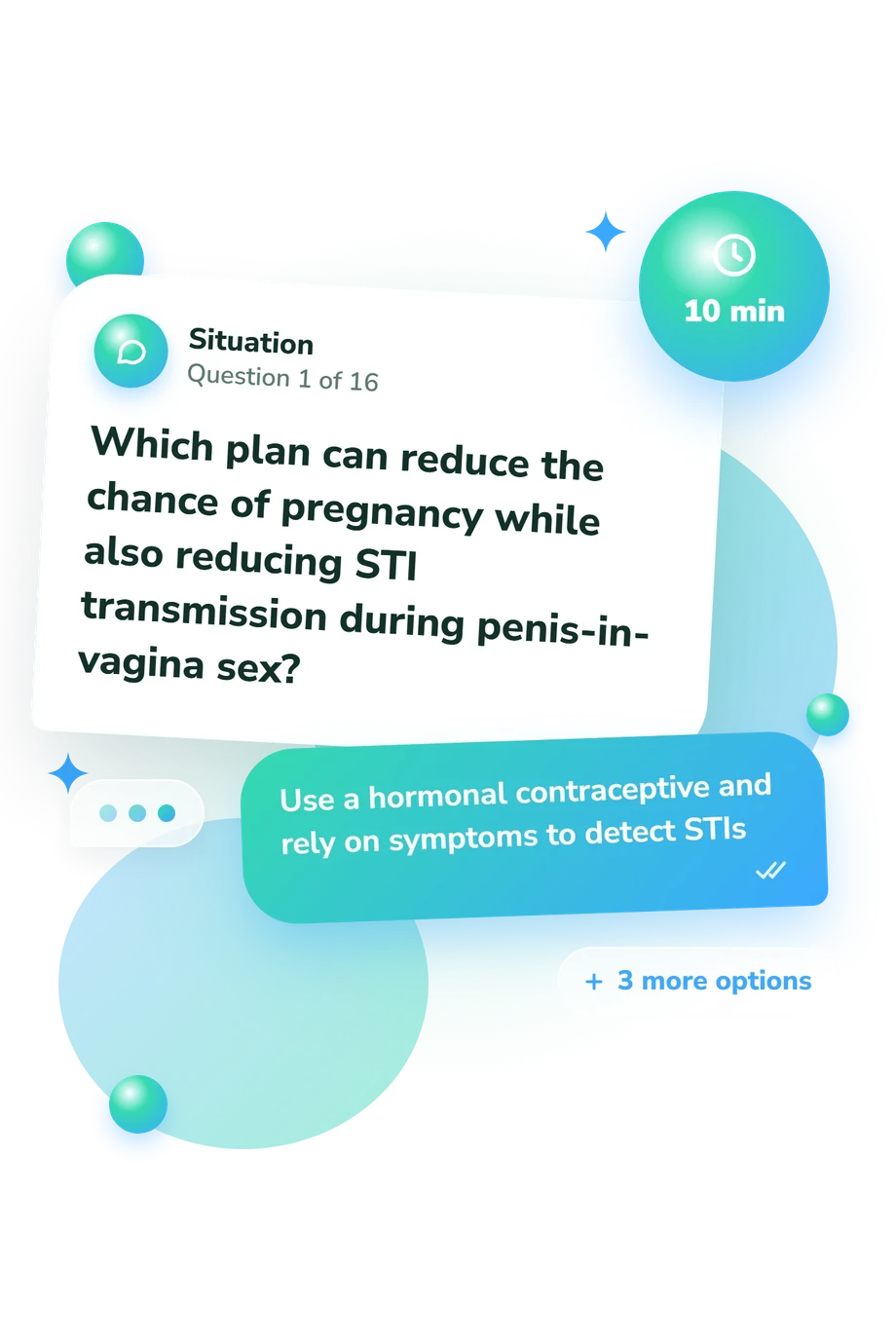
Example Questions From the Test
- Do not share it without the person's explicit permission; images involving minors also raise serious safety and legal concerns
- It may be forwarded to one trusted friend because it was sent privately
- Permission is unnecessary if the person's face is hidden
- Sharing it is acceptable if it is deleted afterward
- Use a hormonal contraceptive and rely on symptoms to detect STIs
- Rely on withdrawal and avoid sex only during menstruation
- Use emergency contraception before every sexual encounter
- Use a condom together with another appropriate contraceptive method
- Seek urgent medical care because these symptoms can signal a serious complication
- Take emergency contraception and rest at home
- Wait until the next menstrual cycle to see whether the pain resolves
- Assume the symptoms are ordinary menstrual cramps
Sex Ed Quiz - Description and methodology of the test
People who want to review everyday sexual-health knowledge can use this assessment as a focused starting point. This sex ed quiz is intended for anyone who wants to examine how confidently they recognize respectful, safer, and medically relevant choices. Questions in this sex education quiz cover common sexual-health decisions, so the assessment can highlight areas for personal review and discussion.
What This Assessment Explores
The questionnaire treats sexual health as practical knowledge rather than simple fact recall. Scenarios ask respondents to apply information about consent, contraception, pregnancy, STI prevention and testing, bodies, development, identity, and safety.
The items fall into several practical groups:
- Consent and boundaries show recognition of voluntary, informed, specific, reversible agreement, including impairment.
- Contraception and pregnancy assess condom use, emergency options, fertile timing, and warning signs.
- STI knowledge reflects asymptomatic infection, testing, vaccines, treatment, and skin transmission.
- Bodies and puberty measure anatomy, developmental variation, menstrual flow, and persistent pain.
- Identity and digital safety cover orientation, gender identity, privacy, and image permission.
Several sexual-health knowledge domains are covered by this sexual education quiz, while its reported result summarizes overall performance rather than topic-specific strengths. Sex Ed Knowledge runs from 0-16: Foundations to build (0-6), Developing knowledge (7-12), and Strong knowledge (13-16).
Methodology and Scientific Basis
Each item presents four answer choices, and the respondent selects the option that best matches established sexual-health information. The stated scoring logic counts correct responses; no extra weighting or reverse-scoring rule is specified. The bands describe the level attached to the total, not a probability or clinical estimate.
Its content is conceptually consistent with the published ASKQ, a measure of sexual-health knowledge. Its breadth also corresponds with the Sexuality Knowledge Assessment Questionnaire (SEKAQ) and Jaworski and Carey’s measure of sexually transmitted disease knowledge. UNESCO’s guidance supplies a broader educational framework for consent, health, safety, bodies, relationships, and identity.
The result is an educational snapshot of what the respondent recognizes today, and the sex education test can show whether review may be worthwhile. The bands are educational categories, not clinical cutoffs or a medical assessment. Attention, guessing, prior learning, and current familiarity with the material can affect answers, so an uncertain result is a prompt to review the underlying topic rather than a definitive judgment.
- Alexandra Kriofske Mainella, Craig Miller, Bianca Tocci, and Callie Koziol. “Development and Evaluation of the Acquired Sexual Knowledge Questionnaire: A Pilot of a New Measure of Sexual Health Knowledge.” American Journal of Sexuality Education 21, no. 1 (2026): 34-50. 10.1080/15546128.2024.2429425
- Laura Alonso Martínez, Jesús Puente Alcaraz, María José Sierra Medina, Raúl Soto Cámara, and Laura Armas Junco. “Sexuality Knowledge Assessment Questionnaire (SEKAQ): Importance of the School Setting in Health Education.” Psychology in the Schools 62, no. 12 (2025): 4903-4916. 10.1002/pits.70050
- Beth C. Jaworski and Michael P. Carey. “Development and Psychometric Evaluation of a Self-Administered Questionnaire to Measure Knowledge of Sexually Transmitted Diseases.” AIDS and Behavior 11, no. 4 (2007): 557-574. 10.1007/s10461-006-9168-5
- UNESCO, UNAIDS, UNFPA, UNICEF, UN Women, and WHO. “International Technical Guidance on Sexuality Education: An Evidence-Informed Approach.” Revised edition. Paris: UNESCO, 2018.
Updated: