
Scrum Quiz
How the Scales are Structured
Who Usually Takes This Test?
See How You Compare
Below is a preview of how scores are typically distributed across each scale.
Example Questions From the Test
- The most senior stakeholder
- The Scrum Master
- The Developers by majority vote
- The Product Owner
- The Product Goal
- The Sprint Goal
- The Definition of Done
- The acceptance plan
- The Sprint Goal
- The Product Goal
- The Definition of Done
- The release plan
Scrum Quiz - Description and methodology of the test
People working with Scrum can use the scrum quiz to rehearse practical decisions about responsibilities, events, and changing work. Its questions present answer choices about accountabilities, artifacts, commitments, and Sprint situations rather than asking for recall alone. As a Scrum knowledge assessment, it can help a learner or team member identify which parts of the framework deserve more deliberate practice.
What This Assessment Measures
This assessment examines whether a respondent can recognize Scrum as a lightweight framework and apply its accountabilities, events, artifacts, and commitments in realistic situations. It suits learners, team members, product professionals, and others checking their grasp.
Questions about Scrum roles, including the Scrum Master, test distinctions among the Scrum Master, Product Owner, and Developers. Other scenarios address changing scope, Sprint cancellation, inspection, unfinished work, and the Definition of Done. These Scrum framework questions cover four themes explaining what the overall score reflects:
- Accountabilities show whether the respondent distinguishes each role's responsibilities.
- Events show whether the respondent understands planning, daily inspection, review, and retrospective work.
- Artifacts and commitments show whether core elements connect correctly.
- Practical decisions show whether the respondent can apply Scrum when priorities change.
The Scrum Knowledge scale is 0-16: Foundation to build (0-6), Developing knowledge (7-12), and Strong knowledge (13-16).
Methodology and Evidence Base
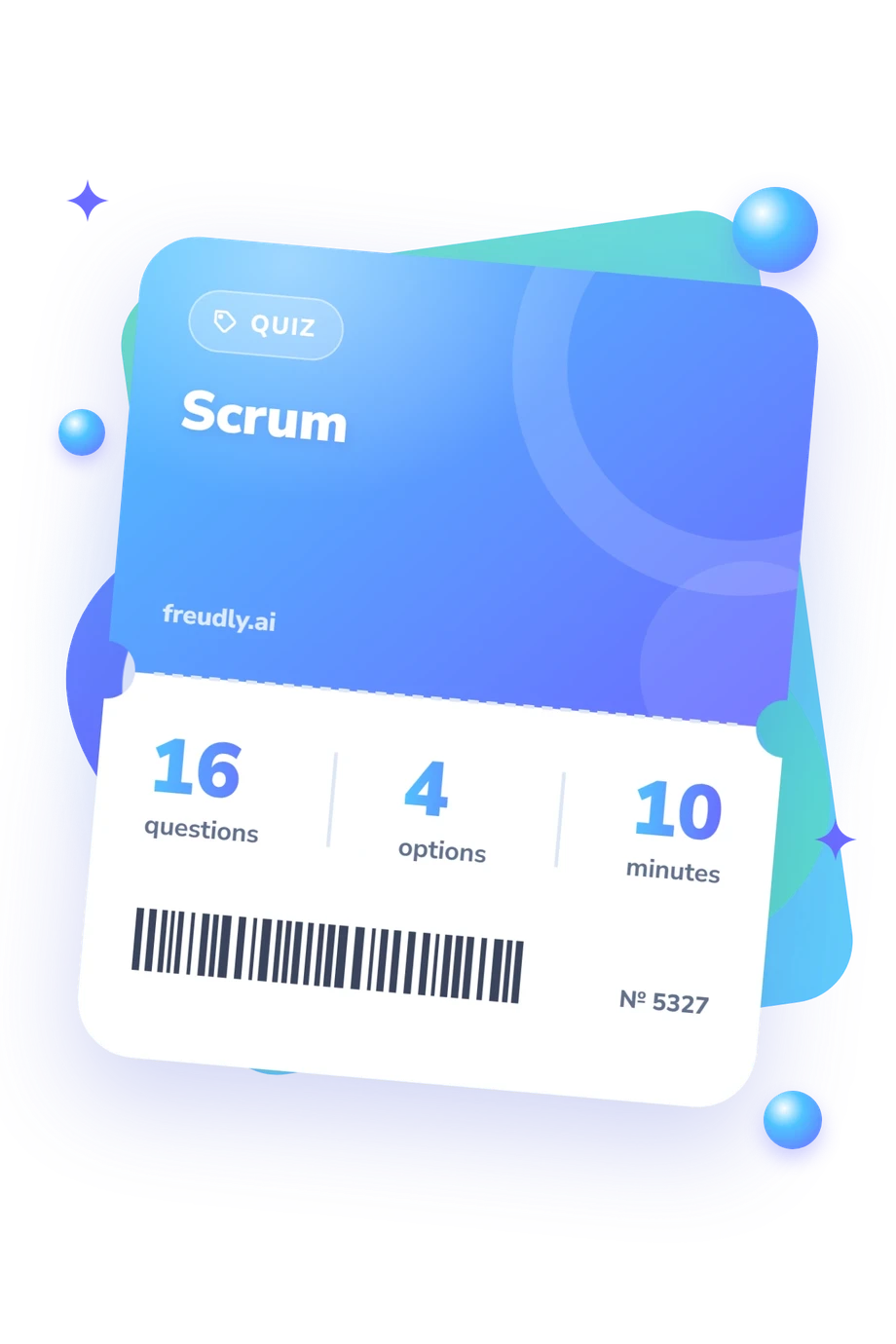
Each item uses four-option multiple choice, asking the respondent to select the answer that best fits Scrum. The scenarios test both recognition of defined accountabilities and judgment when scope, priorities, or events change, so results reflect connected understanding rather than isolated terminology.
As an educational Scrum practice test, this questionnaire presents one overall result. No separate domain scores or published weighting scheme is stated. The displayed outcome can identify review needs, but it is not an official Scrum certification result.
Its content is conceptually consistent with the Scrum Guide, especially its accountabilities, events, artifacts, commitments, and empirical approach. The questionnaire uses those framework concepts to frame scenarios rather than reproducing the Guide.
Interpretation depends on honest responses, attention to wording, prior training, and workplace experience. The result is best used as a focused learning signal for deciding what to revisit in the Scrum Guide and in day-to-day Scrum practice.
- Schwaber, Ken, and Jeff Sutherland. The Scrum Guide: The Definitive Guide to Scrum: The Rules of the Game. November 2020.
- Schwaber, Ken. "SCRUM Development Process." In Business Object Design and Implementation: OOPSLA ’95 Workshop Proceedings 16 October 1995, Austin, Texas, edited by Jeff Sutherland, Cory Casanave, Joaquin Miller, Philip Patel, and Glenn Hollowell, pp. 117-134. Springer, London, 1997. 10.1007/978-1-4471-0947-1_11.
Updated: