
Running Shoe Quiz
How the Scales are Structured
Who Usually Takes This Test?
See How You Compare
Below is a preview of how scores are typically distributed across each scale.
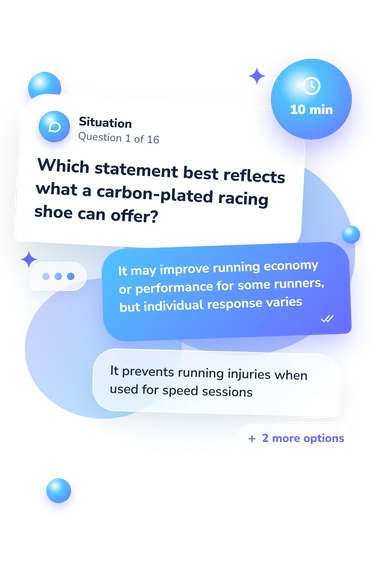
Example Questions From the Test
- A shorter size in the same width
- A higher heel-to-toe drop to lengthen the upper
- A thicker sock to fill the forefoot more evenly
- A wider width or a model with a roomier toe-box shape
- The upper
- The midsole
- The outsole
- The heel counter
- Smooth indoor tracks where minimal friction is preferred
- Road races where reducing outsole texture is the only goal
- Office floors where quiet steps are the main priority
- Soft or loose surfaces where grip and mud shedding are useful
Running Shoe Quiz - Description and methodology of the test
Runners who want a more informed way to compare footwear can use this running shoe quiz to test how confidently they understand everyday selection decisions. This shoe quiz is useful for beginners, experienced runners replacing a worn pair, and anyone sorting practical guidance from confident advertising. It offers a clear starting point for reviewing how personal assumptions shape choices, while the result places knowledge in an overall educational band rather than recommending a particular shoe.
What This Assessment Explores
It examines running-shoe knowledge across fit, terrain, care, and purchasing, rather than naming one best model. Scenarios cover toe-box space, heel hold, drop, cushioning, lugs, transitions, wear, retailer trust, and injury claims.
Rather than matching a runner with a model, the questionnaire works as a knowledge-based shoe finder quiz: it helps users understand selection criteria without recommending a particular shoe.
Running Shoe Knowledge (0-16) measures educational knowledge across fit, terrain, care, and retailer claims; it does not prescribe a shoe or assess injury. Bands: Foundation to build (0-6), Developing knowledge (7-12), Strong knowledge (13-16).
The questions cover four areas:
- Fit and comfort assess space, heel security, socks, and personal feel.
- Construction and geometry explain components, drop, ride, and suitability.
- Terrain and transition address surfaces, lugs, workload, and adaptation.
- Buying and maintenance cover retailer signals, claims, wear, and replacement.
Methodology and Evidence Base
Each item presents a short situation with four answer choices. The preferred option shows context-sensitive reasoning-for example, checking width when toes are squeezed or weighing wear and comfort instead of using a mileage rule. The score summarizes performance across the items; the educational result is presented in the displayed bands, but no item-weighting rule should be assumed beyond what the questionnaire specifies.
A systematic review of road-runners’ shoe-selection decisions is the closest conceptual source: its focus on fit, comfort, use, and buying cues aligns with this questionnaire, but the quiz is not an adaptation of that review. A study of footwear and injury-risk perceptions supports attention to fit, cushioning, stability, and purchase characteristics. Research on footwear advice and injury-prevention claims adds context for interpreting the scenarios. Together, these sources offer context, not validation of the online questionnaire.
For informed purchasing, the questionnaire helps a runner evaluate running shoe buying advice without selecting a model. It is educational rather than norm-referenced, and results may reflect prior knowledge, guessing, and interpretation of brief scenarios; they cannot establish personal fit or injury risk.
- Fife, Andrew, Codi Ramsey, Jean-François Esculier, and Kim Hébert-Losier. "How do road runners select their shoes? A systematic review." Footwear Science 15, no. 2 (2023): 103-112. 10.1080/19424280.2023.2180543
- Vincent, Heather K., and Kevin R. Vincent. "Five Key Characteristics to Consider when Purchasing a Running Shoe." Current Sports Medicine Reports 14, no. 5 (2015): 358. 10.1249/JSR.0000000000000185
- Dhillon, Gurmeet K., Michael A. Hunt, Andrea L. Reid, and Jean-François Esculier. "What are the perceptions of runners and healthcare professionals on footwear and running injury risk?" BMJ Open Sport & Exercise Medicine 6, no. 1 (2020): e000767. 10.1136/bmjsem-2020-000767
- Relph, Nicola, Henrike Greaves, Ross Armstrong, Trevor D. Prior, Sally Spencer, Ian B. Griffiths, Paola Dey, and Ben Langley. "Running shoes for preventing lower limb running injuries in adults." Cochrane Database of Systematic Reviews 8 (2022): CD013368. 10.1002/14651858.CD013368.pub2