
Bill of Rights Quiz
How the Scales are Structured
Who Usually Takes This Test?
See How You Compare
Below is a preview of how scores are typically distributed across each scale.
Example Questions From the Test
- The First Amendment
- The Sixth Amendment
- The Fourth Amendment
- The Tenth Amendment
- The reservation of undelegated powers to the states or people
- Protection against being tried twice for the same offense
- The right to a jury in certain civil cases
- Protection against unreasonable searches and seizures
- The government must follow fair legal procedures
- Congress must approve each individual case
- A civil jury must decide every government action
- The state must transfer the case to a federal court
Bill of Rights Quiz - Description and methodology of the test
Students, teachers, and citizens can use this assessment to check how accurately they connect constitutional amendments with everyday situations. People taking this bill of rights quiz identify which protection fits a factual or hypothetical example. The result gives a snapshot of current civic knowledge and can show whether broad review of Bill of Rights protections may be useful. It also works as a Bill of Rights practice quiz for guided review.
What This Assessment Explores
This assessment tests knowledge of Amendments One through Ten and their application; it does not measure legal expertise. Its situations ask which protection fits expression, searches, criminal procedure, punishment, arms, jury trials, and government limits. A quiz on the Constitution and Bill of Rights suits learners and curious citizens seeking a self-check.
The Bill of Rights Knowledge scale runs 0-16. Building Foundations (0-6) signals some familiarity; Developing Knowledge (7-12) reflects many core protections; Strong Knowledge (13-16) indicates a solid grasp in common examples. These bands show recognition and application of constitutional protections.
The groups are:
- Civic freedoms cover speech, religion, press, assembly, and petition.
- Privacy protections address searches, seizures, warrants, and probable cause.
- Criminal-procedure rights include due process, counsel, and self-incrimination.
- Jury protections cover criminal and qualifying federal civil trials.
- Other themes cover arms, punishment, unlisted rights, and reserved powers.
Methodology and Scientific Basis
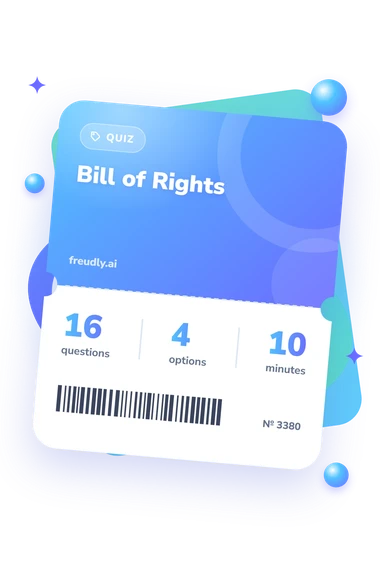
Each item presents a short question with four answer choices. The set combines direct amendment recognition with applied scenarios about probable cause, due process, self-incrimination, double jeopardy, counsel, and civil jury rights. This multiple-choice quiz about the Bill of Rights checks recall and basic application, while a selected answer cannot capture every legal nuance.
The displayed bands organize the result, and no response-weighting rule is documented for this questionnaire. This online questionnaire is an educational knowledge check, not a standardized measure with published legal-knowledge norms.
Coggins et al. (2020) is the closest supporting study: it examined U.S. Bill of Rights knowledge with a questionnaire among undergraduate students. This questionnaire is conceptually consistent with that work, not an adaptation of its instrument, so the study does not validate this exact item set or scoring.
The National Archives transcription and the Library of Congress Constitution Annotated provide the primary constitutional reference points for the amendments and their provisions.
Results can still reflect prior study, wording interpretation, guessing, and current attention. Quiz answers about the Bill of Rights are most useful when checked against the relevant amendment text and explanatory legal materials.
- Porter Eldridge Coggins III, Janet Heuer, and Michael A. Anderson. “A Crisis in Civic Conscience in the United States? Knowledge and Understanding of the U.S. Bill of Rights among a Group of Undergraduate Students Citizens of the United States.” World Journal of Social Science, 7(1), 12-24, 2020. 10.5430/wjss.v7n1p12
- United States Congress. The Bill of Rights: A Transcription. National Archives, 1791.
- Library of Congress. Bill of Rights (First Through Tenth Amendments). Constitution Annotated.