
Pop Music Quiz
How the Scales are Structured
Who Usually Takes This Test?
See How You Compare
Below is a preview of how scores are typically distributed across each scale.
Example Questions From the Test
- “Rolling in the Deep” — Adele
- “Complicated” — P!nk
- “Firework” — Lady Gaga
- “Since U Been Gone” — Miley Cyrus
- Duran Duran
- a-ha
- Depeche Mode
- Tears for Fears
- “Espresso” by Sabrina Carpenter
- “Flowers” by Miley Cyrus
- “Hung Up” by Madonna
- “Call Me Maybe” by Carly Rae Jepsen
Pop Music Quiz - Description and methodology of the test
For readers who enjoy identifying performers, matching songs to eras, and checking their recall of major hits, the Pop Music Quiz offers a focused knowledge check. It is suited to casual listeners, playlist builders, and fans who want to test their recall with pop music quiz questions 2026. It turns pop music quiz questions into a way to see which parts of pop history come most readily to mind.
What This Assessment Explores
The questionnaire tests factual recognition across artists, bands, song titles, release periods, lyrics, collaborations, soundtracks, and pop history. Some items ask for direct identification; others require comparing alternatives or making a simple connection between songs and performers.
Designed for casual listeners and dedicated fans alike, this pop music trivia quiz describes what you recall from the topics represented. It does not measure vocal skill, musical training, taste, or the overall quality of your listening.
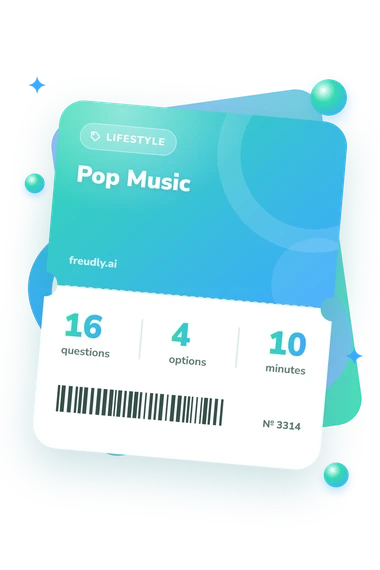
Your result appears on the Pop Music Knowledge scale (0-16) in three bands:
- Emerging Listener (0-6) indicates recognition of some touchstones with room to explore.
- Developing Hitmaker (7-12) shows solid knowledge of mainstream songs, performers, and pop history, though details may blur.
- Pop Expert (13-16) reflects consistent links among hits, artists, eras, lyrics, collaborations, and cultural contexts.
Methodology and Scientific Basis
The method is a multiple-choice recognition task: each item presents a prompt with four answer choices. Questions cover direct identification and connections between songs and performers. Together, these choices make this pop music knowledge test a focused exercise in recognition rather than open-ended recall.
The result is reported on the Pop Music Knowledge scale and interpreted through its supplied bands; interpret it alongside the songs represented and your listening history.
The cited studies are conceptually relevant, but they do not validate or norm the quiz. Schellenberg and colleagues' work offers the closest support for recognizing popular recordings and linking musical information with known songs. Krumhansl's work is consistent with recognition from compact cues, while Spivack and colleagues add context about collective memory for popular music. The questionnaire is conceptually consistent with these works, not an adaptation.
Performance depends on attention, exposure, cultural familiarity, and current memory, so the result provides a snapshot rather than a fixed ability. Use it as an overall view of pop-music knowledge; the questions may also prompt reflection on familiar and less familiar topics.
- Schellenberg, E. Glenn, Paul Iverson, and Margaret C. McKinnon. "Name that tune: Identifying popular recordings from brief excerpts." Psychonomic Bulletin & Review 6(4) (1999): 641-646. 10.3758/BF03212973
- Krumhansl, Carol L. "Plink: ‘Thin Slices’ of Music." Music Perception 27(5) (2010): 337-354. 10.1525/mp.2010.27.5.337
- Spivack, Stephen, Sara Jordan Philibotte, Nathaniel Hugo Spilka, Ian Joseph Passman, and Pascal Wallisch. "Who remembers the Beatles? The collective memory for popular music." PLOS ONE 14(2) (2019): e0210066. 10.1371/journal.pone.0210066