
News Quiz
How the Scales are Structured
Who Usually Takes This Test?
See How You Compare
Below is a preview of how scores are typically distributed across each scale.
Example Questions From the Test
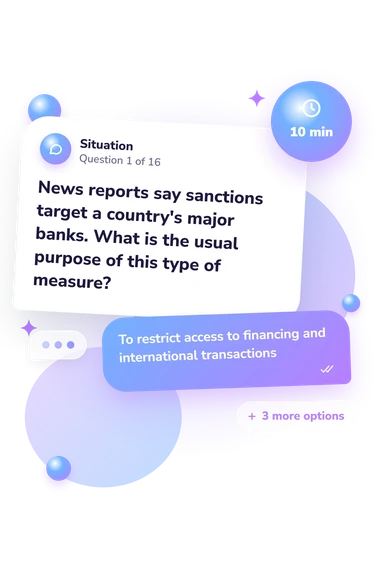
- To restrict access to financing and international transactions
- To transfer ownership of the banks to the United Nations
- To guarantee depositors a higher interest rate
- To replace the country's currency immediately
- The General Assembly
- The International Court of Justice
- The Security Council
- The Secretariat
- The largest party automatically receives every cabinet position
- The courts select the new prime minister
- The previous election result is automatically cancelled
- Parties negotiate a coalition or another governing arrangement
News Quiz - Description and methodology of the test
A concept-focused assessment suits readers who want to test how they reason through common news situations rather than recall specialist detail. In this news quiz, four-choice items ask you to select the best-supported interpretation of evidence, institutions, policy, economics, and reporting. The result offers a broad performance level on applied news concepts, making the current events quiz useful for structured self-reflection.
What This Assessment Explores
The questions sample knowledge through practical situations rather than a catalogue of headlines. They ask you to recognize and apply concepts involving sanctions, asylum status, polling, coalitions, climate negotiations, courts, economic indicators, corrections, and causal claims. This assessment is a news reasoning assessment focused on its concepts, not a complete measure of current-events knowledge.
The result uses one displayed scale, News Knowledge (0-16). It reflects this 16-item set, not complete knowledge of every current event. Its bands describe the application level shown by the total:
- Building Foundations (0-6) indicates recognition of some news concepts, with review still useful for institutions, statistics, and reporting conventions.
- Developing News Literacy (7-12) shows understanding of many common headline concepts, while interpretation and verification can be sharpened.
- Strong News Literacy (13-16) reflects consistent application of key concepts across major news topics.
Methodology and Scientific Basis
Each item presents a scenario with four answer choices. The respondent selects the best-supported interpretation, so the format tests applied knowledge rather than frequency or agreement ratings. It rewards reading statistics carefully, distinguishing legal steps, recognizing institutional roles, and weighing evidence. This four-choice knowledge assessment can reveal reasoning gaps as well as factual gaps, while prior knowledge, attention, context, and guessing may affect performance.
The questionnaire reports one total, but gives no separate weighting or conversion rule. Its displayed bands interpret performance on this 16-item total. The result is a snapshot of performance on these items.
The closest comparison is the News Literacy Knowledge Measure described by Maksl, Ashley, and Craft, a validated knowledge measure on a related subject; this questionnaire is not that instrument, and its validation results do not transfer. Maksl, Ashley, and Craft describe a news-media-literacy framework, while McGrew and colleagues support tracing sources, comparing evidence, and avoiding conclusions that evidence cannot support. These sources clarify the concepts sampled here, but do not establish the same validation evidence for this questionnaire.
- Maksl, Adam, Peter J. Boedeker, Emily K. Vraga, Stephanie Craft, Melissa Tully, and Seth Ashley. (2024). Developing and Validating a 15-Item True/False Measure of News Literacy Knowledge. Communication Research. Advance online publication. 10.1177/00936502241284406
- Maksl, Adam, Seth Ashley, and Stephanie Craft. (2015). Measuring News Media Literacy. Journal of Media Literacy Education, 6(3), 29-45. 10.23860/jmle-6-3-3
- McGrew, Sarah, Joel Breakstone, Teresa Ortega, Mark Smith, and Sam Wineburg. (2018). Can Students Evaluate Online Sources? Learning From Assessments of Civic Online Reasoning. Theory & Research in Social Education, 46(2), 165-193. 10.1080/00933104.2017.1416320
Updated: