
Muscles of the Trunk Quiz
How the Scales are Structured
Who Usually Takes This Test?
See How You Compare
Below is a preview of how scores are typically distributed across each scale.
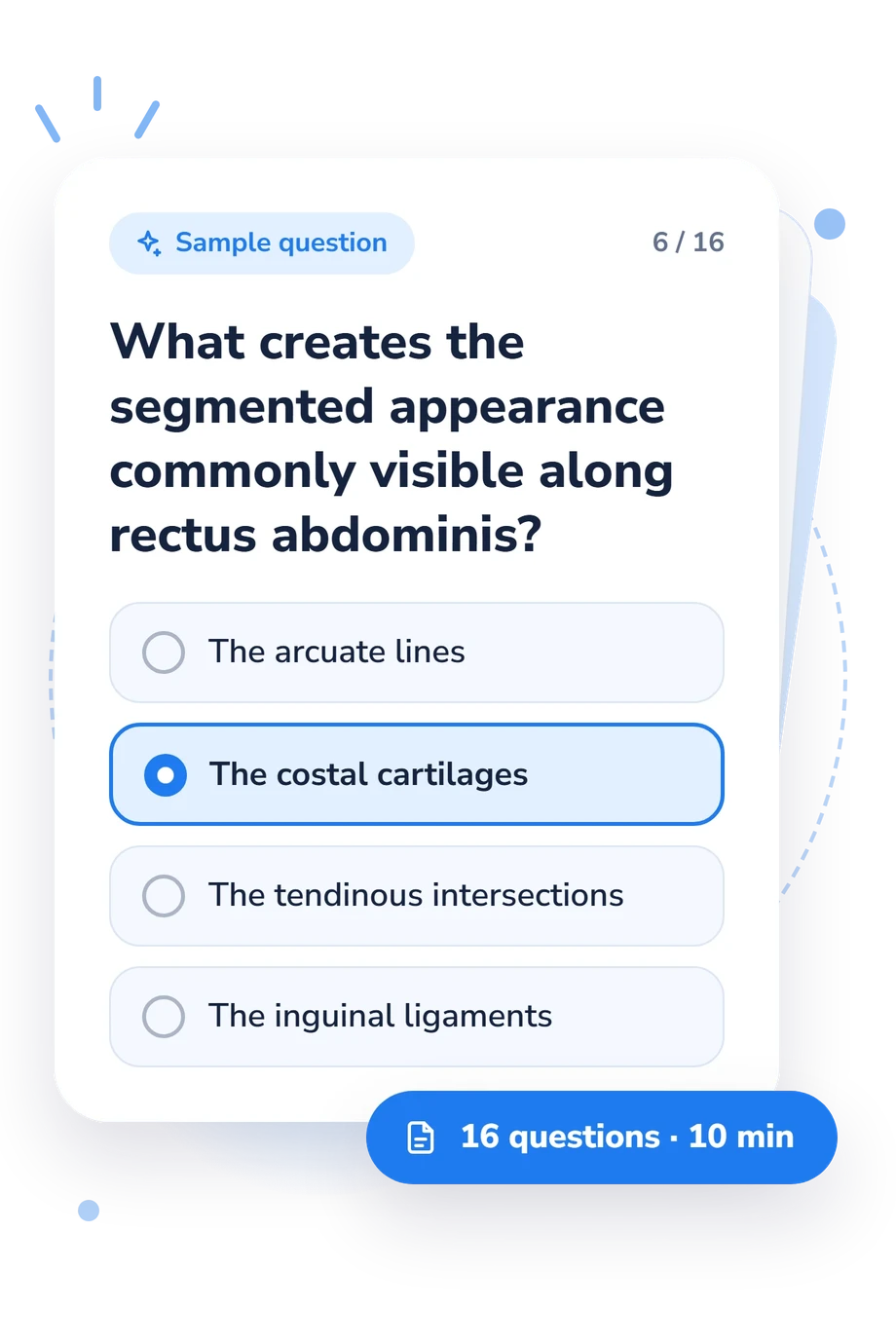
Example Questions From the Test
- Latissimus dorsi
- Erector spinae
- Trapezius
- Quadratus lumborum
- Inguinal ligament
- Linea semilunaris
- Linea alba
- Arcuate line
- Left external oblique and right internal oblique
- Right external oblique and left internal oblique
- Both right and left rectus abdominis
- Left transversus abdominis and right rectus abdominis
Muscles of the Trunk Quiz - Description and methodology of the test
Students, trainees, and curious readers who want to connect anatomy with movement can use the muscles of the trunk quiz to check how confidently they identify structures and explain their actions. Rather than treating this trunk muscles quiz as simple name recall, this assessment gives learners an opportunity to apply anatomical knowledge to movement-related questions.
What This Assessment Explores
The questions span the anterior, lateral, posterior, and thoracic regions of the trunk. They ask you to identify muscles by location or attachment, distinguish layers and planes, and apply actions such as rotation, lateral flexion, extension, stabilization, inhalation, and forceful expiration. As a trunk muscle anatomy quiz, this assessment checks how remembered facts connect with movement and regional relationships.
The result is organized as Muscles of the Trunk Knowledge (0-16) and summarizes overall knowledge across the quiz. Its bands describe the levels shown to the visitor:
- Foundational (0-6) indicates recognition of trunk-muscle concepts and suggests reviewing locations, layers, and primary actions.
- Developing (7-12) indicates understanding of major structures and functions, with room to strengthen anatomical relationships and movement reasoning.
- Strong (13-16) indicates consistent knowledge of trunk-muscle anatomy, actions, and functional relationships.
Methodology and Scientific Basis
Each item presents a stem with four answer choices. Questions move between identification and applied reasoning: you may infer a muscle’s action, follow a neurovascular plane, connect a structure with breathing, or identify a regional relationship. The displayed scale summarizes overall knowledge across the quiz.
Viewed as a trunk anatomy test, this assessment is a four-choice, content-based knowledge check, not a personality or symptom inventory. The 2002 article by Haladyna, Downing, and Rodriguez gives general multiple-choice item-writing guidance; it does not establish how this questionnaire was constructed or validate it.
Anatomical content is conceptually consistent with Gray's Anatomy for Students and Moore's Clinically Oriented Anatomy. These sources support the locations, attachments, layers, actions, respiratory roles, and regional relationships addressed here; the quiz is not presented as an adaptation or standardized edition of either textbook.
Because performance depends on study history, attention, and current recall, the result is a focused learning indicator. Reviewing difficult items can guide further study of muscle attachments, actions, planes, and respiratory relationships, rather than serve as a clinical judgment or formal credential.
- Drake RL, Vogl AW, Mitchell AWM. Gray's Anatomy for Students. 5th ed. Philadelphia, PA: Elsevier; 2023. ISBN 9780323934237.
- Dalley AF II, Agur AMR. Moore's Clinically Oriented Anatomy. 9th ed. Philadelphia, PA: Wolters Kluwer; 2023. ISBN 9781975154066.
- Haladyna TM, Downing SM, Rodriguez MC. A Review of Multiple-Choice Item-Writing Guidelines for Classroom Assessment. Applied Measurement in Education. 2002;15(3):309-333. 10.1207/S15324818AME1503_5.
Updated: