
Limerence Test
How the Scales are Structured
Who Usually Takes This Test?
See How You Compare
Below is a preview of how scores are typically distributed across each scale.
Example Questions From the Test
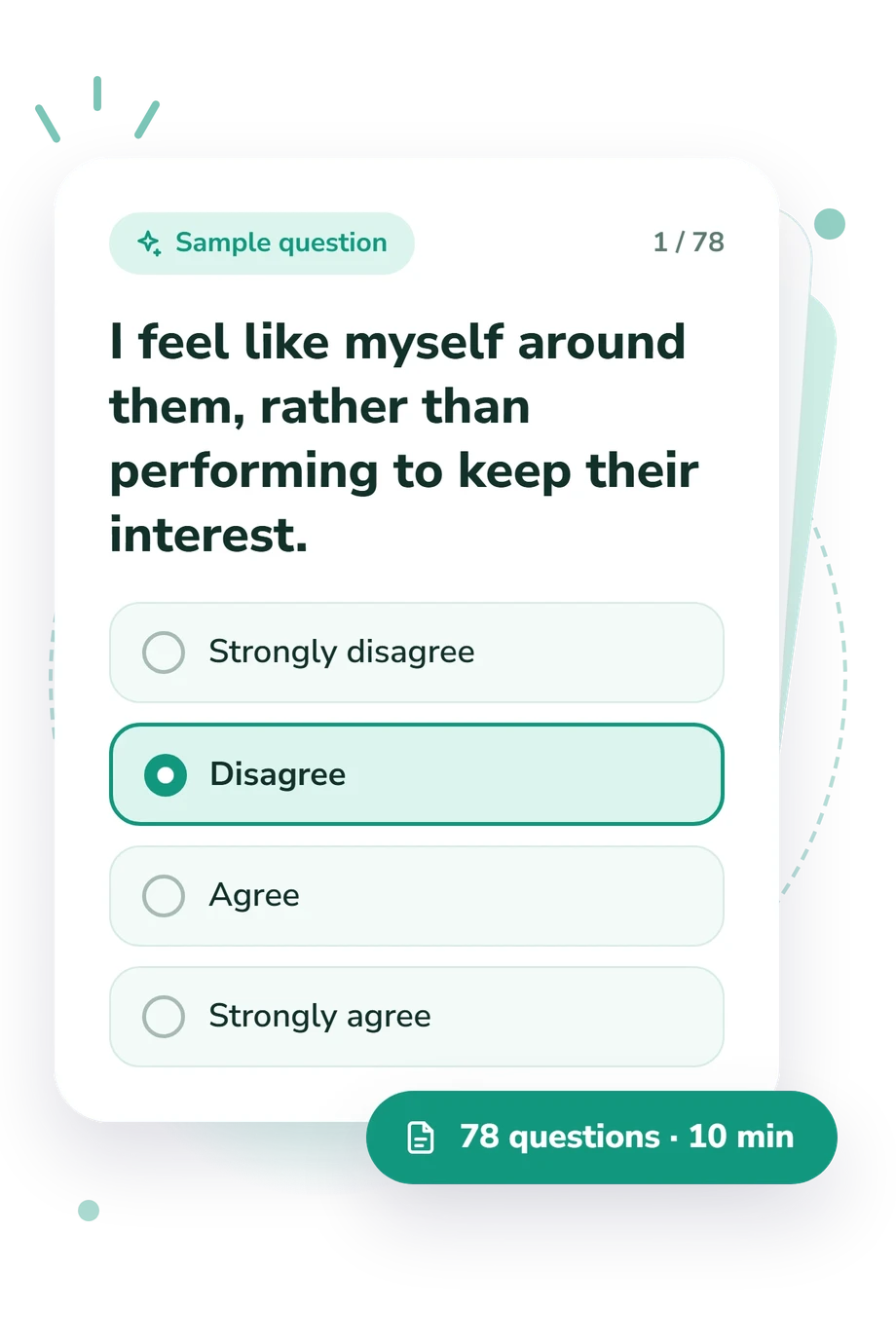
- Strongly disagree
- Disagree
- Agree
- Strongly agree
- Strongly disagree
- Disagree
- Not sure
- Agree
- Strongly disagree
- Disagree
- Agree
- Strongly agree
Limerence Test - Description and methodology of the test
People who feel pulled between excitement, uncertainty, and repetitive thoughts may use this limerence test to examine what is happening in a particular connection. It is intended for anyone reflecting on romantic feelings, whether the relationship is new, unclear, mutual, or mostly imagined. As a limerence quiz about infatuation, attachment, and intrusive thinking, it turns a vague emotional experience into a profile of intensity, stability, and mental preoccupation.
What This Assessment Explores
This limerence and attachment quiz profiles consuming infatuation, attachment stability, and preoccupation through reassurance seeking, idealization, urgency, emotional steadiness, realistic expectations, and shifting attention. Love is context here, not a displayed scale: the profile can show high or low intensity alongside steadier or less secure attachment, with preoccupation varying independently.
The three displayed scales describe different parts of that pattern:
- Attachment Stability (0-30) shows how steady, reality-based, and secure feelings are; Low stability 0-14, Moderate stability 15-22, and High stability 23-30 mark increasing steadiness and tolerance of uncertainty.
- Limerence Intensity (0-40) shows intrusive focus, craving, urgency, and difficulty disengaging; Low 0-13, Moderate 14-26, and High 27-40 mark increasing intensity.
- Preoccupation & Intrusion (0-30) shows repetitive or unwanted thoughts that interfere with concentration, sleep, or routine; Low 0-10, Moderate 11-20, and High 21-30 mark increasing mental interference.
Methodology and Evidence Base
Question formats pair statements with response sets; choices indicate agreement, frequency, intensity, or whether an experience feels true, and some include uncertainty. These formats capture occurrence and strength without treating every romantic thought as limerence.
Responses form three dimensions rather than one verdict. Their bands allow high intensity to coexist with stable attachment or marked intrusion. Categories organize the profile without collapsing these dimensions into one score.
This limerence assessment places mental urgency alongside emotional steadiness. The Limerence Questionnaire (LQ-11; Marshall et al., 2025) offers a relevant conceptual comparison for limerence research. This questionnaire is conceptually consistent with that work, not an adaptation of it. It is also conceptually consistent with the infatuation-and-attachment distinction examined by Langeslag et al. (2013); Tennov’s framework overlaps in features such as intrusive focus, hope, and uncertainty.
As an online self-report, the result depends on honest answers, current circumstances, and self-awareness, and its displayed bands organize this questionnaire’s profile rather than functioning as validated norms or clinical cutoffs. It describes tendencies at completion rather than proving what another person feels or what a relationship will become.
- Marshall, Lynn, Daniel Waldeck, Luca Pancani, Susan Churchill, and Ian Tyndall. "Development and Validation of the Limerence Questionnaire (LQ-11)." Psychological Reports, 2025. 10.1177/00332941251394980
- Langeslag, Sandra J. E., Peter E. H. M. Muris, and Ingmar H. A. Franken. "Measuring Romantic Love: Psychometric Properties of the Infatuation and Attachment Scales." Journal of Sex Research, 50(8), 739-747, 2013. 10.1080/00224499.2012.714011
- Tennov, Dorothy. Love and Limerence: The Experience of Being in Love. Stein and Day, 1979.
Updated: