
Gut Type Quiz
How the Scales are Structured
Who Usually Takes This Test?
See How You Compare
Below is a preview of how scores are typically distributed across each scale.
Example Questions From the Test
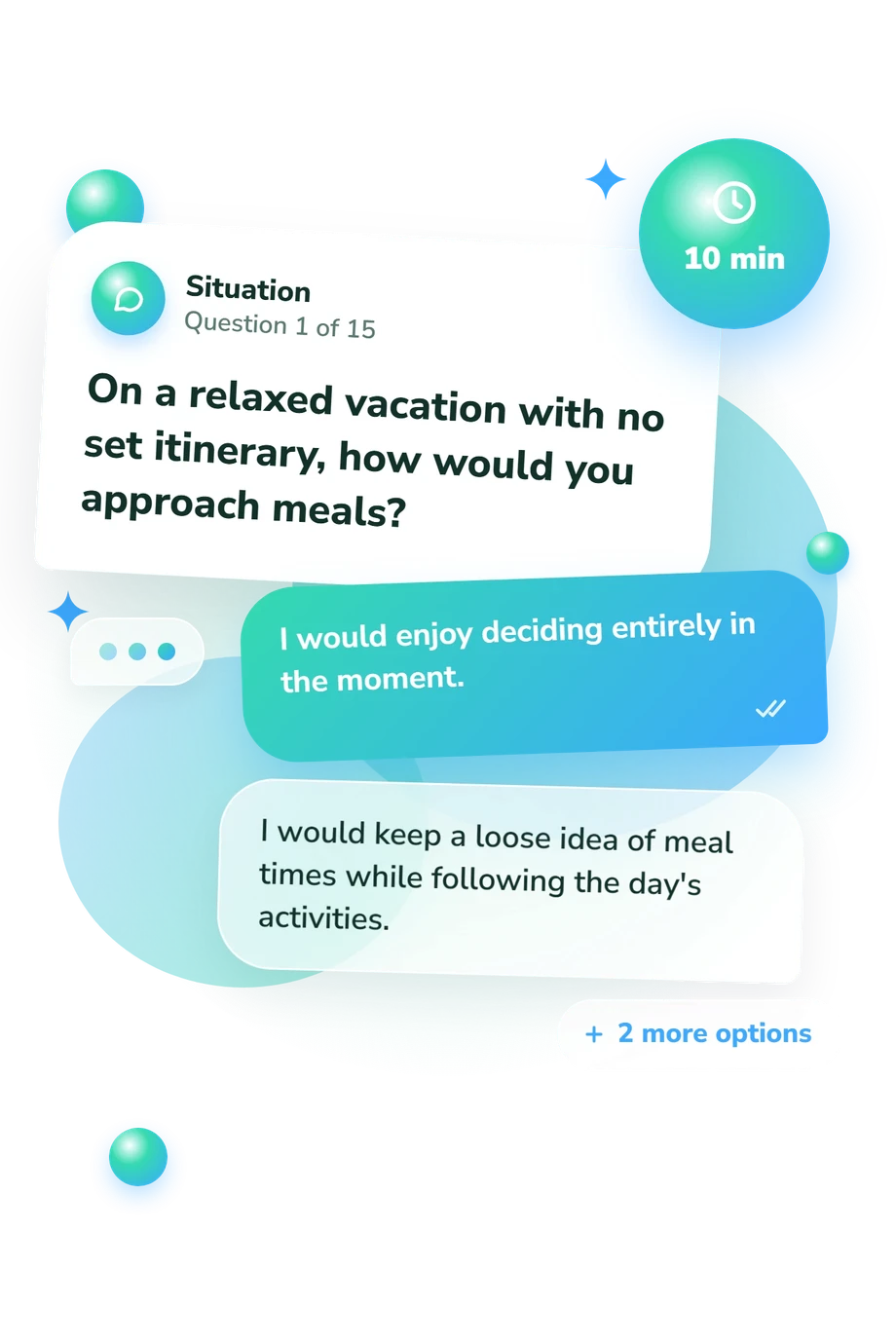
- I would enjoy deciding entirely in the moment.
- I would keep a loose idea of meal times while following the day's activities.
- I would preserve one or two familiar meal-time anchors.
- I would try to recreate my usual meal schedule fairly closely.
- Mostly to the taste, setting, and shared experience.
- To digestion only if a clear sensation gets my attention.
- Back and forth between enjoying the food and checking how my body responds.
- Toward digestive signals from the first few bites through the hours afterward.
- I treat it as an ordinary variation and give it no further attention.
- I note the feeling, then let my attention move elsewhere.
- I consider the meal and activity around it to understand the sensation.
- I monitor the feeling closely and let it shape my next food-related decision.
Gut Type Quiz - Description and methodology of the test
People deciding whether to explore their everyday digestive habits may find the Gut Type Quiz useful as a structured self-reflection exercise. Its questions invite you to decide whether ordinary changes in schedule, mood, and bodily awareness are noticeable enough to track in your own life. The result offers a digestive habits profile describing perceived tendencies rather than assessing physical health.
What This Assessment Explores
The questions focus on ordinary situations involving meal timing, unfamiliar food, emotional changes, mild digestive sensations, disrupted routines, and choices guided by bodily cues. The three displayed dimensions are:
- Digestive Routine Preference (0-15) reflects flexibility, adjustment, or preference for predictable meal sequences: Spontaneous rhythm 0-5; Context-shaped rhythm 6-10; Consistency-oriented rhythm 11-15.
- Gut-Emotion Responsiveness (0-15) reflects how often digestive changes stand out during emotional shifts: Less apparent connection 0-5; Occasional connection 6-10; Strongly noticed connection 11-15.
- Gut-Signal Attention (0-15) reflects how much digestive cues enter awareness and guide choices: Background awareness 0-5; Situational awareness 6-10; Foreground awareness 11-15.
Together, the scales form an interoceptive awareness profile of perceived habits and attention, not a ranking of good or bad digestion. Higher scores mean more of the tendency named by that scale, not automatically greater health, sensitivity, or difficulty.
Methodology and Scientific Basis
Each item offers four ordered responses, moving from less pronounced responses toward stronger preference, emotional connection, or monitoring. Results are reported across three displayed scales and named bands; labels indicate tendency levels rather than clinical thresholds. The dimensions can combine in different ways, so the profile does not assign one fixed type.
Its framework is conceptually consistent with the 2023 Three-domain Interoceptive Sensations Questionnaire (THISQ) and can be read alongside the ISAQ and the MAIA. This questionnaire is a dimensional online profile, not a standardized or validated adaptation of THISQ, ISAQ, or MAIA; these instruments provide conceptual context, not evidence of its measurement properties.
Self-report varies with memory, current stress, attention, and interpretation. The routine-preference result describes preference rather than digestive health; signal attention does not indicate a medical problem, and emotional-responsiveness bands do not establish a medical or psychological cause. Persistent or worsening changes warrant clinical attention, and the profile can organize observations over time as a digestive awareness assessment without assigning a fixed identity.
- Vlemincx, Elke; Walentynowicz, Marta; Zamariola, Giorgia; Van Oudenhove, Lukas; Luminet, Olivier. A novel self-report scale of interoception: the three-domain interoceptive sensations questionnaire (THISQ). Psychology & Health, 2023, 38(9), 1234-1253. 10.1080/08870446.2021.2009479
- Bogaerts, Katleen; Walentynowicz, Marta; Van Den Houte, Maaike; Constantinou, Elena; Van den Bergh, Omer. The Interoceptive Sensitivity and Attention Questionnaire: Evaluating Aspects of Self-Reported Interoception in Patients With Persistent Somatic Symptoms, Stress-Related Syndromes, and Healthy Controls. Psychosomatic Medicine, 2022, 84(2), 251-260. 10.1097/PSY.0000000000001038
- Mehling, Wolf E.; Price, Cynthia; Daubenmier, Jennifer J.; Acree, Mike; Bartmess, Elizabeth; Stewart, Anita. The Multidimensional Assessment of Interoceptive Awareness (MAIA). PLoS ONE, 2012, 7(11), e48230. 10.1371/journal.pone.0048230
Updated: