
Greek Mythology Quiz
How the Scales are Structured
Who Usually Takes This Test?
See How You Compare
Below is a preview of how scores are typically distributed across each scale.
Example Questions From the Test
- Hestia
- Demeter
- Hera
- Thetis
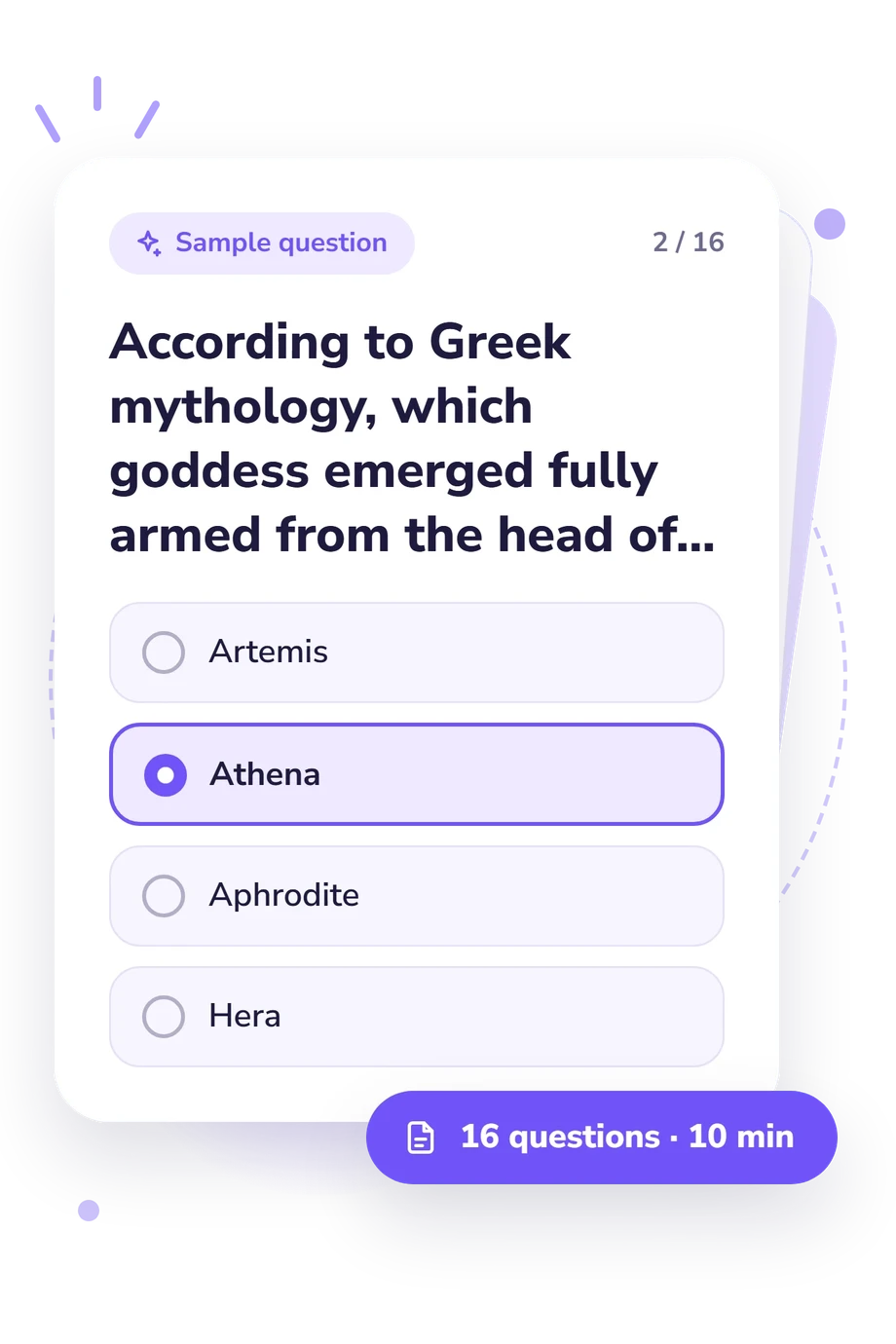
- Artemis
- Athena
- Aphrodite
- Hera
- Heracles
- Ajax
- Hector
- Achilles
Greek Mythology Quiz - Description and methodology of the test
Readers beginning a course, revisiting classical stories, or choosing material for further study can use the Greek Mythology Quiz as a focused starting point. It suits learners, literature readers, and mythology enthusiasts who want a structured mythology quiz rather than an opinion-based personality result. The outcome can help you choose what to review next and turn a broad interest in mythology into a practical reading plan.
What This Assessment Explores
The questions examine gods, Titans, heroes, monsters, punishments, transformations, and famous episodes. Here, figures are linked to defining actions, objects, relationships, and outcomes; in this Greek quiz, recognition and narrative association matter more than extended interpretation.
The main thematic groups are:
- Gods and goddesses are identified through their realms, symbols, powers, and relationships.
- Heroes and kings are recognized through quests, decisions, victories, and consequences.
- Monsters and supernatural figures are linked to the challenges they create for other characters.
- Stories are recalled through distinctive objects, transformations, punishments, and plot clues.
Together, these themes test recall of narrative links rather than personal interpretation. The mythology questions draw on Greek traditions and feed the Greek Mythology Knowledge scale, which runs from 0-16. Mythology Explorer (0-6) indicates recognition of central figures; Developing Mythologist (7-12) indicates broad familiarity with some difficult details; Mythology Scholar (13-16) indicates strong command of prominent myths and narrative clues.
Methodology and Evidence Base
Each item presents a short mythological situation or direct identification prompt with four answer choices. You select the deity, hero, monster, object, or outcome that best fits the clue. The displayed result summarizes the responses you select across Greek mythology questions from this quiz.
The content is conceptually consistent with the comparative framework presented by Morford, Lenardon, and Sham in their treatment of classical mythology. Apollodorus and Hesiod represent ancient narrative and genealogical sources, while Denova provides a modern scholarly account of Greek gods, myths, and heroes. The questionnaire is not an adaptation of those works or a standardized administration of any one source; it is an online knowledge self-check.
Read the bands as performance on recognition tasks, not as formal educational attainment or complete command of Greek mythology. Previous reading, classroom exposure, cultural familiarity, memory, and the wording of an individual prompt can affect the result, so the profile is best used to identify secure knowledge and stories worth revisiting.
- Morford, Mark P. O., Robert J. Lenardon, and Michael Sham. Classical Mythology. 11th ed. Oxford University Press, 2018.
- Apollodorus. The Library of Greek Mythology. Translated with an introduction and notes by Robin Hard. Oxford University Press, 1997.
- Hesiod. Theogony and Works and Days. Translated with an introduction and notes by Martin L. West. Oxford University Press, 1988.
- Denova, Rebecca I. “Myths, Gods, and Heroes: Greece.” In Greek and Roman Religions, pp. 47-70. Wiley-Blackwell, 2018. 10.1002/9781119392552.ch3
Updated: