
Ethics Quiz
How the Scales are Structured
Who Usually Takes This Test?
See How You Compare
Below is a preview of how scores are typically distributed across each scale.
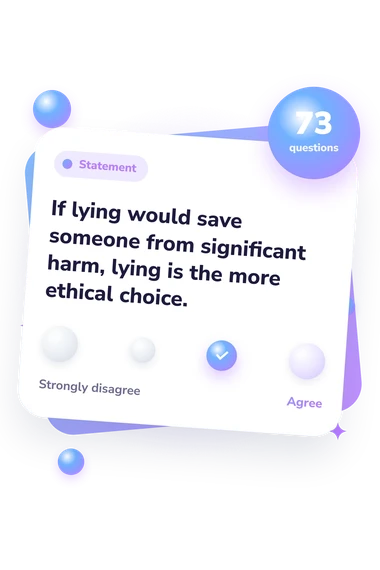
Example Questions From the Test
- Strongly disagree
- Disagree
- Not sure
- Agree
- Strongly disagree
- Disagree
- Not sure
- Agree
- Strongly disagree
- Disagree
- Not sure
- Agree
Ethics Quiz - Description and methodology of the test
People who want to examine the principles behind difficult choices can use this ethics quiz to identify recurring moral priorities rather than seek one universally correct answer. It is intended for readers interested in self-reflection, interpersonal responsibility, and the way values shape judgment under pressure. Its dilemma-based format makes it a moral reasoning test that organizes reactions to everyday and high-stakes dilemmas into a readable personal profile.
What This Assessment Explores
It examines three dimensions of moral judgment: concern for harm and care, preference for duties or outcomes, and loyalty to close groups or communities. This ethics test can help readers understand why a choice feels compelling when compassion, rules, fairness, and solidarity pull in different directions. The result describes response emphases, not fixed character.
The result is organized into these scales:
- Care/Harm Sensitivity (0-30) shows how strongly you prioritize preventing suffering and meeting others’ needs: Lower sensitivity 0-10; Moderate sensitivity 11-20; Higher sensitivity 21-30.
- Duty vs Outcomes (0-40) shows whether judgments lean toward obligations or consequences: Duty-leaning 0-13; Balanced 14-26; Outcome-leaning 27-40.
- Loyalty & Group Commitment (0-30) shows how much group bonds shape trade-offs: Low Loyalty Focus 0-10; Balanced Loyalty Focus 11-20; High Loyalty Focus 21-30.
Methodology and Scientific Basis
The representative items shown use first-person statements about preventing harm, keeping promises, defending friends, reporting wrongdoing, and exceptions to rules. Their four options-Strongly disagree, Disagree, Not sure, and Agree-show how each position fits the respondent. The result reports separate scores on three displayed scales; its scoring method and weighting are not specified.
The questionnaire is conceptually consistent with the Moral Foundations Questionnaire (Graham et al., 2011), particularly its care and group-loyalty themes. Its duty/outcome contrast is conceptually consistent with Robinson’s Consequentialist Scale and Conway and Gawronski’s process-dissociation approach, which distinguishes deontological and utilitarian inclinations. These parallels do not make this online questionnaire an adaptation or validated version. Its dilemma format makes this an ethical decision-making quiz: the contrasts describe tendencies rather than declaring one style universally correct.
Read each result as the position of a score on its displayed dimension, not as a universal ranking of moral worth. Self-report answers can shift with context, self-awareness, and the wish to appear consistent, so the result is a snapshot of stated priorities and situations that bring them forward.
- Graham, Jesse, Brian A. Nosek, Jonathan Haidt, Ravi Iyer, Spassena Koleva, and Peter H. Ditto. (2011). Mapping the Moral Domain. Journal of Personality and Social Psychology, 101(2), 366-385. 10.1037/a0021847
- Robinson, Jeffrey Sean. (2012). The Consequentialist Scale: Elucidating the Role of Deontological and Utilitarian Beliefs in Moral Judgments. Master's thesis, University of Toronto.
- Conway, Paul, and Bertram Gawronski. (2013). Deontological and utilitarian inclinations in moral decision making: A process dissociation approach. Journal of Personality and Social Psychology, 104(2), 216-235. 10.1037/a0031021