
Equations Quiz
How the Scales are Structured
Who Usually Takes This Test?
See How You Compare
Below is a preview of how scores are typically distributed across each scale.
Example Questions From the Test
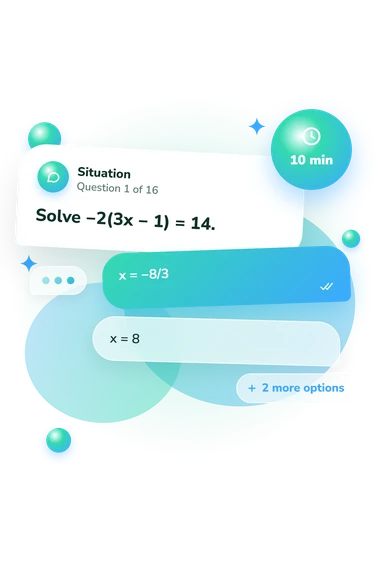
- x = −8/3
- x = 8
- x = −2
- x = 4/3
- h = A/(2b)
- h = 2A/b
- h = Ab/2
- h = 2b/A
- 5 units
- 7 units
- 6 units
- 8 units
Equations Quiz - Description and methodology of the test
Students, adult learners, and anyone revisiting algebra can use this equations quiz to assess current knowledge across symbolic, contextual, and system-based problems. The result offers a compact picture of current algebra performance. As an algebra assessment, it can help you choose between reviewing foundations, practising multi-step reasoning, or extending work to systems and formulas.
What This Assessment Explores
These items test whether you can represent an unknown, preserve equality while transforming an expression, and verify a value in the original equation. They cover inverse operations, distribution, formulas, perimeter and cost situations, ticket mixtures, radicals, identities, coordinate pairs, and systems. The result reflects performance across these tasks, not mathematical ability as a whole.
At its core, this equation skills assessment asks whether a learner can choose operations, translate language into equations, recognize equivalent forms, and check a proposed solution.
The Equations Knowledge scale (0-16) reports:
- Foundations to build (0-6) indicates that inverse operations, distribution, or substitution checks may need review.
- Developing command (7-12) shows that standard equations are manageable, while multi-step, contextual, or non-linear forms need practice.
- Strong command (13-16) reflects consistent use of equation principles across calculations, scenarios, systems, and formulas.
Methodology and Scientific Basis
Each item presents a problem and four answer choices. Prompts ask for a solution, an equivalent rearrangement, an ordered pair, a number of solutions, or a check of a claim. This format samples procedural execution and conceptual recognition: success may depend on applying operations, interpreting context, or noticing when expressions remain equivalent.
The result summarizes performance across the items and is interpreted through the descriptive bands shown with the score. Its 0-16 result uses descriptive bands rather than documented normative reference values or formal standardisation; item weighting is not defined by the questionnaire, so the result is best read as a snapshot of performance on these algebra tasks.
The questionnaire is conceptually consistent with the procedural and conceptual algebra screening work of Genareo and colleagues, but is not presented as an adaptation of that measure. Research on mathematical equivalence by Rittle-Johnson and colleagues supports attention to equivalent forms, while work by Fyfe and colleagues reinforces assessment of formal equivalence knowledge.
An algebra equation test can guide practice choices, although notation familiarity, recent instruction, guessing, and care in checking can affect performance.
- Genareo, Vincent R., Anne Foegen, Barbara J. Dougherty, William W. DeLeeuw, Jeannette Olson, and Ruveyda Karaman Dundar. (2021). Technical Adequacy of Procedural and Conceptual Algebra Screening Measures in High School Algebra. Assessment for Effective Intervention, 46(2), 121-131. 10.1177/1534508419862025
- Rittle-Johnson, Bethany, Percival G. Matthews, Roger S. Taylor, and Katherine L. McEldoon. (2011). Assessing Knowledge of Mathematical Equivalence: A Construct-Modeling Approach. Journal of Educational Psychology, 103(1), 85-104. 10.1037/a0021334
- Fyfe, Emily R., Percival G. Matthews, Eric Amsel, Katherine L. McEldoon, and Nicole M. McNeil. (2018). Assessing Formal Knowledge of Math Equivalence Among Algebra and Pre-Algebra Students. Journal of Educational Psychology, 110(1), 87-101. 10.1037/edu0000208
Updated: