
DMV Quiz
How the Scales are Structured
Who Usually Takes This Test?
See How You Compare
Below is a preview of how scores are typically distributed across each scale.
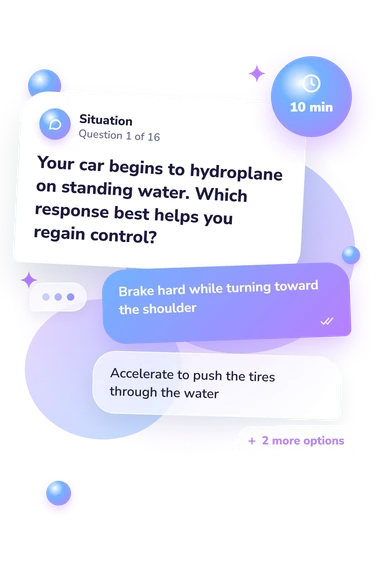
Example Questions From the Test
- Brake hard while turning toward the shoulder
- Accelerate to push the tires through the water
- Ease off the accelerator and keep steering smooth
- Turn the wheel rapidly from side to side
- Come to a complete stop
- Yield to traffic before continuing
- Do not enter the roadway
- Slow down for a warning ahead
- At the headlights so you can track the vehicle precisely
- Toward the right edge of your lane while maintaining your path
- Into the rearview mirror until the vehicle passes
- Down at the dashboard until the glare is gone
DMV Quiz - Description and methodology of the test
For people deciding whether they are ready to begin driving, continue reviewing, or seek more study, the DMV Quiz offers a focused knowledge check. Its result helps show whether understanding is secure enough for the next step or whether particular areas deserve attention, while a driving quiz format keeps the assessment focused on concrete judgment. The result describes general knowledge rather than licensing eligibility.
What This Assessment Explores
Questions ask the respondent to choose the safest or most accurate response to familiar road situations. The themes cover traffic-control meanings, vehicle control, lane use, right-of-way, and hazard management. Learners preparing for a permit can use this permit quiz to refresh foundational knowledge, while drivers revisit uncertain rules.
The practical areas reflected in the questions include:
- Traffic-control recognition tests understanding of signs, signals, and lane markings.
- Vehicle control shows whether a response preserves stability during skids, hydroplaning, or a tire failure.
- Hazard and right-of-way judgment covers merging, following distance, pedestrians, crossings, glare, fatigue, and turning.
The displayed scale is DMV Knowledge (0-16). Its bands are Foundations to review (0-6), Developing knowledge (7-12), and Strong general knowledge (13-16). These labels show whether general road knowledge needs review, is developing, or is strong; they do not predict passing an official exam.
Methodology and Evidence Base
Each selected-response item presents alternatives, and the respondent chooses the safest or most accurate answer. The response-based result has no additional scoring rule specified. For driver education, the questionnaire functions as a driving test quiz, checking rule knowledge rather than vehicle handling.
Conceptually, the traffic-control content aligns with Hawkins, Womack, and Mounce (1995), whose study examined driver understanding of signs, signals, and pavement markings. Road-rule content also reflects guidance in California's driver handbook and the FHWA's MUTCD. The questionnaire is conceptually consistent with these sources, but it is not an adaptation or validated version of the cited instruments.
Safety items are consistent with the hazard-perception emphasis discussed by Scialfa and colleagues (2011), although this assessment uses text scenarios rather than a standardized video protocol. In driver education, this questionnaire can function as a drivers ed quiz and study signal, prompting respondents to check the relevant state handbook because local rules can differ. The online scoring has no established norms or standardization; familiarity with local rules and scenario interpretation can affect performance.
- H. Gene Hawkins Jr., Katie N. Womack, and John M. Mounce. Motorist Understanding of Traffic Control Devices: Study Results and Recommendations. Report No. FHWA/TX-9511261-4. Texas Transportation Institute, Texas A&M University, 1995.
- California Department of Motor Vehicles. California Driver's Handbook. DL 600, revised June 2025. State of California, 2025.
- Federal Highway Administration. Manual on Uniform Traffic Control Devices for Streets and Highways, 11th Edition with Revision 1 Incorporated. U.S. Department of Transportation, December 2025.
- Charles T. Scialfa, Micheline C. Deschênes, Jennifer Ference, Jessica Boone, Mark S. Horswill, and Mark Wetton. A hazard perception test for novice drivers. Accident Analysis & Prevention 43, no. 1 (2011): 204-208. 10.1016/j.aap.2010.08.010