
Cursive Quiz
How the Scales are Structured
Who Usually Takes This Test?
See How You Compare
Below is a preview of how scores are typically distributed across each scale.
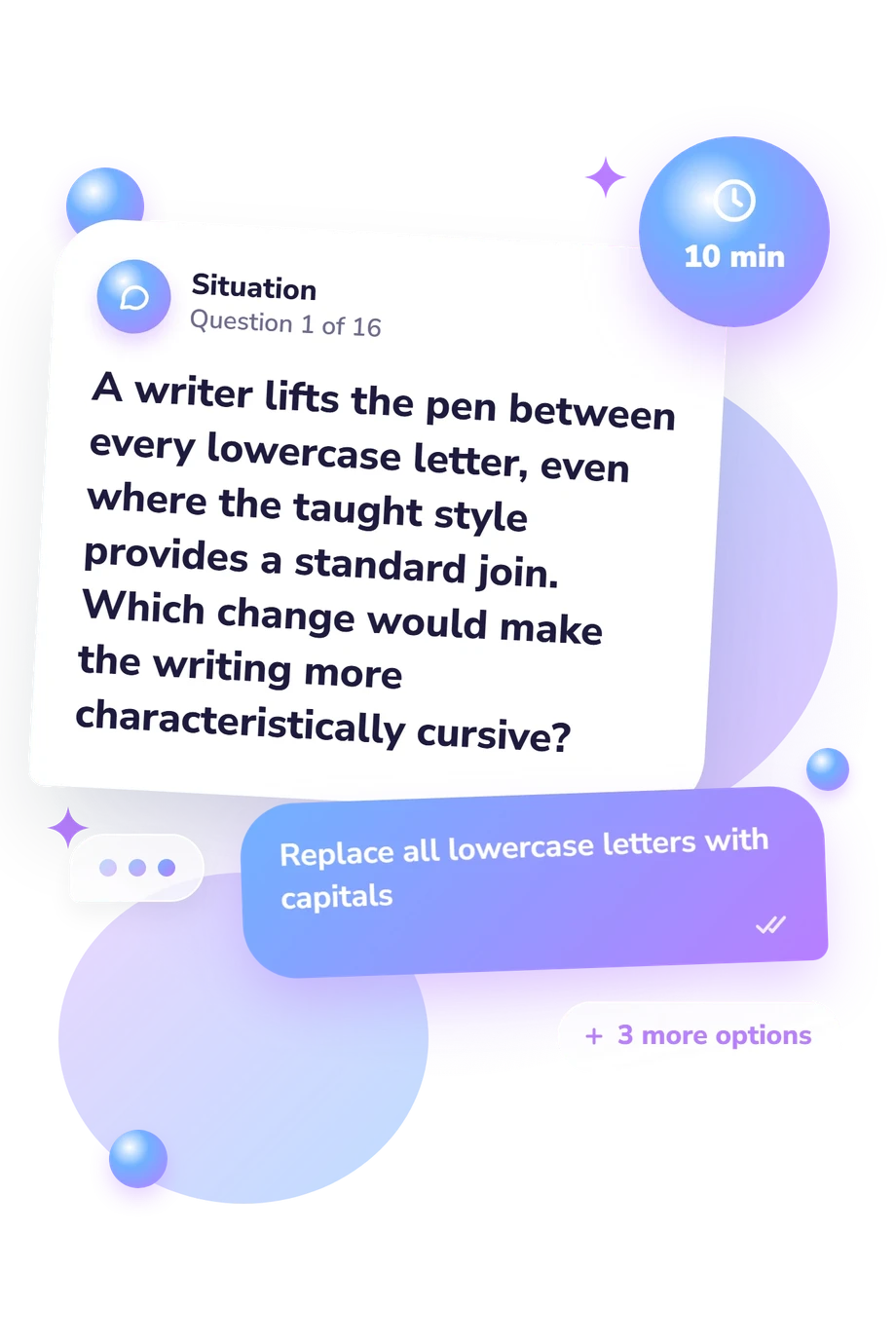
Example Questions From the Test
- Use larger flourishes whenever the rhythm slows
- Write at maximum speed and correct the shapes later
- Pause after every stroke to check its angle
- Maintain an even rhythm at a speed where letterforms remain clear
- Delayed strokes
- Baseline shifts
- Exit strokes
- Retraced joins
- A stroke that crosses another stroke
- A curved entry into the first letter of a word
- The part of a letter that extends below the baseline
- The upper loop of a tall lowercase letter
Cursive Quiz - Description and methodology of the test
People who want to understand how well they understand and apply basic cursive conventions can use this assessment as a focused starting point. For learners, teachers, and adults returning to handwriting, the cursive quiz connects familiar writing problems with a clear picture of current knowledge. As a cursive writing assessment, it helps identify which foundations deserve more deliberate practice without judging personal style or artistic flair.
What This Assessment Explores
Rather than rating penmanship as attractive or unattractive, this cursive knowledge quiz checks whether the respondent understands conventions that make writing connected, consistent, and readable. Its items cover terminology, letter construction, movement, and practical corrections, so the result describes knowledge of cursive principles rather than a full measure of motor skill.
The questions examine three connected areas:
- Letter anatomy identifies whether you can distinguish ascenders, descenders, baselines, loops, ligatures, and internal openings.
- Connections and movement show whether you recognize joins, entry and exit strokes, delayed strokes, and controlled rhythm.
- Spacing and writing control indicate how well you understand word separation, slant, arches, grip, pressure, fluency, and legibility.
The result is reported as Cursive Knowledge (0-16): Foundations to build (0-6), Developing knowledge (7-12), or Strong knowledge (13-16).
Methodology and Scientific Basis
Each item presents a handwriting situation or technical term with four answer choices. One point is awarded for each correct answer, so the total reflects recognition and application of principles rather than the visual quality of handwriting produced during the session.
The assessment is conceptually consistent with the 1980 Montgomery County Public Schools handwriting handbook, particularly its treatment of letter anatomy, joining, spacing, rhythm, and legibility. It is not presented as a digital edition or validated adaptation. Graham, Weintraub, and Berninger (1998) connect handwriting style with speed and legibility, while Graham and Weintraub (1996) review links among instruction, fluency, and readable production. Together, these sources provide context, not evidence that this questionnaire has the same psychometric properties as a published instrument.
For practical use, the cursive handwriting test is most useful when its result is paired with actual writing practice. A higher band indicates broader command of the tested principles, while a lower band points to concepts worth revisiting. The questionnaire has no stated norm-referenced sample, reliability estimate, or independent validation; attention, prior instruction, guessing, and current practice context can influence performance.
- Montgomery County Public Schools. Communicating Through Handwriting: A Handbook for Manuscript and Cursive Writing. Rockville, MD: Board of Education of Montgomery County, 1980. Developed by Jeanne H. Bruce, Smyrna N. Jackson, Nancy D. Martin, Jane Sheehan Riggott, and Doris G. Waiters under the direction of Sherene B. Webb.
- Graham, Steve; Weintraub, Naomi; Berninger, Virginia W. The Relationship Between Handwriting Style and Speed and Legibility. Journal of Educational Research, 91(5), 290-297, 1998. 10.1080/00220679809597556
- Graham, Steve; Weintraub, Naomi. A Review of Handwriting Research: Progress and Prospects from 1980 to 1994. Educational Psychology Review, 8(1), 7-87, 1996. 10.1007/BF01761831
Updated: