
BV or Yeast Infection Quiz
How the Scales are Structured
Who Usually Takes This Test?
See How You Compare
Below is a preview of how scores are typically distributed across each scale.
Example Questions From the Test
- An allergic reaction to Candida yeast
- A shift in the usual balance of vaginal bacteria
- A viral infection limited to the cervix
- A urinary infection that spreads to the vagina
- Mild external itching
- A change in discharge texture
- Fever with significant pelvic or lower-abdominal pain
- An odor that becomes more noticeable at certain times
- Marked external itching with skin cracking
- Thin grayish or white discharge with a fishy odor
- Thick, clumpy discharge with little odor
- Painful blisters accompanied by fever
BV or Yeast Infection Quiz - Description and methodology of the test
People with vaginal itching, discharge, odor, or treatment questions may use a bv or yeast infection quiz to organize what they know before deciding on next steps. It is intended for readers who want clearer distinctions between common symptom patterns, testing needs, and warning signs. Framed as a do i have a yeast infection quiz, this self-check supports focused learning rather than a guess based on one symptom.
What This Assessment Explores
This questionnaire tests how BV and yeast can overlap. Its result reflects understanding of symptoms, context, and testing.
It covers:
- Symptom patterns show how itching, discharge, odor, and pH can point in different directions.
- Causes and context cover bacterial balance, Candida overgrowth, antibiotics, douching, and sexual activity.
- Testing and treatment explain when self-care may be unsuitable, especially with recurrence, pregnancy, or severe symptoms.
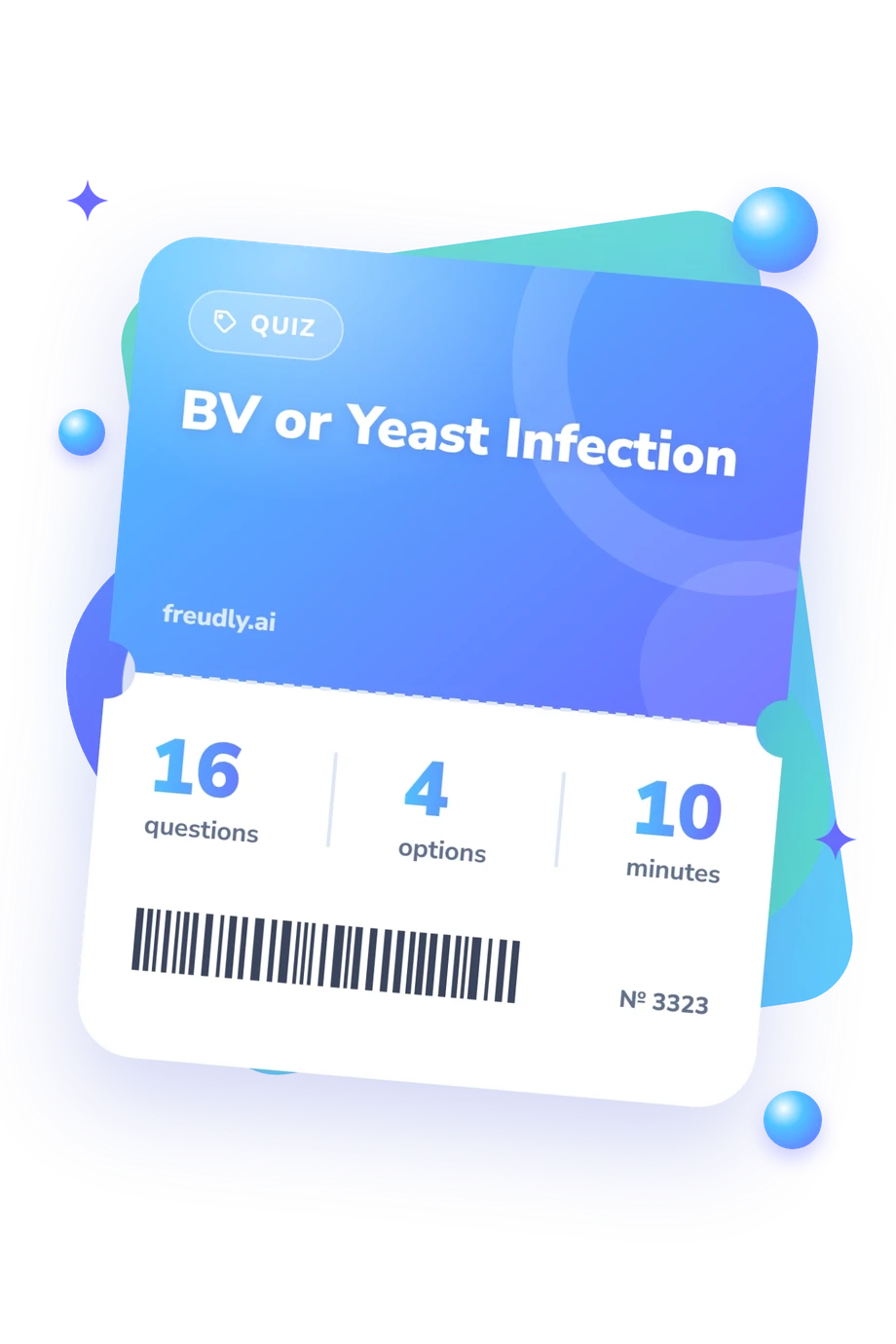
It can function as a quiz built around the question do I have BV or a yeast infection, helping identify whether self-treatment might miss another condition. The BV and Yeast Infection Knowledge scale runs from 0-16: Foundation to build (0-6), Developing knowledge (7-12), and Strong knowledge (13-16). The bands are unvalidated educational summaries, not clinical cutoffs.
Methodology and Scientific Basis
Each item presents a vaginal-health scenario or factual question with four answer choices. The alternatives test whether the respondent can separate typical patterns from claims that one symptom proves a cause. The displayed result is a knowledge total: it reflects correct responses across the questionnaire, but the stated range does not establish an item-level weighting rule.
As a yeast infection quiz, this assessment tests recognition of symptom overlap rather than symptom severity. The content is conceptually consistent with Sherrard et al. (2018), which emphasizes context and appropriate testing for vaginal discharge, but this questionnaire is not an adaptation of that guideline. Amsel et al. (1983) supports considering discharge, odor, pH, and related findings in BV. Workowski et al. (2021) supports attention to sexually transmitted infections, treatment, and pregnancy-related care.
As an online self-report knowledge check, it is not a standardized diagnostic instrument, and recall, interpretation, and current anxiety can affect responses, so results cannot establish or exclude infection. Persistent, recurrent, worsening symptoms, fever, or significant pelvic pain call for clinical assessment.
- Sherrard J, Wilson J, Donders G, Mendling W, Jensen JS. 2018 European (IUSTI/WHO) International Union against sexually transmitted infections (IUSTI) World Health Organisation (WHO) guideline on the management of vaginal discharge. International Journal of STD & AIDS. 2018;29(13):1258-1272. 10.1177/0956462418785451
- Amsel R, Totten PA, Spiegel CA, Chen KCS, Eschenbach D, Holmes KK. Nonspecific vaginitis. Diagnostic criteria and microbial and epidemiologic associations. The American Journal of Medicine. 1983;74(1):14-22. 10.1016/0002-9343(83)91112-9
- Workowski KA, Bachmann LH, Chan PA, Johnston CM, Muzny CA, Park I, Reno H, Zenilman JM, Bolan GA. Sexually Transmitted Infections Treatment Guidelines, 2021. MMWR Recommendations and Reports. 2021;70(4):1-187. 10.15585/mmwr.rr7004a1
Updated: