
Bias Test
How the Scales are Structured
Who Usually Takes This Test?
See How You Compare
Below is a preview of how scores are typically distributed across each scale.
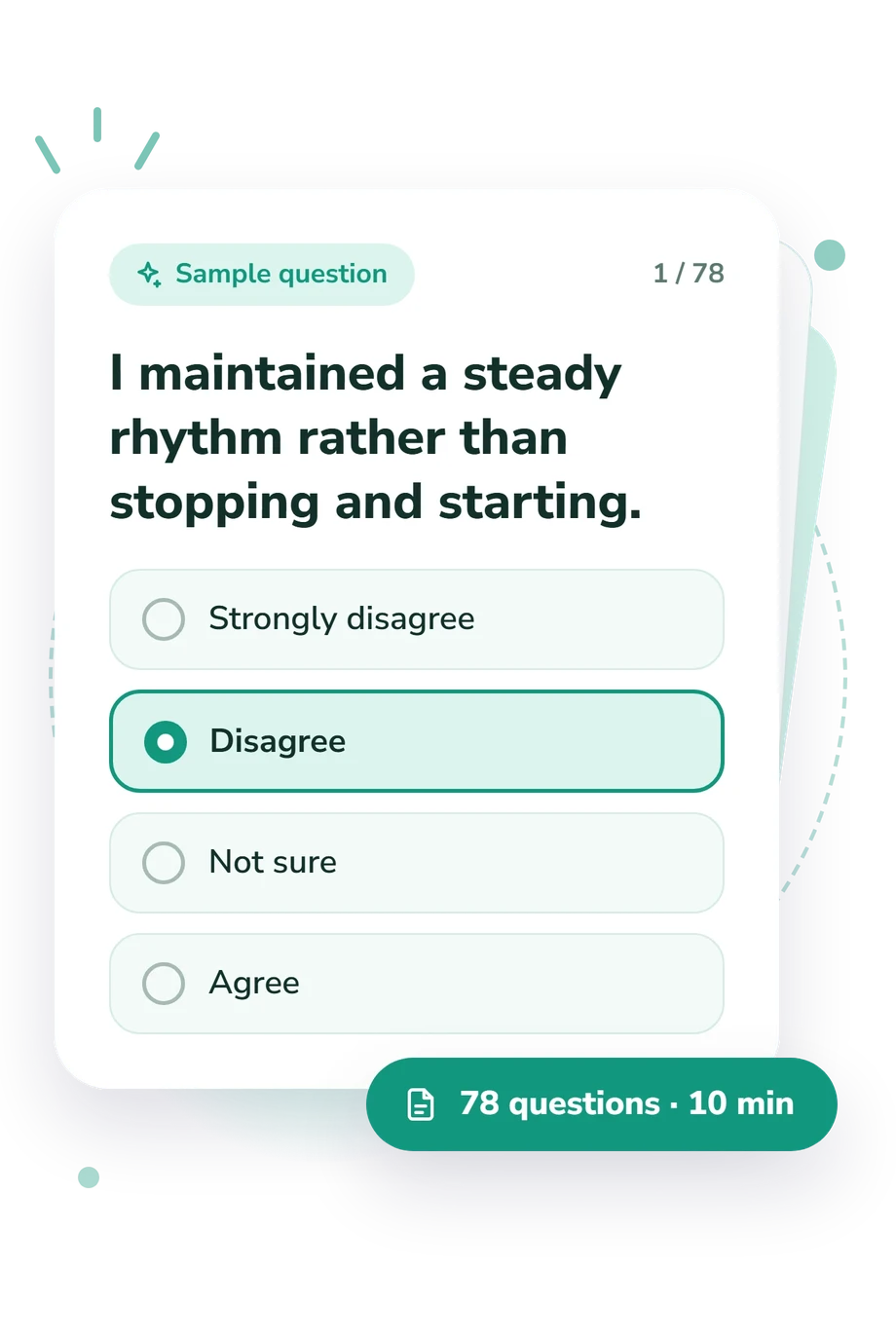
Example Questions From the Test
- Strongly disagree
- Disagree
- Not sure
- Agree
- Never
- Sometimes
- Often
- Almost always
- Strongly disagree
- Disagree
- Not sure
- Agree
Bias Test - Description and methodology of the test
For readers who want to examine how automatic associations may appear in speeded categorization, the bias test offers a structured self-report profile rather than a judgment of character. It may suit someone considering a test for unconscious bias as a prompt for reflection on performance, attention, and learned associations. The result separates directional tendency from response stability, helping you decide what to explore further.
What This Assessment Explores
The items address paired-categorization difficulty: easier versus harder pairings, switching disruption, speed differences, errors, pauses, and attention. Ordered options cover agreement, frequency, and intensity. A bias quiz summarizes perceived automatic responding rather than deliberate beliefs.
The displayed result has three dimensions:
- Bias Strength (Absolute), 0-2, shows magnitude regardless of direction; higher values indicate a stronger association. Low 0.0-0.66, Moderate 0.67-1.33, High 1.34-2.0.
- IAT D-Score, -2-2, shows direction and strength: Negative association -2.0 to -0.1, Little to no measurable preference -0.1 to 0.1, Positive association 0.1 to 2.0.
- Response Consistency, 0-100, shows stability; higher values suggest less noise. Low consistency 0-33, Moderate consistency 34-66, High consistency 67-100.
An unconscious bias quiz is best read as a profile of performance conditions, not a permanent statement about identity.
Methodology and Scientific Basis
Methodologically, this questionnaire is conceptually consistent with the Implicit Association Test (Greenwald et al., 1998), which compares performance across differently paired categories. Here, respondents rate statements about perceived speed, effort, disruption, and consistency instead of completing a laboratory key-press task. It is therefore an IAT-style self-report profile, not a direct administration of the published procedure.
The ordered choices support graded answers, but the wording does not establish a universal point value for every response. D-score terminology follows the scoring logic clarified by Greenwald, Nosek, and Banaji (2003), separating direction from magnitude; the consistency output adds information about response noise. Because this format is not a standardized administration or normed clinical instrument, its bands are descriptive categories rather than population norms.
Research on the original IAT is influential, yet interpretation remains debated. Schimmack (2021) notes construct-validity concerns, including uncertainty about what an individual IAT effect represents. Attention, distraction, category familiarity, expectations, and self-report accuracy can shape the result. An unconscious bias quiz should support structured reflection, not serve as a diagnosis or proof of conscious prejudice.
- Greenwald, A. G., McGhee, D. E., & Schwartz, J. L. K. (1998). Measuring individual differences in implicit cognition: The implicit association test. Journal of Personality and Social Psychology, 74(6), 1464-1480. 10.1037/0022-3514.74.6.1464
- Greenwald, A. G., Nosek, B. A., & Banaji, M. R. (2003). Understanding and using the Implicit Association Test: I. An improved scoring algorithm. Journal of Personality and Social Psychology, 85(2), 197-216. 10.1037/0022-3514.85.2.197
- Schimmack, U. (2021). The Implicit Association Test: A method in search of a construct. Perspectives on Psychological Science, 16(2), 396-414. 10.1177/1745691619863798
Updated: