
Am I Obsessive Quiz
How the Scales are Structured
Who Usually Takes This Test?
See How You Compare
Below is a preview of how scores are typically distributed across each scale.
Example Questions From the Test
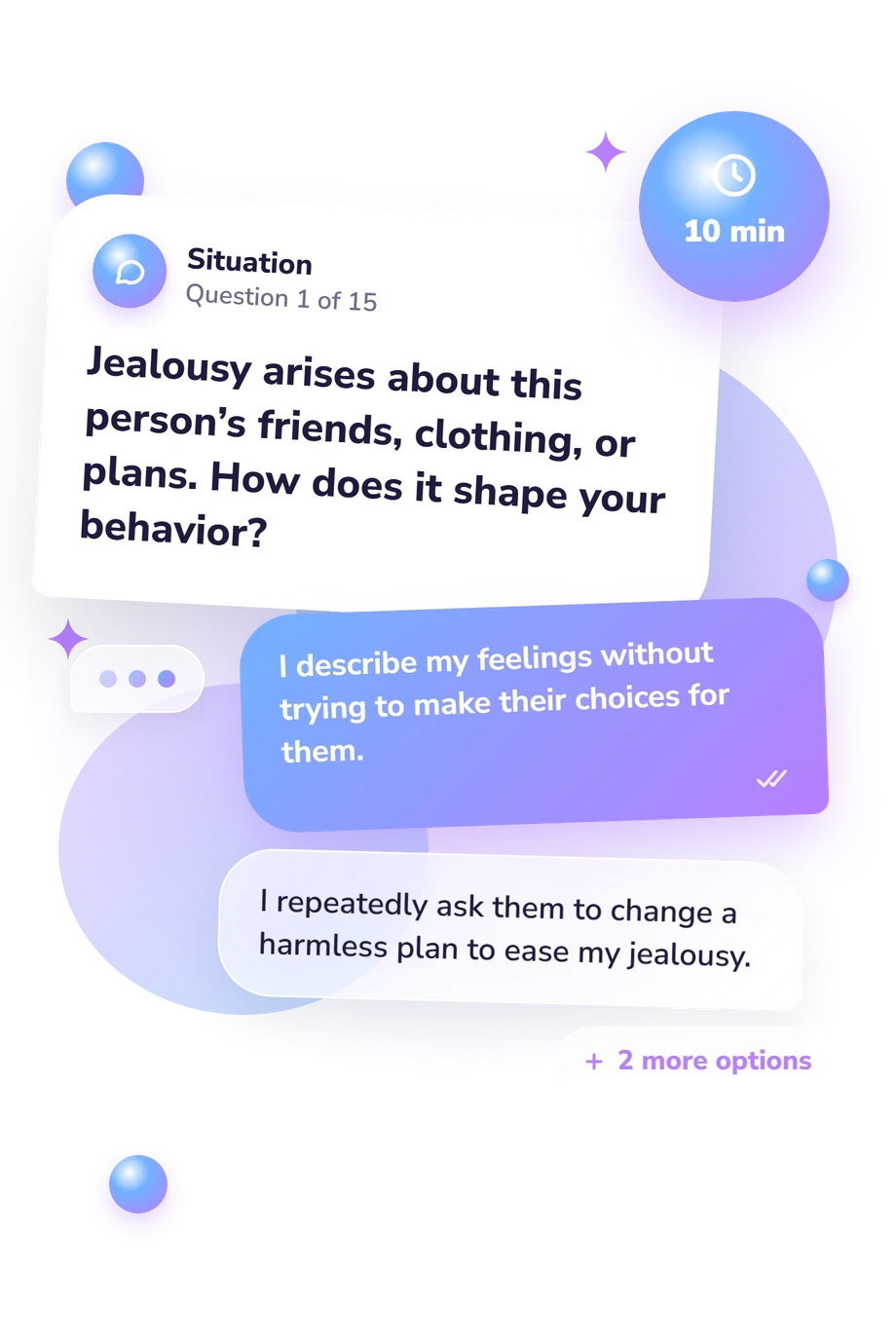
- I describe my feelings without trying to make their choices for them.
- I repeatedly ask them to change a harmless plan to ease my jealousy.
- I pressure them to reduce contact, change clothing, or report their activities to me.
- I intimidate, physically block, restrain, or punish them for making their own choice.
- I can tolerate the uncertainty without repeatedly reviewing it.
- I replay a conversation longer than I want to.
- I repeatedly search for signs or ask others for reassurance.
- I feel unable to settle until I have certainty, even after receiving reassurance.
- I continue meeting my important responsibilities.
- I delay minor tasks because I am thinking, checking, or waiting.
- I miss deadlines, classes, shifts, or essential duties because of it.
- My job, education, housing, or another essential responsibility has been seriously jeopardized.
Am I Obsessive Quiz - Description and methodology of the test
People who are unsure whether romantic preoccupation is becoming intrusive can use the Am I Obsessive Quiz to organize what they notice about attention, distress, contact, and respect for another person’s limits. It is an obsession quiz for readers who want a structured starting point for self-reflection. The result highlights patterns worth examining in daily life and relationships.
What This Assessment Explores
The questions examine romantic fixation through jealousy, checking, rejection, contact after boundaries, and certainty-seeking. They cover effects on responsibilities, sleep, eating, social connection, and emotional stability. It suits anyone reflecting on unwanted preoccupation or escalating contact.
The displayed result separates three dimensions:
- Boundaries and Control (0-15) reflects pressure, monitoring, coercion, threats, or difficulty accepting limits; Not endorsed 0, Worth addressing 1-2, Action warranted 3-15.
- Daily Wellbeing Impact (0-15) reflects effects of romantic distress on functioning or emotional stability; Not endorsed 0, Worth noticing 1-2, Action warranted 3-15.
- Intrusive Romantic Preoccupation (0-15) reflects unwanted thoughts, checking, memories, or imagined scenes that occupy attention; Not endorsed here 0, Worth noticing 1-2, Action warranted 3-15.
Together, these scales separate conduct affecting others from the respondent’s distress. They address whether preoccupation is becoming obsessive-the question an are you obsessed quiz poses-without reducing the result to a yes-or-no label.
Methodology and Scientific Basis
Each item is a self-report scenario with four response choices, moving from manageable reactions toward persistent, disruptive, coercive, or dangerous behavior. Responses are grouped into three scale totals, so this romantic preoccupation test distinguishes intrusive thoughts from wellbeing effects and boundary-related conduct. The questionnaire does not specify a point value for each response or population norms, so the displayed bands are reflective rather than validated clinical cutoffs; they indicate patterns, not severity ratings.
The SORI-Q is a relevant conceptual reference for stalking and obsessive relational intrusion. This questionnaire is conceptually consistent with it, not presented as a direct adaptation. Senkans and colleagues’ 2016 work contextualizes relational rumination, while Cupach and Spitzberg’s 2000 work supports attention to unwanted pursuit, perceived intrusiveness, and coping.
Any score-3 red flag warrants action regardless of the total; seek urgent help if the respondent or another person may be in immediate danger. Answers may shift with distress, memory, self-awareness, or a wish to minimize or justify behavior, so use the profile to identify issues needing closer reflection.
- Gamache, Dominick, Claudia Savard, Jonathan Faucher, and Marie-Ève Cloutier. (2022). Development and Validation of the Stalking and Obsessive Relational Intrusions Questionnaire (SORI-Q). Journal of Interpersonal Violence, 37(21-22), NP19420-NP19446. 10.1177/08862605211042808
- Senkans, Svenja, Troy E. McEwan, Jason Skues, and James R. P. Ogloff. (2016). Development of a Relational Rumination Questionnaire. Personality and Individual Differences, 90, 27-35. 10.1016/j.paid.2015.10.032
- Cupach, William R., and Brian H. Spitzberg. (2000). Obsessive Relational Intrusion: Incidence, Perceived Severity, and Coping. Violence and Victims, 15(4), 357-372. 10.1891/0886-6708.15.4.357
Updated: