
Am I Manic Quiz
How the Scales are Structured
Who Usually Takes This Test?
See How You Compare
Below is a preview of how scores are typically distributed across each scale.
Example Questions From the Test
- Not at all
- A little
- Quite a bit
- Extremely
- Not at all true
- A little true
- Mostly true
- Very true
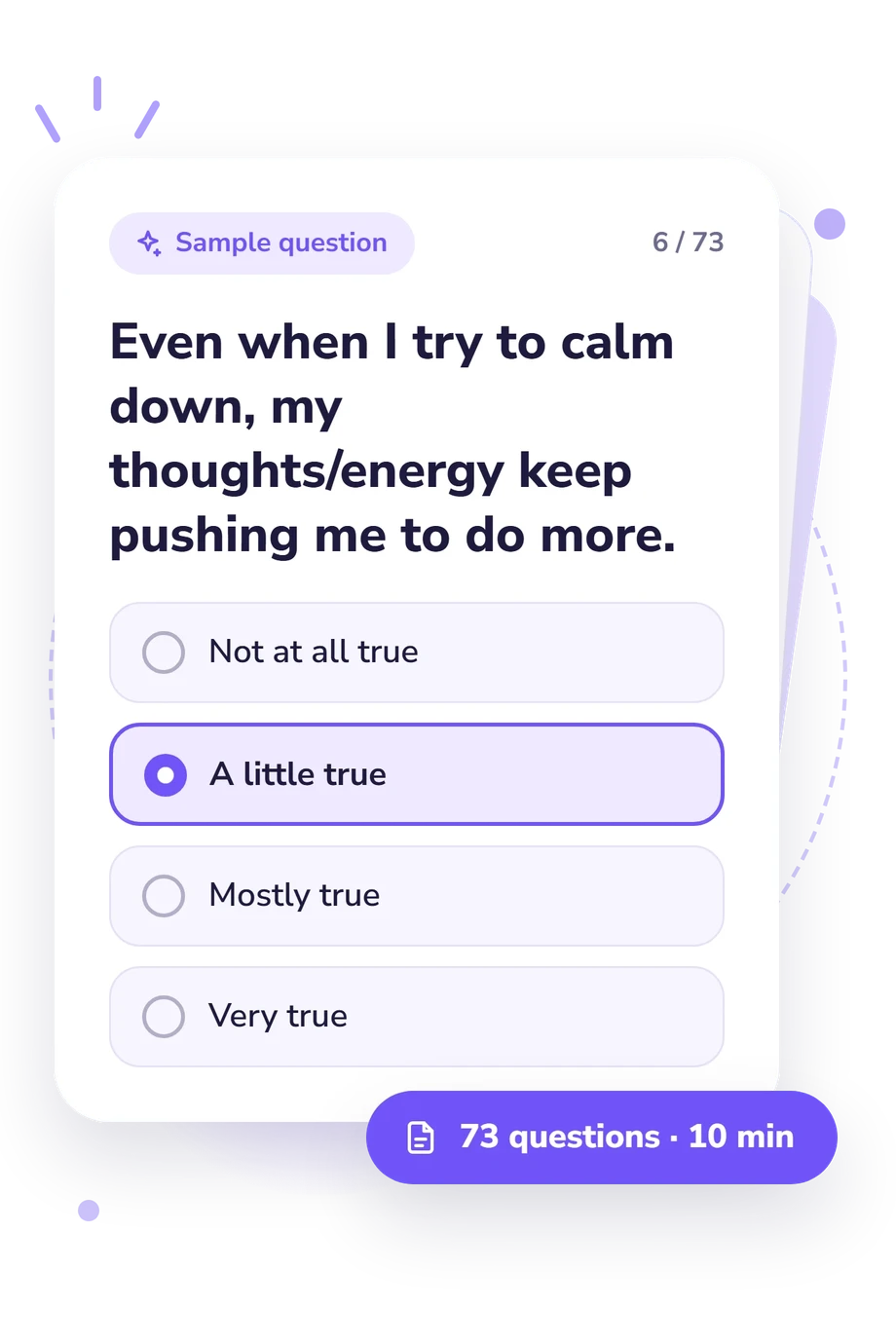
- Not at all true
- A little true
- Mostly true
- Very true
Am I Manic Quiz - Description and methodology of the test
To clarify what deserves attention and what kind of next step may fit, the Am I Manic Quiz organizes responses into a profile of symptom intensity, impulsivity, and functional impact. It focuses on changes from a person’s usual pattern, including experiences that may initially feel productive but begin to affect judgment, relationships, responsibilities, or safety. Used as a mania test, this questionnaire can help frame a conversation with a professional.
What This Assessment Explores
The questionnaire focuses on recent changes in mood, energy, sleep, judgment, and activity, including irritability, racing thoughts, intense goal pursuit, risky choices, and difficulty slowing down. It also asks whether these changes disrupt responsibilities or relationships. When recent manic symptoms are concerning, the result organizes patterns rather than judging one answer.
The result separates three dimensions:
- Functional Impact & Control (0-20) shows disruption to daily functioning, relationships, judgment, and self-control; Low impact 0-6, Moderate impact 7-13, High impact 14-20.
- Impulsivity & Risk-Taking (0-20) reflects unusual or out-of-character spending, driving, substance-related, sexual, financial, or thrill-seeking risks; Low 0-6, Moderate 7-13, High 14-20.
- Mania/Hypomania Symptom Severity (0-30) reflects intensity and frequency of elevated or irritable mood, reduced need for sleep, racing thoughts, and increased activity; Low 0-10, Moderate 11-20, High 21-30.
Methodology and Scientific Basis
Each item uses an ordered response set, such as Not at all to Extremely, Never to Very often, or Strongly disagree to Strongly agree. Some questions refer to the past two weeks; others ask whether behavior is unusual, difficult to control, or followed by consequences.
Answers are combined into displayed dimension scores. Higher results indicate more intense symptoms, greater risk-taking, or greater disruption in the relevant domain. As an online self-report questionnaire, it organizes responses to mania symptoms into a pattern. Its displayed bands are questionnaire result categories.
Its symptom content is conceptually consistent with the Mood Disorder Questionnaire and the Altman Self-Rating Mania Scale. The questionnaire is not an adaptation of either instrument. The DSM-5-TR provides a clinical framework, while self-report remains sensitive to memory, current stress, insight, substances, sleep, medical factors, and personal baseline. The result alone does not establish a diagnosis; worsening safety or control warrants prompt professional help.
- Hirschfeld, R. M. A., Williams, J. B. W., Spitzer, R. L., Calabrese, J. R., Flynn, L., Keck, P. E., Jr., Lewis, L., McElroy, S. L., Post, R. M., Rapport, D. J., Russell, J. M., Sachs, G. S., and Zajecka, J. (2000). Development and validation of a screening instrument for bipolar spectrum disorder: The Mood Disorder Questionnaire. American Journal of Psychiatry, 157(11), 1873-1875. 10.1176/appi.ajp.157.11.1873
- Altman, E. G., Hedeker, D., Peterson, J. L., and Davis, J. M. (1997). The Altman Self-Rating Mania Scale. Biological Psychiatry, 42(10), 948-955. 10.1016/S0006-3223(96)00548-3
- American Psychiatric Association. (2022). Diagnostic and Statistical Manual of Mental Disorders, Fifth Edition, Text Revision (DSM-5-TR). American Psychiatric Association Publishing. 10.1176/appi.books.9780890425787
Updated: