
Am I Human Quiz
How the Scales are Structured
Who Usually Takes This Test?
See How You Compare
Below is a preview of how scores are typically distributed across each scale.
Example Questions From the Test
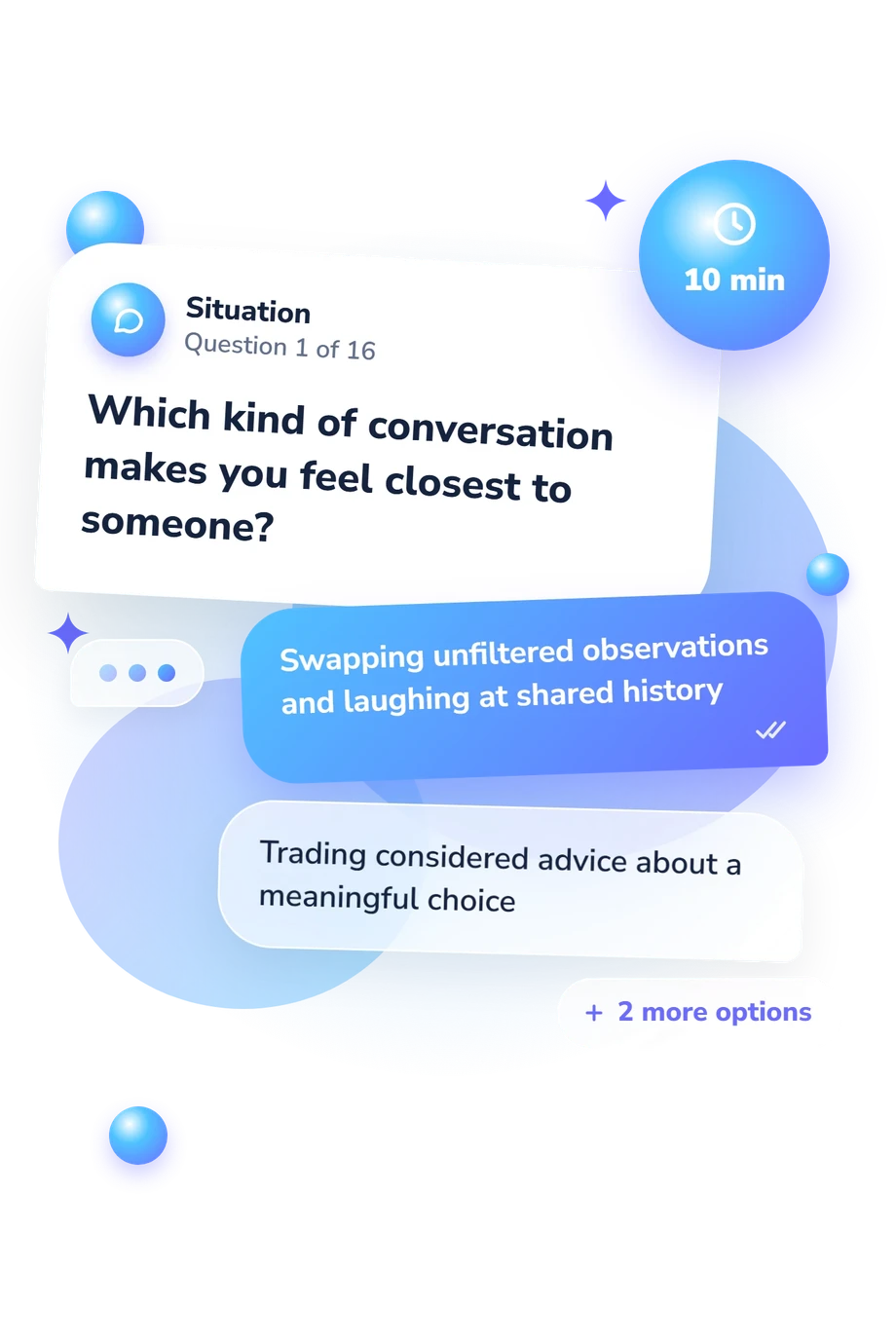
- Swapping unfiltered observations and laughing at shared history
- Trading considered advice about a meaningful choice
- Listening to stories that reveal where they came from
- Doing something new together with little need for discussion
- Keep the original downtime and let everyone recharge
- Return to a favorite place the family already knows
- Offer two nearby options and see which gains interest
- Turn it into an unplanned outing somewhere new
- Make sure the essential comforts and logistics are covered
- Plan a loose welcome and adjust once everyone arrives
- Focus on activities that will make the visit memorable
- Think of a few conversation topics everyone could enjoy
Am I Human Quiz - Description and methodology of the test
People curious about their everyday relationship style can use this questionnaire to reflect on how they approach family relationships and what helps closeness feel natural. The Am I Human Quiz turns ordinary family scenarios into a practical question: how do your usual choices shape conversations, support, and shared time with relatives? As an are you human quiz, it suits anyone seeking a fresh prompt for self-reflection about family interactions.
What This Assessment Explores
Family choices reveal four relative-style affinities; close scores blend.
Together, these dimensions make this a human connection quiz:
- The Adventurous Cousin (0-12) reflects affinity with a relative bringing novelty, flexible plans, and fresh connections: Familiar-rhythm companion (0-4) prefers routine; Flexible explorer (5-8) welcomes fitting novelty; Adventurous catalyst (9-12) creates momentum.
- The Candid Sibling (0-12) reflects affinity with a relative bonding through honesty and banter: Diplomatic connector (0-4) favors tact; Selectively candid (5-8) needs trust; Straight-talking ally (9-12) gives frank feedback.
- The Steady Caregiver (0-12) reflects affinity with a relative offering practical care and stability: Independent presence (0-4) stays independent; Situational supporter (5-8) helps as needed; Grounding caregiver (9-12) gives dependable reassurance.
- The Storytelling Grandparent (0-12) reflects affinity with a relative connecting through stories, tradition, and perspective: Present-focused voice (0-4) favors now; Thoughtful keeper (5-8) draws on history; Storytelling guide (9-12) preserves context.
Methodology and Evidence Base
Each item presents a family situation with four possible reactions. The choices make this an am i human or something else quiz, covering conversation, planning, practical support, tension, traditions, stories, and novelty. Four reactions to each situation turn everyday preferences into the four displayed affinity scores.
Responses are organized across four affinity scales. The result compares the four displayed scores: the highest is the strongest affinity, while any outcomes within one point of that score form a blended result. The bands then identify the connection pattern associated with each score range.
Its relational approach is conceptually consistent with the Network of Relationships Inventory (Furman & Buhrmester, 1985), which examined different provisions sought from different relationships. The 2009 Behavioral Systems Version offers a related framework for recurring relationship functions, while Vangelisti, Crumley, and Baker (1999) connect family narratives with relationship standards. The questionnaire is presented as a structured online reflection, not a standardized administration of those instruments. Because it relies on self-report, current context, self-awareness, and response bias can affect the profile.
- Furman, W., & Buhrmester, D. (1985). Children's perceptions of the personal relationships in their social networks. Developmental Psychology, 21(6), 1016-1024. 10.1037/0012-1649.21.6.1016
- Furman, W., & Buhrmester, D. (2009). The Network of Relationships Inventory: Behavioral Systems Version. International Journal of Behavioral Development, 33(5), 470-478. 10.1177/0165025409342634
- Vangelisti, A. L., Crumley, L. P., & Baker, J. L. (1999). Family Portraits: Stories As Standards for Family Relationships. Journal of Social and Personal Relationships, 16(3), 335-368. 10.1177/0265407599163004
Updated: