
Am I a Fascist Quiz
How the Scales are Structured
Who Usually Takes This Test?
See How You Compare
Below is a preview of how scores are typically distributed across each scale.
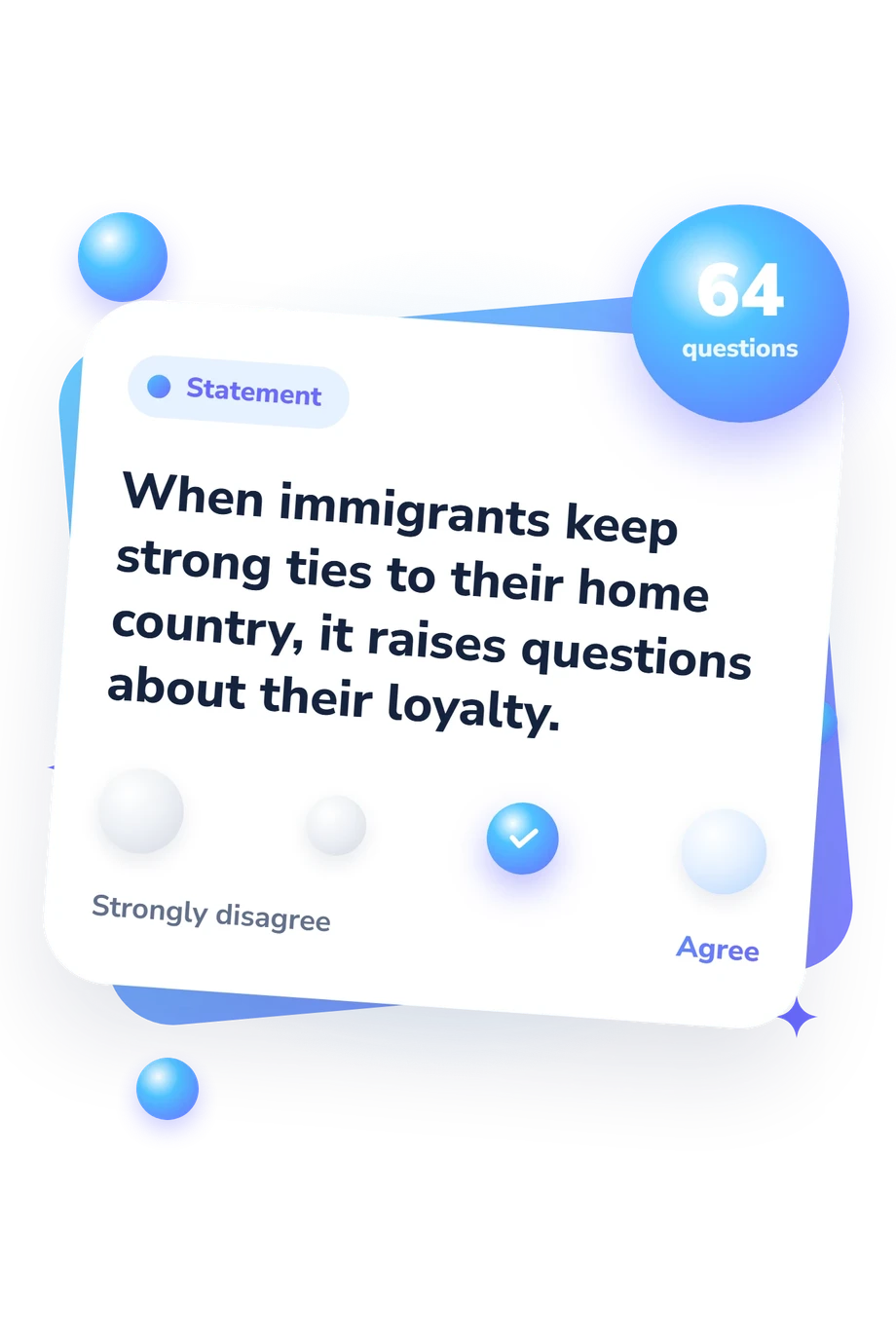
Example Questions From the Test
- Strongly disagree
- Disagree
- Not sure
- Agree
- Strongly disagree
- Disagree
- Not sure
- Agree
- Strongly disagree
- Disagree
- Not sure
- Agree
Am I a Fascist Quiz - Description and methodology of the test
People who want to examine their reactions to authority, civil liberties, and national belonging can use the Am Ia Fascist Quiz as a self-reflection exercise. It is intended for anyone curious about how they respond to contested political principles, rather than for assigning an identity from one response. Rather than identifying someone as fascist, this fascism test examines related political-attitude dimensions and reports authoritarian, democratic, or exclusionary tendencies.
What This Assessment Explores
This questionnaire examines political attitudes about authority, rights, national identity, and democratic limits. Its three-part result is a profile, not a single ideological label.
The displayed scales are:
- Authoritarianism (0-40) measures preference for strong leaders, obedience to authority, conformity, and restricting liberties for order; bands: Low 0-13, Moderate 14-26, High 27-40.
- Democratic Commitment (0-40) measures support for elections, rule of law, minority rights, free speech, and limits on power; bands: Low commitment 0-19, Moderate 20-29, High 30-40.
- Exclusionary Nationalism (0-40) measures in-group superiority, nativism, outsider blame, and “us versus them” politics; bands: Inclusive/Pluralistic 0-13, Mixed/Selective 14-26, Exclusionary/Ethnocentric 27-40.
Because this political values quiz examines both rights-supporting and restrictive views, its dimensions can coexist without being forced into one category. The result is a snapshot of expressed attitudes, not a permanent identity.
Methodology and Evidence Base
Items use four response options-Strongly disagree, Disagree, Not sure, or Agree-and cover themes including loyalty, authority, emergency powers, minority rights, free expression, legal limits, immigration, and national belonging. The result presents three displayed scores, and each score is assigned to its named band.
The conceptual reference is FAMID (Dunwoody et al., 2022), which links authoritarian politics with submission to authority, anti-democratic tendencies, and exclusionary nationalism. The questionnaire is conceptually consistent with FAMID, but this does not establish derivation, adaptation, or validation. Dunwoody and Funke’s three-factor authoritarianism model (2016) and Adorno et al. (1950) provide theoretical context for authority and conformity, not evidence of this questionnaire’s derivation, adaptation, or validation.
Authority-related items give this authoritarianism test specific content: they examine endorsement of obedience, hierarchy, and restrictions justified by order alongside the other dimensions. The online questionnaire is not presented as a standardized or validated instrument; its displayed bands are descriptive categories rather than universal cutoffs. A self-report result may shift with current events, interpretation, social desirability, and self-awareness; it describes expressed attitudes at completion, not a fixed identity.
- Dunwoody, Philip T., Joseph Gershtenson, Dennis L. Plane, and Territa Upchurch-Poole (2022). The fascist authoritarian model of illiberal democracy. Frontiers in Political Science, 4, 907681. 10.3389/fpos.2022.907681
- Dunwoody, Philip T., and Friedrich Funke (2016). The Aggression-Submission-Conventionalism Scale: Testing a New Three Factor Measure of Authoritarianism. Journal of Social and Political Psychology, 4(2), 571-600. 10.5964/jspp.v4i2.168
- Adorno, Theodor W., Else Frenkel-Brunswik, Daniel J. Levinson, and Nevitt Sanford (1950). The Authoritarian Personality. New York, NY: Harper & Brothers.
Updated: