
World's Hardest Quiz
How the Scales are Structured
Who Usually Takes This Test?
See How You Compare
Below is a preview of how scores are typically distributed across each scale.
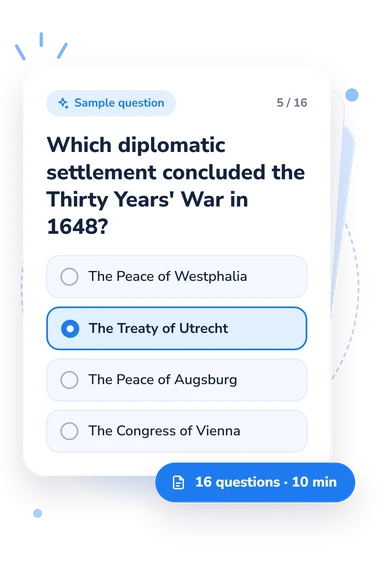
Example Questions From the Test
- Mr. Lockwood and Nelly Dean
- Edgar Linton and Isabella Linton
- Heathcliff and Catherine Earnshaw
- Hareton Earnshaw and Cathy Linton
- It would become four times larger
- It would be halved
- It would remain unchanged
- It would double
- Robert Nozick
- Jeremy Bentham
- John Rawls
- Jean-Paul Sartre
World's Hardest Quiz - Description and methodology of the test
For readers who want to test broad knowledge rather than one subject, the Worlds Hardest Quiz offers a concentrated challenge across unrelated fields. It suits students and curious adults who enjoy a general knowledge quiz that shifts between factual recall and applied reasoning; the result gives an overall indication of performance on the mixed-topic questions. The main challenge is switching subjects without losing precision, not measuring intelligence as a whole.
What This Assessment Explores
This assessment samples broad knowledge rather than mastery of one subject. Items mix recall with brief applications of rules or concepts, so the result reflects both knowledge and recognition of correct principles. The title's hardest quiz wording signals difficulty, but the score describes performance on these 16 mixed-topic questions rather than an external ranking.
The themes represented by the questions are:
- Science items show application of astronomy, chemistry, physics, and earth science.
- Literature and art items test recall of works, authors, narratives, and visual concepts.
- History and geography items measure knowledge of events, countries, settlements, and rivers.
- Mathematics, statistics, and logic items require concise rule-based reasoning.
Results are reported on one scale, World's Hardest Quiz Knowledge, scored 0-16. Building Foundation (0-6) leaves room to broaden knowledge; Formidable Range (7-12) indicates strong cross-field knowledge with specialist gaps; Exceptional Command (13-16) means at least 80% correct on this difficult test.
Methodology and Scientific Basis
Each question presents four answer choices, asking you to select the best-supported response rather than explain it. The mix requires retrieval, discrimination among plausible alternatives, and occasional calculation. The total is based on the number of correct answers, with one point assigned for each correct answer.
The format is conceptually consistent with Russian General-Knowledge Norms (Martín-Luengo et al., 2020), a project that normed general-knowledge items. Tauber et al. (2013) and the related but distinct BEFKI GC-K instrument (Schipolowski et al., 2013) offer context for general knowledge, but they do not establish that this questionnaire measures crystallized intelligence. These studies do not validate this exact online selection or establish its population norms, reliability, or clinical cutoffs.
The test is a bounded knowledge check, so its result should be read in relation to the specific mixed-topic items. Performance can vary with language, cultural familiarity, memory, guessing, and concentration. The mixed-topic quiz requires switching among subjects, so a higher score is best read as stronger performance on these items and a prompt for further learning.
- Martín-Luengo, B., Zinchenko, O., Alekseeva, M., & Shtyrov, Y. (2020). Russian Norms for 500 General-Knowledge Questions. Frontiers in Psychology, 11, 545304. 10.3389/fpsyg.2020.545304
- Tauber, S. K., Dunlosky, J., Rawson, K. A., Rhodes, M. G., & Sitzman, D. M. (2013). General knowledge norms: Updated and expanded from the Nelson and Narens (1980) norms. Behavior Research Methods, 45(4), 1115-1143. 10.3758/s13428-012-0307-9
- Schipolowski, S., Wilhelm, O., Schroeders, U., Kovaleva, A., Kemper, C. J., & Rammstedt, B. (2013). BEFKI GC-K: A Short Scale for the Measurement of Crystallized Intelligence. Methods, Data, Analyses, 7(2), 153-181. 10.12758/mda.2013.010