
History Quiz for Kids
How the Scales are Structured
Who Usually Takes This Test?
See How You Compare
Below is a preview of how scores are typically distributed across each scale.
Example Questions From the Test
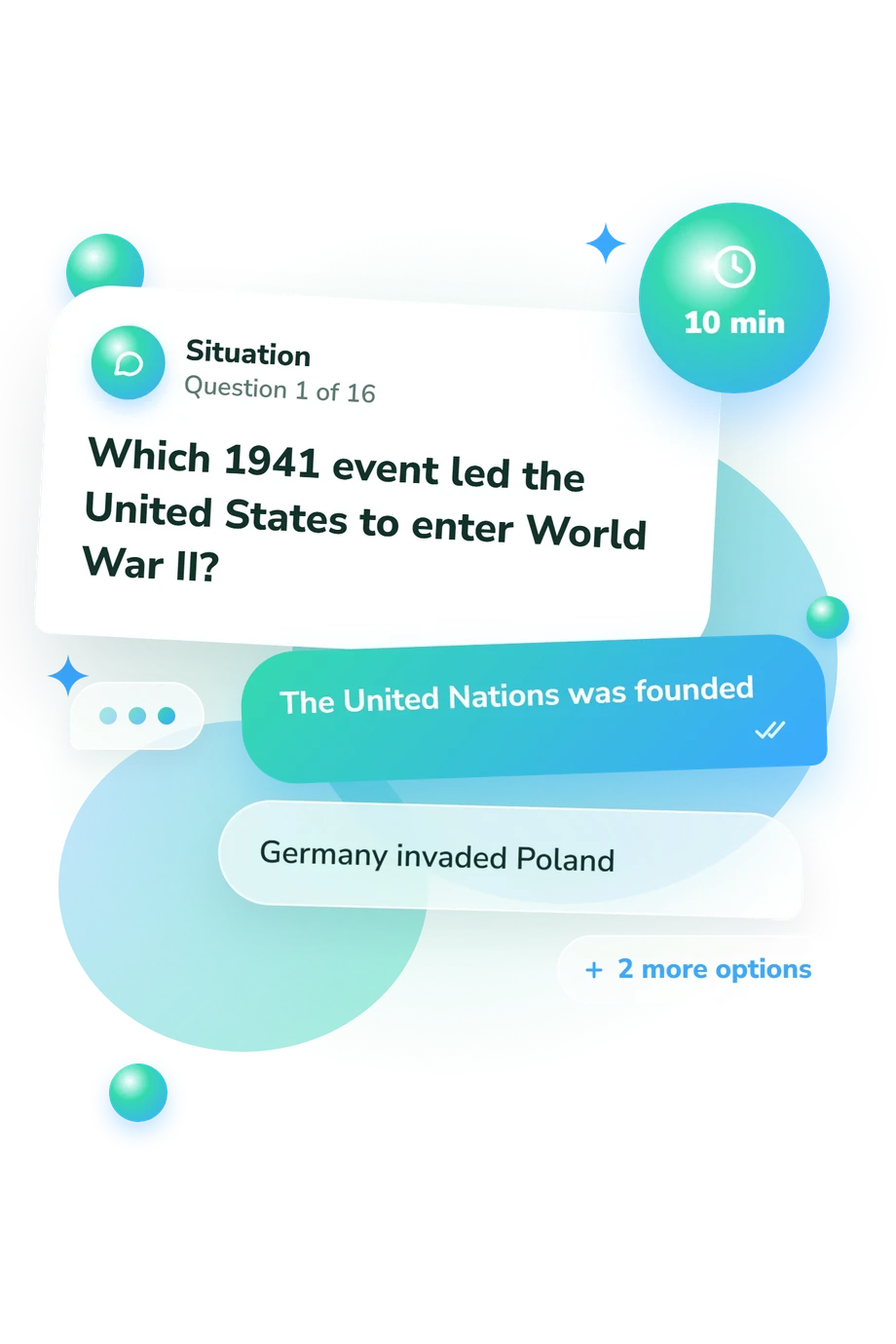
- The United Nations was founded
- Germany invaded Poland
- The Berlin Wall was built
- Japan attacked Pearl Harbor
- The Mayflower Compact
- The Emancipation Proclamation
- The Gettysburg Address
- The United States Constitution
- The purchase of Alaska
- The annexation of Texas
- The settlement of Oregon Country
- The Louisiana Purchase
History Quiz for Kids - Description and methodology of the test
For families, teachers, and young learners choosing a history quiz for kids, the main value is an overview of performance across questions about the people, documents, conflicts, and civic changes that shaped the United States. As a children's history quiz, it offers a focused way to review performance across the full set of questions. It suits home learning, classroom review, and shared discussion without requiring extended written answers.
What This Assessment Explores
The assessment is intended for children building a U.S. history timeline and adults seeking a learning check. It covers landmark events, constitutional ideas, influential people, amendments, court decisions, migration, transportation, and technological milestones. An American quiz for kids emphasizes recognition and connections rather than extended writing.
The questions group into three broad areas:
- Founding and government show recognition of independence, representation, constitutional design, and national institutions.
- Conflict and rights show how learners connect slavery, war, emancipation, citizenship, voting, and civil rights.
- Expansion and development show familiarity with territorial growth, migration, transportation, and major achievements.
The United States History Knowledge score runs from 0-16: Building Foundations (0-6) signals topics to review; Developing Historian (7-12) reflects a solid base with some periods to revisit; History Explorer (13-16) reflects strong knowledge of covered topics. It describes quiz performance, not overall ability.
Methodology and Scientific Basis
Each item presents a historical situation or direct question with four answer choices. In these history quiz questions and answers for kids, the learner identifies a best-supported response; prompts may link an event with a person, document, amendment, cause, or consequence.
Results are condensed into one total score and assigned to the displayed bands, which summarize performance across the quiz's content rather than broader historical ability.
Brophy, VanSledright, and Bredin (1993) provide a relevant comparison through their study of entering students' historical knowledge. The 2018 NAEP framework supplies broader dimensions-chronology, themes, context, and civics. Neither source validates this online quiz, which is not presented as an adaptation of either one. Mark D. Smith (2017) discusses what well-designed multiple-choice items can measure; here, the format mainly tests recognition and basic connections rather than extended source analysis.
Interpretation should stay tied to the topics. Performance can vary with schooling, reading demands, prior exposure, and guessing. Use it to choose review topics and guide discussion, not to rank overall historical ability.
- Jere Brophy, Bruce VanSledright, and Nancy Bredin (1993). What Do Entering Fifth Graders Know About U. S. History? The Journal of Social Studies Research, 16-17(1), 2-22. 10.1177/235227981993016001002
- National Assessment Governing Board (2018). 2018 NAEP U.S. History Framework. Washington, DC: National Assessment Governing Board.
- Mark D. Smith (2017). Cognitive Validity: Can Multiple-Choice Items Tap Historical Thinking Processes? American Educational Research Journal, 54(6), 1256-1287. 10.3102/0002831217717949
Updated: