
Wuthering Heights Quiz
How the Scales are Structured
Who Usually Takes This Test?
See How You Compare
Below is a preview of how scores are typically distributed across each scale.
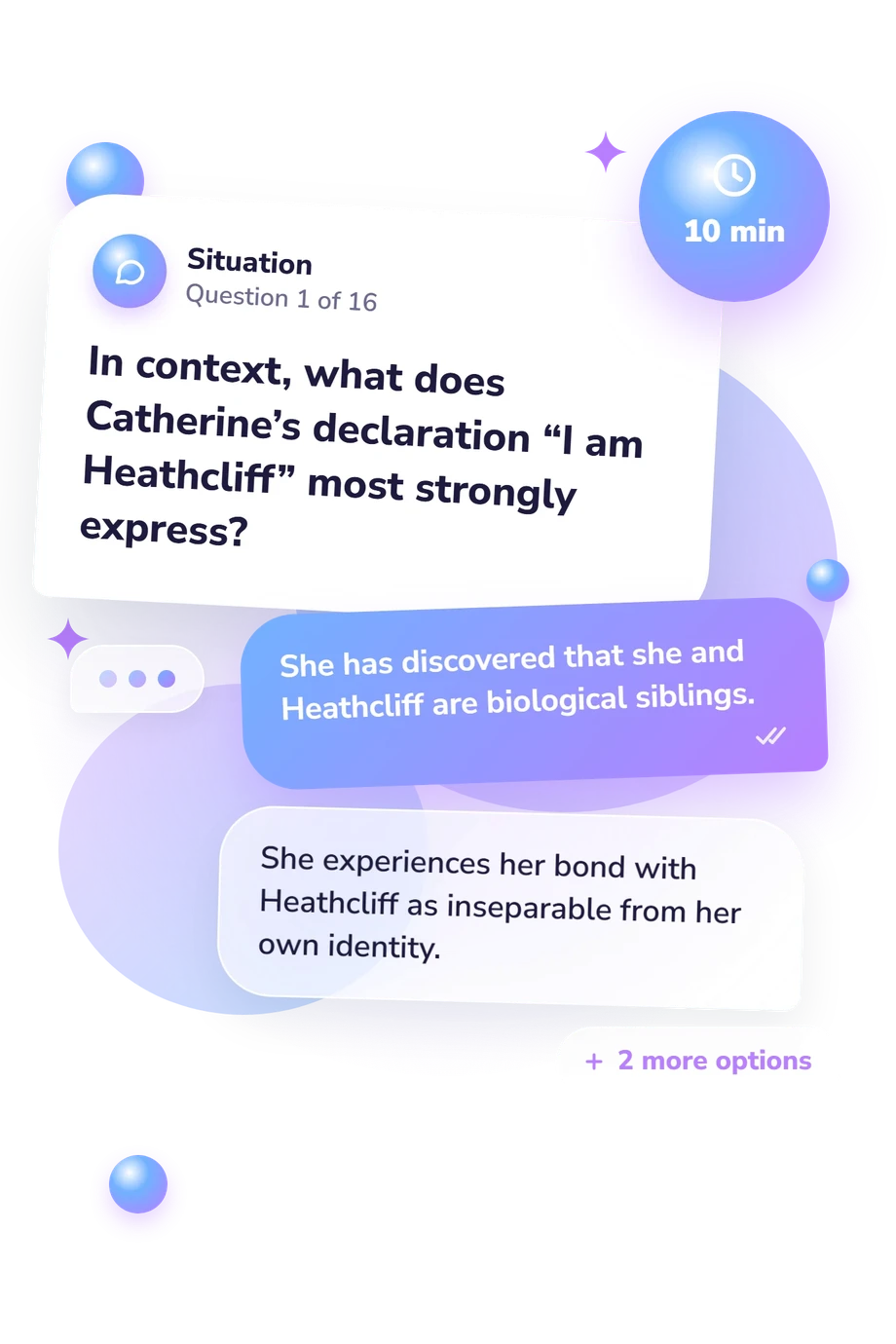
Example Questions From the Test
- The ghost of Frances Earnshaw
- The ghost of Isabella Linton
- The ghost of Catherine
- The ghost of Mr. Earnshaw
- Mr. Lockwood
- Hareton Earnshaw
- Edgar Linton
- Joseph
- Zillah
- Isabella Linton
- Catherine Earnshaw
- Nelly Dean
Wuthering Heights Quiz - Description and methodology of the test
Students, book-club members, and rereaders can use the Wuthering Heights Quiz to decide whether they want to revisit the novel’s narrative and themes before discussion or further study. As an Emily Brontë novel quiz, it focuses on this book rather than a broad literature test. The result points to areas of the book that may reward closer attention.
What This Quiz Measures
The assessment checks characters, family ties, events, settings, and narrative choices. Items ask why decisions matter, how generations affect one another, and what the novel suggests about identity, revenge, and reconciliation.
The result draws on three areas:
- Characters and relationships show how motives, marriages, and family lines connect.
- Plot and chronology show whether you recognize turning points and consequences.
- Structure and themes show how framing, settings, and conflicts shape meaning.
Across the quiz questions on Wuthering Heights, recall is connected with interpretation rather than names. That makes this useful for students, book-club members, and readers checking understanding after reading or rereading. The Wuthering Heights Knowledge scale runs from 0 to 16: Foundations to revisit (0-6) marks partial recognition; Developing command (7-12) reflects solid but incomplete understanding; Strong command (13-16) indicates accurate, well-rounded knowledge of plot, structure, relationships, and themes.
Methodology and Evidence Base
Each item presents four answer choices and asks for the best reading of a character, event, relationship, quotation, or formal feature. This fixed-choice literary knowledge quiz judges answers against the novel’s content: the respondent selects the option that fits the text rather than rating personal traits. The result summarizes performance on the selected content areas, not a personality profile.
The literary reference point is Wuthering Heights (Brontë, 1847). Bensoussan (2017) is relevant to its layered narration through Lockwood and Nelly, while McCarthy and O’Sullivan (2021) support the authorship detail concerning Emily Brontë and the name used at first publication. These works clarify the knowledge tested; the online questionnaire is not an adaptation of a validated psychological scale.
As a Wuthering Heights study quiz, it has no stated population norms or psychometric standardization. Its band describes performance on the selected domains, not intelligence, overall literary ability, or complete familiarity with the novel. Recent rereading, memory, and interpretation of ambiguous passages can affect results.
- Brontë, Emily. Wuthering Heights. London: Thomas Cautley Newby, 1847.
- Bensoussan, Natacha. "The Narrative Structure of Wuthering Heights: An Examination of Nelly Dean and Lockwood." Ellipsis: A Journal of Art, Ideas, and Literature, vol. 44, no. 1, 2017, article 24. 10.46428/ejail.44.24
- McCarthy, Rachel, and James O'Sullivan. "Who Wrote Wuthering Heights?" Digital Scholarship in the Humanities, vol. 36, no. 2, 2021, pp. 383-391. 10.1093/llc/fqaa031
Updated: