
Am I a Leader or a Follower Quiz
How the Scales are Structured
Who Usually Takes This Test?
See How You Compare
Below is a preview of how scores are typically distributed across each scale.
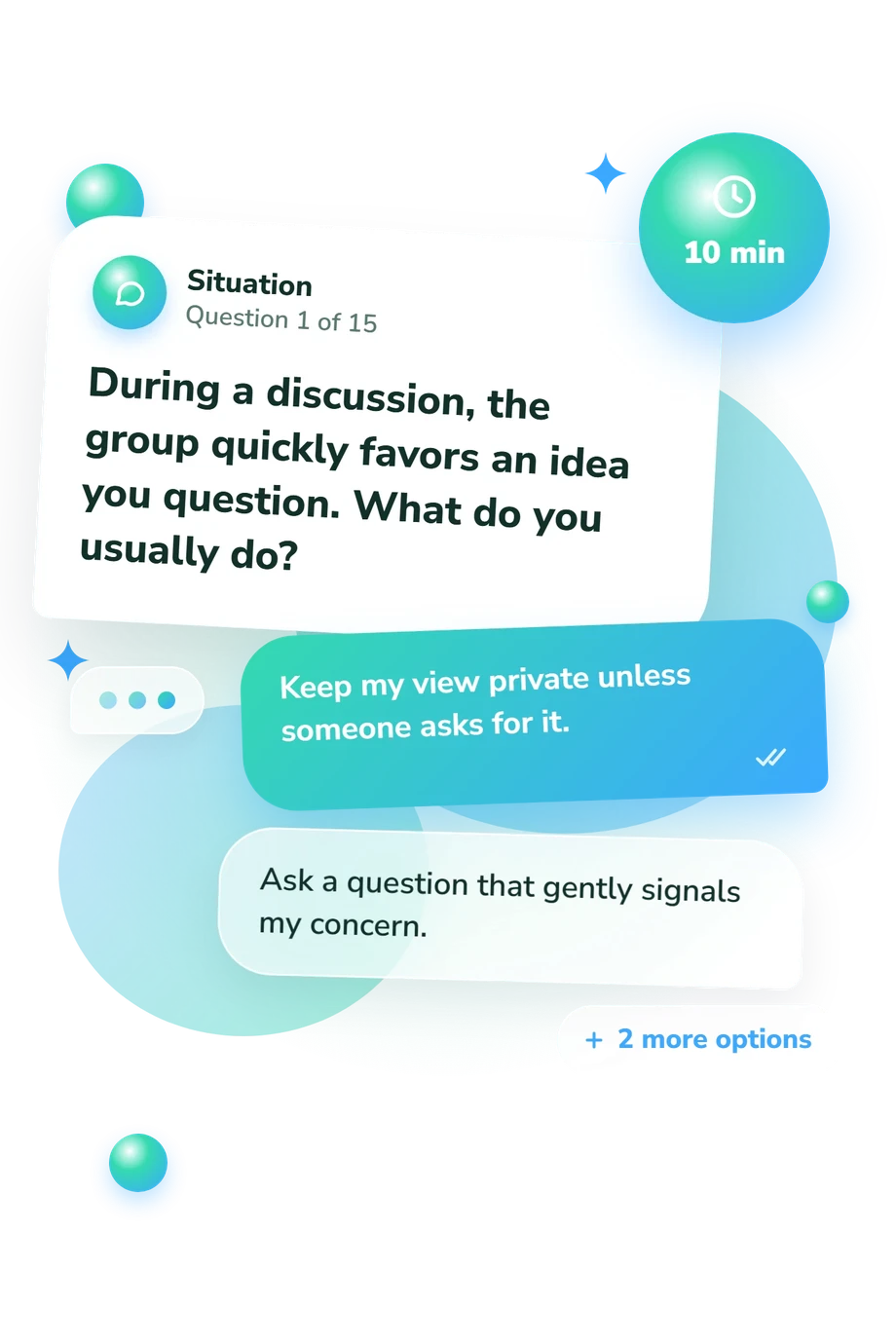
Example Questions From the Test
- Keep my view private unless someone asks for it.
- Ask a question that gently signals my concern.
- State my concern and give one clear reason for it.
- Make a fuller case and invite the group to test its assumptions.
- Prefer a clear role under someone who already knows the area.
- Observe how experienced people handle it before volunteering.
- Volunteer for a contained part and expand your role as you learn.
- Coordinate the first attempt while openly learning along the way.
- Adapt to whatever the others prefer.
- Share my preference if someone asks me directly.
- State my preference and explain why it could work for the group.
- Actively build enthusiasm for the option I think will work best.
Am I a Leader or a Follower Quiz - Description and methodology of the test
People who want to understand their place in group decisions can use the Am I a Leader or a Follower Quiz to examine preferred patterns of initiative, influence, and support. It suits students, colleagues, partners, and anyone reflecting on how responsibility shifts across different groups. Its scenarios invite reflection on your leadership style when a group needs direction, disagreement needs addressing, or coordinated support is needed.
What This Assessment Explores
This questionnaire looks beyond being in charge. Its scenarios explore responses when a group lacks direction, another person coordinates, your view meets resistance, or a plan needs support. The result describes self-reported tendencies in those situations, not a permanent identity, and can show why your role changes across groups.
The profile separates three dimensions:
- Initiative and Direction (0-15) shows how readily you create a path and take responsibility: Responsive Starter (0-5), Situational Initiator (6-10), or Direction Setter (11-15).
- Social Influence and Voice (0-15) shows how actively you shape decisions: Quiet Contributor (0-5), Selective Advocate (6-10), or Vocal Influencer (11-15).
- Support and Role Flexibility (0-15) shows how readily you strengthen another person’s direction: Autonomous Contributor (0-5), Flexible Partner (6-10), or Active Supporter (11-15). It reflects collaboration preference, not passivity or competence.
Methodology and Scientific Basis
Each situation offers four response options that move from holding back or adapting to stating a view, persuading others, or taking responsibility. The questionnaire examines reported choices in leadership scenarios rather than assigning a fixed leader identity. Results appear across the three dimensions separately, not as one score.
Carsten et al. (2010) is the closest conceptual reference because it treats followership as socially constructed and potentially active. Uhl-Bien et al. (2014) adds a relational and contextual view, while Kelley (1992) emphasizes judgment, self-direction, and contribution from people who are not formally in charge. The questionnaire is conceptually consistent with these works, but it is not an adaptation, standardized version, or validation of any of them.
Interpret the bands as descriptions of response tendencies, not population norms, fixed abilities, or clinical thresholds. A person may initiate with one group, support an expert in another, or change approach as confidence, stakes, and relationships shift. Because the format relies on self-report, answers can also reflect current circumstances, memory, self-awareness, and the wish to appear cooperative or assertive; compare the profile with observed behavior and lived group experience.
- Carsten, Melissa K., Mary Uhl-Bien, Bradley J. West, Jaime L. Patera, and Rob McGregor. (2010). Exploring social constructions of followership: A qualitative study. The Leadership Quarterly, 21(3), 543-562. 10.1016/j.leaqua.2010.03.015
- Uhl-Bien, Mary, Ronald E. Riggio, Kevin B. Lowe, and Melissa K. Carsten. (2014). Followership theory: A review and research agenda. The Leadership Quarterly, 25(1), 83-104. 10.1016/j.leaqua.2013.11.007
- Kelley, Robert E. (1992). The Power of Followership: How to Create Leaders People Want to Follow, and Followers Who Lead Themselves. New York: Doubleday/Currency.
Updated: