
AR Reading Quiz
How the Scales are Structured
Who Usually Takes This Test?
See How You Compare
Below is a preview of how scores are typically distributed across each scale.
Example Questions From the Test
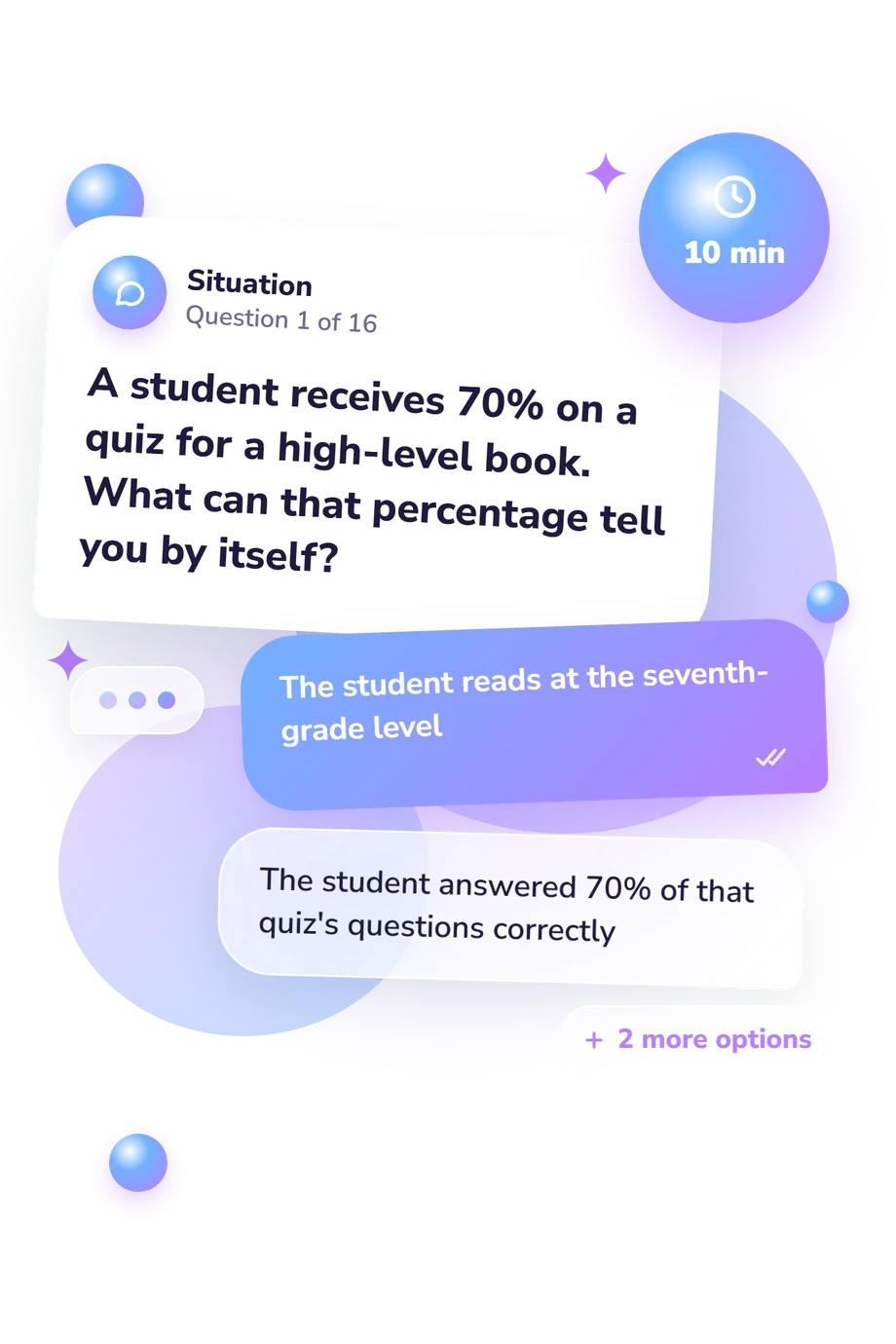
- The student reads at the seventh-grade level
- The student answered 70% of that quiz's questions correctly
- The student completed 70% of the book
- The book was 30% above the student's reading range
- The percentage of the book that the student finished
- The student's reading speed compared with classmates
- The percentage of quiz questions the student answered correctly
- The percentage of available book points the student selected
- Its cover price and page size
- Its publication date and genre
- Its length and text difficulty
- Its quiz length and number of characters
AR Reading Quiz - Description and methodology of the test
Students, families, and educators who want to understand Accelerated Reader terminology can use this AR reading test before choosing or discussing books. The AR Reading Quiz focuses on practical knowledge rather than literary taste. The result indicates how accurately the reader understands and applies concepts such as levels, points, percentages, comprehension, and reading challenge.
What This Assessment Measures
The questionnaire checks whether a reader can apply core Accelerated Reader ideas in practical situations. It suits students, parents, teachers, and adults who want to understand how book levels, points, percentages, comprehension, and reading challenge fit together. This questionnaire measures conceptual understanding of Accelerated Reader concepts, not reading speed or literary preference.
The items distinguish definitions from applications, including what a percentage measures, how level relates to text difficulty, and why a perfect score on an easy book may still mean limited challenge. The displayed scale is Accelerated Reader Knowledge (0-16), with these bands:
- Foundations to Build (0-6) shows that some concepts are recognized but key distinctions may be confused.
- Developing Knowledge (7-12) indicates that essentials are understood but application may need practice.
- Strong Knowledge (13-16) indicates accurate understanding of the concepts covered.
Methodology and Evidence Base
Each item presents a short reading situation with several answer choices. The respondent selects the option that best fits the concept, and one total summarizes performance across the tested material. The questionnaire presents one overall result on the displayed scale, while no item-level allocation is specified. A student preparing to take an AR quiz can use the overall band to review concepts covered by the questionnaire.
Renaissance Learning’s 2006 design document describes the Accelerated Reader assessment framework and distinctions among book level, points, quiz percentage, comprehension, and reading range. The framework documents terminology used in the questionnaire; it does not establish that this questionnaire is a standardized adaptation.
Students who work through Accelerated Reader quizzes should treat the result as an educational snapshot. Terminology familiarity, attention, and current reading context can affect performance, and the result is educational rather than an official Accelerated Reader assessment. It can support review of the concepts covered by the questionnaire, but it cannot by itself describe overall reading ability.
- Vollands, Stacy R., Topping, Keith J., & Evans, Ryka M. (1999). Computerized self-assessment of reading comprehension with the Accelerated Reader: Action research. Reading & Writing Quarterly, 15(3), 197-211. 10.1080/105735699278189
- Topping, Keith J., & Fisher, Anna M. (2003). Computerised formative assessment of reading comprehension: Field trials in the UK. Journal of Research in Reading, 26(3), 267-279. 10.1111/1467-9817.00202
- Renaissance Learning. (2006). The design of Accelerated Reader assessments. Madison, WI: Renaissance Learning.
Updated: