
1950s Quiz
How the Scales are Structured
Who Usually Takes This Test?
See How You Compare
Below is a preview of how scores are typically distributed across each scale.
Example Questions From the Test
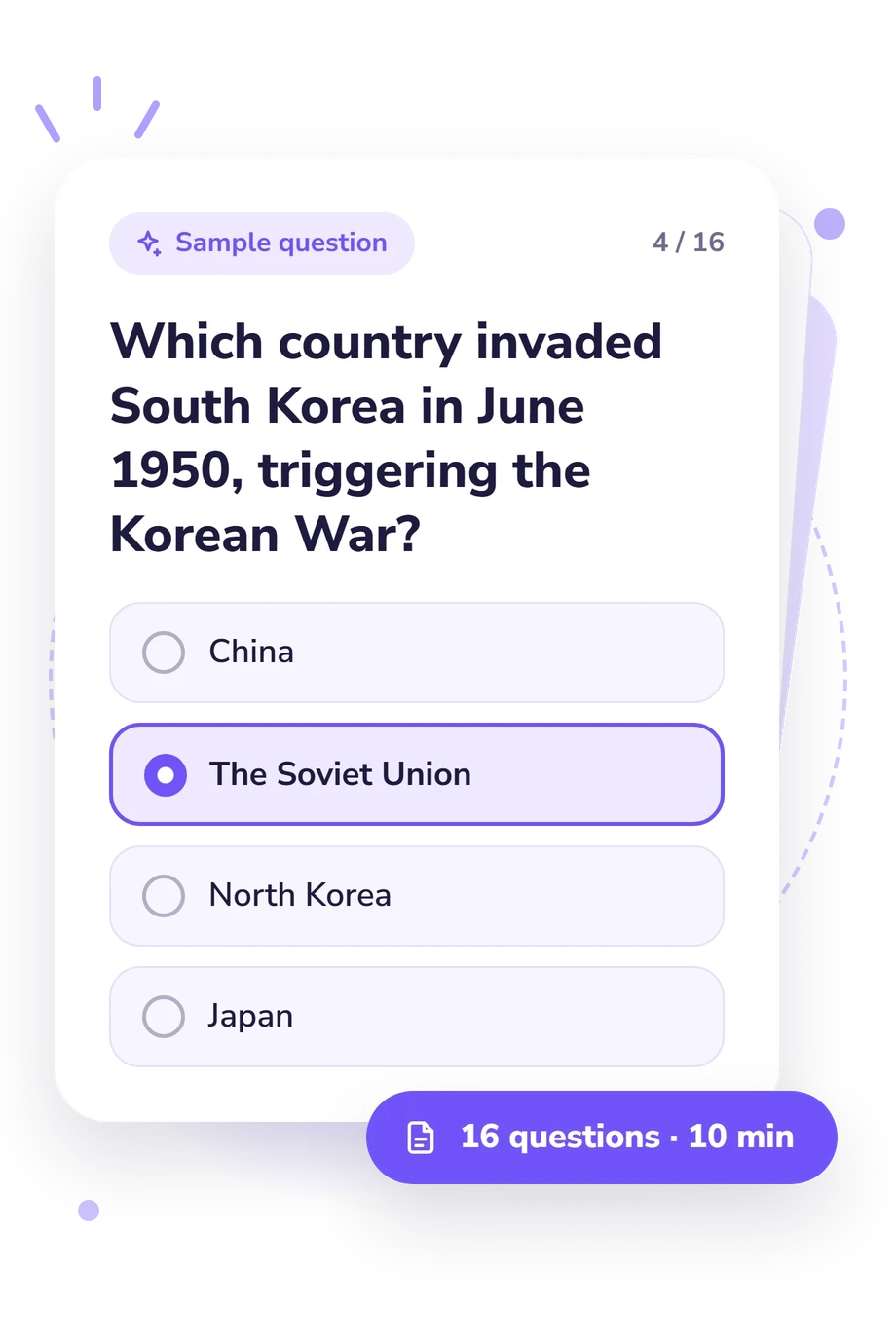
- China
- The Soviet Union
- North Korea
- Japan
- Birmingham
- Montgomery
- Atlanta
- Little Rock
- The Warsaw Pact
- The Marshall Plan
- The Treaty of Rome
- The North Atlantic Treaty
1950s Quiz - Description and methodology of the test
Readers who want to check their grasp of the decade can use this 1950 quiz as a focused historical knowledge exercise. It suits learners, students, and curious adults who want a structured way to revisit major events rather than rely on a general impression. The 1950s quiz connects factual recall with wider themes across politics, society, culture, science, and international affairs.
What This Assessment Explores
This assessment measures factual knowledge of the 1950s through questions about events, people, movements, inventions, and social change. It suits anyone checking which parts of the decade’s history they recognize confidently and which deserve further study. When this 50s quiz asks about historical events, it requires recalling facts and selecting the best of four choices, not writing a narrative.
The questions cover these thematic groups:
- Politics and international affairs identify conflicts, alliances, leaders, and state actions.
- Society and civil rights connect public events with changes in rights and institutions.
- Culture and everyday life measure recognition of music, literature, television, and consumer habits.
- Science and technology cover medical, space, and household developments.
Together, these areas provide a broad snapshot of selected historical knowledge. The result profiles recall across themes, not every form of historical reasoning or personal expertise.
Methodology and Evidence Base
Each item presents a historical prompt with four answer choices and asks for the best response. The score is the number of correct answers, so a higher total indicates stronger command of the facts sampled here. Together, these 1950s quiz questions span Cold War, decolonization, civil rights, culture, medicine, technology, and consumer life.
The displayed scale is 1950s Knowledge (0-16). Its bands are Foundations to Build (0-6), Developing Knowledge (7-12), and Strong Knowledge (13-16). These labels describe performance against the questionnaire’s own score bands.
This is a multiple-choice historical-knowledge exercise. Olson and Gumpert (2018) and Schoppa (2021) address the revolution, Cold War, and decolonization topics represented in the items. Huijgen et al. (2014) distinguishes factual recognition from historical perspective-taking, while Reich (2013) explains why multiple-choice results represent selected knowledge rather than every form of understanding. The 1950-themed quiz questions can guide focused review, but prior education, cultural familiarity, language, and test conditions may affect performance. The quiz has no published standardization, reliability estimates, or external reference cutoffs, so the result is descriptive feedback.
- Olson, James S., and Mariah Gumpert. The 1950s: Key Themes and Documents. ABC-CLIO, 2018. ISBN 9781440861321.
- Schoppa, R. Keith. “A New Day? Revolution, Cold War, and Decolonization, 1950-1965.” In The Twentieth Century: A World History, 71-92. Oxford University Press, 2021. 10.1093/oso/9780190497354.003.0005.
- Huijgen, Tim, Carla van Boxtel, Wim van de Grift, and Paul Holthuis. “Testing elementary and secondary school students’ ability to perform historical perspective taking: the constructing of valid and reliable measure instruments.” European Journal of Psychology of Education 29 (2014): 653-672. 10.1007/s10212-014-0219-4.
- Reich, Gabriel A. “Imperfect models, imperfect conclusions: An exploratory study of multiple-choice tests and historical knowledge.” The Journal of Social Studies Research 37, no. 1 (2013): 3-16. 10.1016/j.jssr.2012.12.004.
Updated: