
What Should I Do Right Now Quiz
How the Scales are Structured
Who Usually Takes This Test?
See How You Compare
Below is a preview of how scores are typically distributed across each scale.
Example Questions From the Test
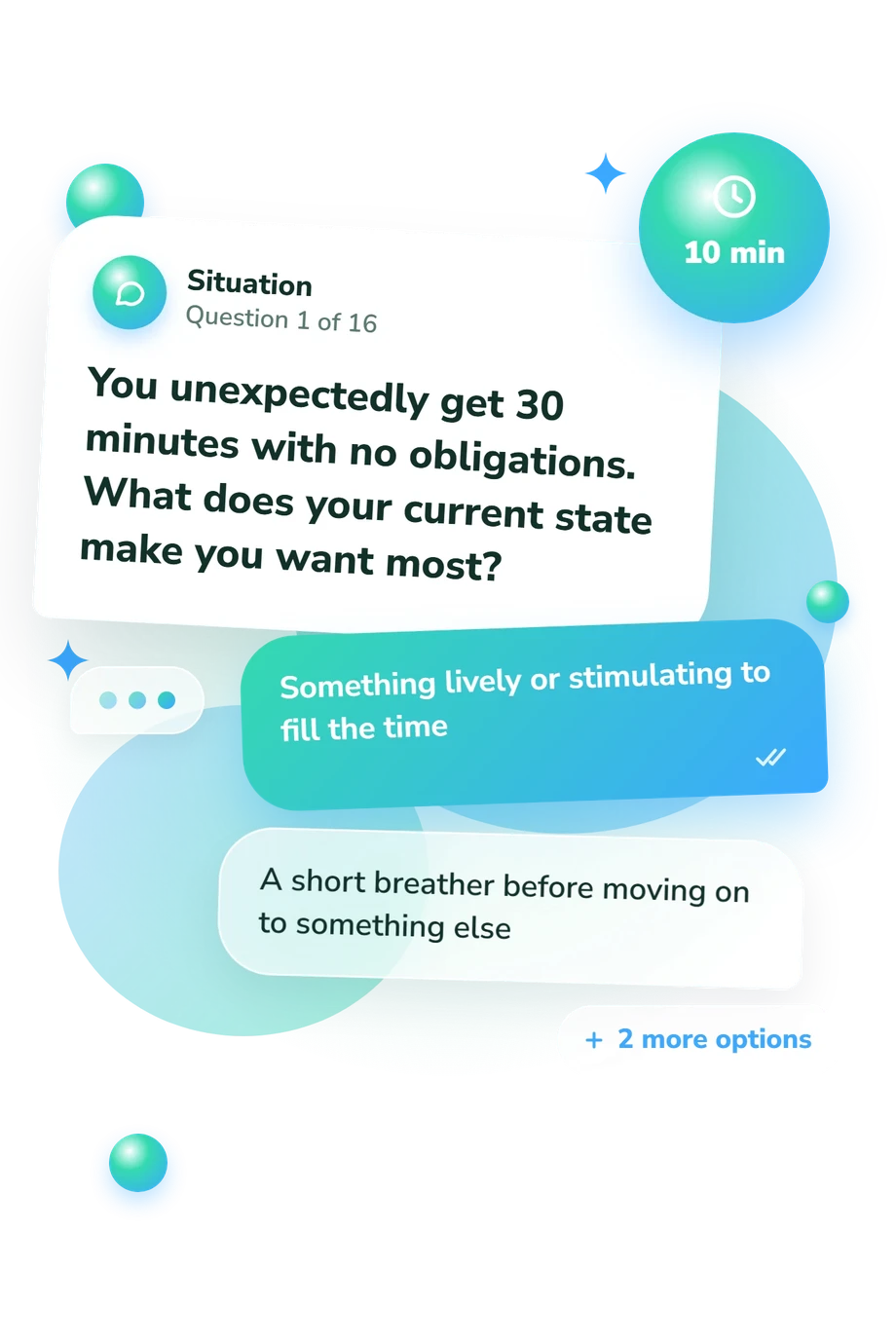
- Something lively or stimulating to fill the time
- A short breather before moving on to something else
- A calm activity that helps clear mental clutter
- As little input or effort as possible while I recover
- Time with a favorite activity I already know well
- A gentle change of scenery or routine
- A fun challenge that asks me to improvise a little
- Following pure curiosity wherever it leads
- Doing something alone at my own pace
- Going somewhere with people around but no need to interact
- Inviting someone to join a simple activity
- Making dedicated time for a person I want to see or hear
What Should I Do Right Now Quiz - Description and methodology of the test
People choosing between rest, connection, productivity, and novelty can use this assessment to turn a vague moment into a clear next direction. The What Should I Do Right Now Quiz is for anyone whose available time feels hard to place, whether energy is scattered or several appealing options compete. It works as a What Should I Do Today Quiz when the immediate need is choosing an activity that fits the present moment.
What This Assessment Explores
The questionnaire treats indecision as present fit rather than fixed personality. Its situations cover contact, manageable action, novelty, unfinished tasks, and relief from demands. It addresses the practical question behind a what do i want to do today quiz: which direction feels workable now, without judging character.
The dimensions describe current tendencies, not judgments of relationships, productivity, creativity, or health. The result types are:
- Connect with Someone (0-12) shows social preference: Solitude Pull (0-4), Light Connection (5-8), Strong Connection (9-12).
- Make Progress (0-12) shows task fit: Progress can wait (0-4), One step may satisfy (5-8), Strong progress affinity (9-12).
- Play and Explore (0-12) shows novelty appetite: Prefer familiar (0-4), Small detour (5-8), Strong exploration (9-12).
- Rest and Reset (0-12) shows recovery preference: Low reset pull (0-4), Moderate reset pull (5-8), High reset pull (9-12).
Methodology and Evidence Base
Each item presents an everyday situation with four response options. The choices span social contact, task readiness, novelty, and recovery, with no correct answer. Responses produce separate directional scores, and bands show which activity currently fits.
The method is conceptually consistent with Nguyen, Konu, and Forbes (2025), whose ecological-momentary work examines solitude as a way to downregulate daily arousal. It supports reading solitary choices as a present regulation preference, not relationship quality. The framing also aligns with self-determination theory from Ryan and Deci (2000), especially autonomy, relatedness, and intrinsic interest.
Recovery language is conceptually consistent with the Recovery Experience Questionnaire described by Sonnentag and Fritz (2007), particularly unwinding and psychological detachment. The questionnaire is not an adaptation of those published measures. It is an online self-reflection tool, not a standardized clinical measure; its bands offer guidance rather than population norms or clinical cutoffs. Current context, fatigue, stress, and self-awareness can shift responses, so use the strongest direction to decide what to do right now and choose one manageable next step.
- Nguyen, Thuy-vy T., Delali Konu, and Samuel Forbes. "Investigating solitude as a tool for downregulation of daily arousal using ecological momentary assessments." Journal of Personality, 93(1), 31-50 (2025). 10.1111/jopy.12939
- Ryan, Richard M., and Edward L. Deci. "Self-determination theory and the facilitation of intrinsic motivation, social development, and well-being." American Psychologist, 55(1), 68-78 (2000). 10.1037/0003-066X.55.1.68
- Sonnentag, Sabine, and Charlotte Fritz. "The Recovery Experience Questionnaire: Development and validation of a measure for assessing recuperation and unwinding from work." Journal of Occupational Health Psychology, 12(3), 204-221 (2007). 10.1037/1076-8998.12.3.204
Updated: