
Guess the Movie Quiz
How the Scales are Structured
Who Usually Takes This Test?
See How You Compare
Below is a preview of how scores are typically distributed across each scale.
Example Questions From the Test
- Predator
- The Thing
- Event Horizon
- Alien
- The Prestige
- Shutter Island
- Inception
- Memento
- Return to Oz
- Alice in Wonderland
- The Wizard of Oz
- Chitty Chitty Bang Bang
Guess the Movie Quiz - Description and methodology of the test
For viewers deciding whether a scene-clue challenge suits them, the Guess the Movie Quiz offers a focused way to test recall of plots, characters, settings, objects, and visual moments. It is a light, self-guided movie trivia quiz for anyone who wants to see how readily familiar cinematic details come together under quiz conditions.
What This Assessment Explores
Recognition, not enjoyment, opinion, or film criticism, is the focus. Each prompt describes a distinctive event and asks which title fits it. Clues involve plot turns, characters, settings, objects, and memorable sequences, so success may depend on recalling a story, visual image, or combination of details. Casual viewers and committed film fans may enjoy this movie scene quiz, but its result remains tied to the selected titles.
The result has one dimension:
- Movie Knowledge measures the number of film identities identified correctly: 0-6 is Opening Credits, 7-12 is Keen Viewer, and 13-16 is Scene Expert. These bands describe performance on the selected films, not comprehensive knowledge of cinema.
A missed answer may reflect unfamiliarity with a genre, era, or scene rather than weak memory overall. The score does not measure taste, intelligence, or critical analysis.
Methodology and Scientific Basis
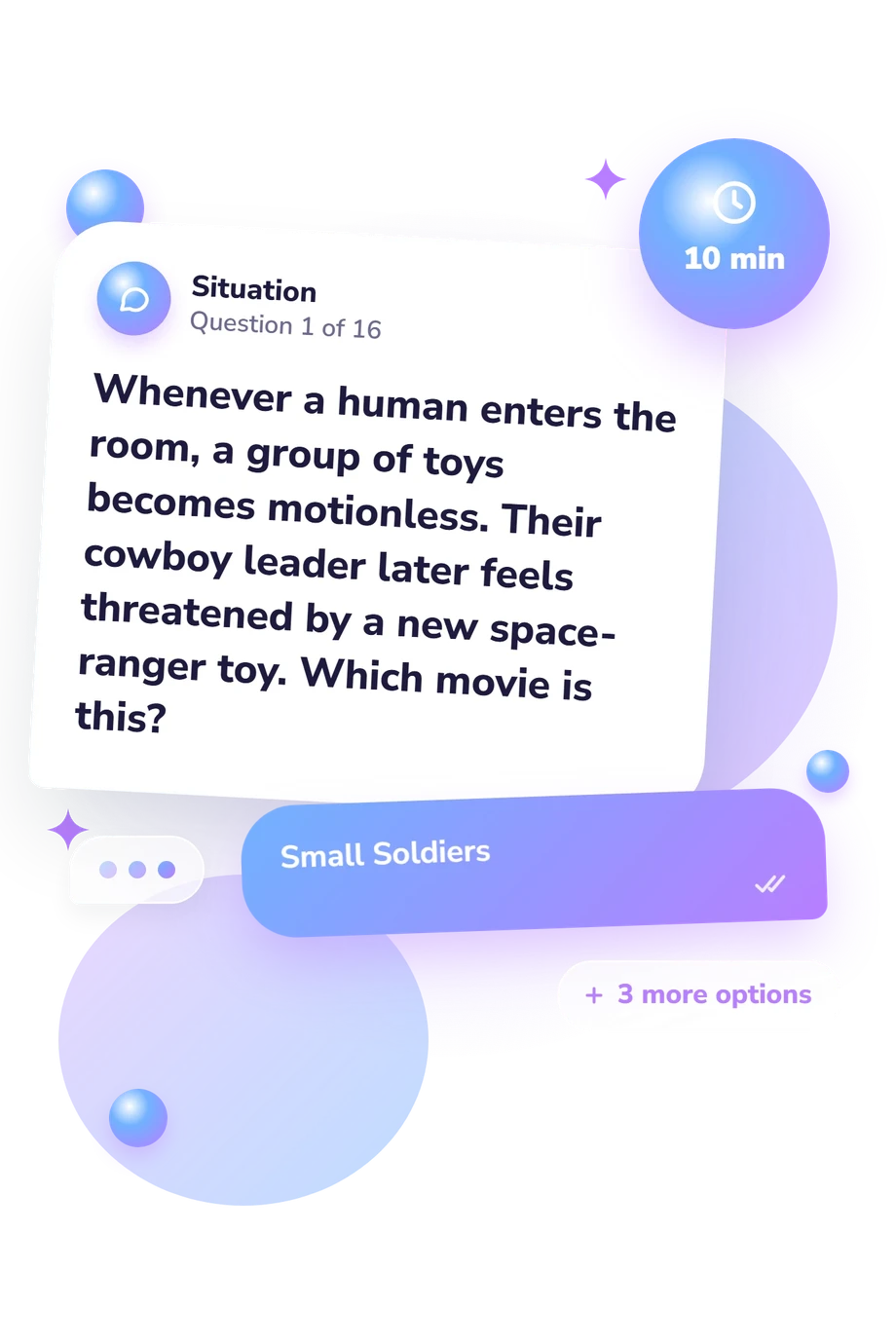
Every item presents a scene description with four film titles, and the respondent chooses the best match. The total is the number of correct answers across all items, so the score reflects performance on the selected questions. The clues cover narrative events, character actions, settings, objects, and endings.
This film recognition test is conceptually consistent with research on memory for audiovisual narratives and changing scenes. Furman et al. (2007) found that viewers can retain information from an extended movie narrative. Tang et al. (2016) examined why some movie events are remembered more readily, and Ferguson et al. (2017) studied memory for temporally dynamic scenes. This questionnaire is not an adaptation of those instruments.
The total and its bands are descriptive for this selected film set, not population norms or standardized clinical classifications. Prior exposure, cultural familiarity, genre preferences, attention, and confidence can affect performance, especially when films share broad story elements. Read the result as a snapshot of recognition for these titles, not as a complete measure of cinema knowledge.
- Furman, Orit, Nimrod Dorfman, Uri Hasson, Lila Davachi, and Yadin Dudai. "They saw a movie: Long-term memory for an extended audiovisual narrative." Learning & Memory 14, no. 6 (2007): 457-467. 10.1101/lm.550407
- Tang, Hanlin, Jed Singer, Matias J. Ison, Gnel Pivazyan, Melissa Romaine, Rosa Frias, Elizabeth Meller, Adrianna Boulin, James Carroll, Victoria Perron, Sarah Dowcett, Marlise Arellano, and Gabriel Kreiman. "Predicting episodic memory formation for movie events." Scientific Reports 6 (2016): 30175. 10.1038/srep30175
- Ferguson, Ryan, Donald Homa, and Derek Ellis. "Memory for temporally dynamic scenes." Quarterly Journal of Experimental Psychology 70, no. 7 (2017): 1197-1210. 10.1080/17470218.2016.1174721
Updated: