
Famous Paintings Quiz
How the Scales are Structured
Who Usually Takes This Test?
See How You Compare
Below is a preview of how scores are typically distributed across each scale.
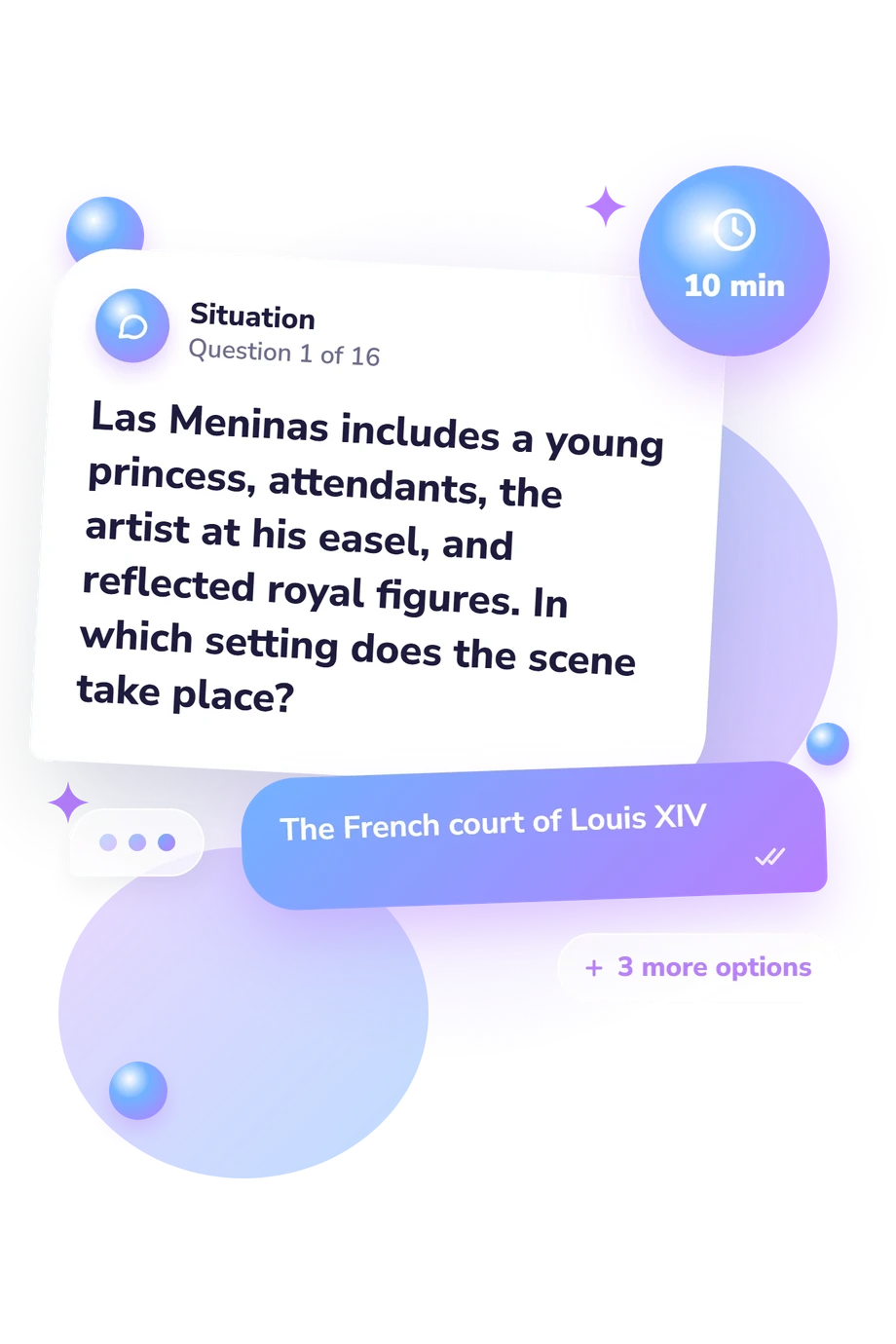
Example Questions From the Test
- Raphael
- Leonardo da Vinci
- Titian
- Sandro Botticelli
- Gustav Klimt
- Edvard Munch
- Henri de Toulouse-Lautrec
- Egon Schiele
- Frans Hals
- Johannes Vermeer
- Rembrandt van Rijn
- Peter Paul Rubens
Famous Paintings Quiz - Description and methodology of the test
Visitors who want to connect iconic paintings with their creators, techniques, movements, and historical settings can use this famous paintings quiz as a focused knowledge check. It suits curious learners, museum-goers, and students who want a quick sense of which parts of visual culture they recognize confidently. As a famous art quiz, it turns recognition into a structured opportunity for further study.
What This Assessment Explores
The questions examine how well readers link celebrated works with artists, clues, techniques, movements, and historical settings. Some items ask for direct identification; others require recognition from a scene description or knowledge of a work’s significance.
Taken as a famous paintings test, it suits readers checking art-history familiarity rather than professional expertise. Results indicate whether recognition is strongest for images and names, formal vocabulary, or historical associations.
The displayed result uses one scale, Famous Paintings Knowledge (0-16). It reflects this selection, not all art history, and is shown as:
- Foundation to Build (0-6) indicates recognition of some major works while leaving connections among artists, styles, and contexts to strengthen.
- Developing Knowledge (7-12) indicates a useful base with details about techniques, movements, and settings still to refine.
- Strong Knowledge (13-16) indicates accurate connections among celebrated paintings, creators, visual features, media, and historical contexts.
Methodology and Scientific Basis
Each item presents a question or visual description with four answer choices. The set covers artist identification, subject recognition, technique, medium, movement, and historical context, so the score samples factual connections rather than one artistic skill.
Answers are summarized into the displayed result bands, which describe performance on this selection. The format works as a famous artwork quiz, but it is not a norm-referenced estimate of overall art knowledge or artistic ability.
Conceptually, the questionnaire is consistent with the VAIAK, a published measure distinguishing art interest from art knowledge. It is not presented as an adaptation, validation, or digital reproduction of VAIAK.
Its factual and contextual emphasis also parallels Hirano and Okumura (2018), whose 2018 study examined knowledge in relation to art appreciation.
This is an online, self-administered knowledge check rather than a standardized assessment with established population norms. Familiarity with particular paintings, schooling, museum exposure, language, and momentary memory can influence performance. Read the result as a prompt to explore less familiar artists, movements, techniques, or settings, not as a complete account of art understanding.
- Specker, Eva, Michael Forster, Hanna Brinkmann, Jane Boddy, Matthew Pelowski, Raphael Rosenberg, and Helmut Leder (2020). The Vienna Art Interest and Art Knowledge Questionnaire (VAIAK): A Unified and Validated Measure of Art Interest and Art Knowledge. Psychology of Aesthetics, Creativity, and the Arts, 14(2), 172-185. DOI 10.1037/aca0000205
- Hirano, Tomoki, and Takaaki Okumura (2018). Uses of Knowledge in Art Appreciation: A Quantitative Analysis of an Art Certification Test. The Journal for Japanese Association of Art Education, 39, 275-287. DOI 10.24455/aaej.39.0_275
Updated: