
Wonder Quiz
How the Scales are Structured
Who Usually Takes This Test?
See How You Compare
Below is a preview of how scores are typically distributed across each scale.
Example Questions From the Test
- Summer
- Julian
- Miranda
- Jack
- Julian, Charlotte, and Summer
- Amos, Miles, and Henry
- Justin, Miranda, and Via
- Mr. Browne, Mr. Tushman, and Mr. Davenport
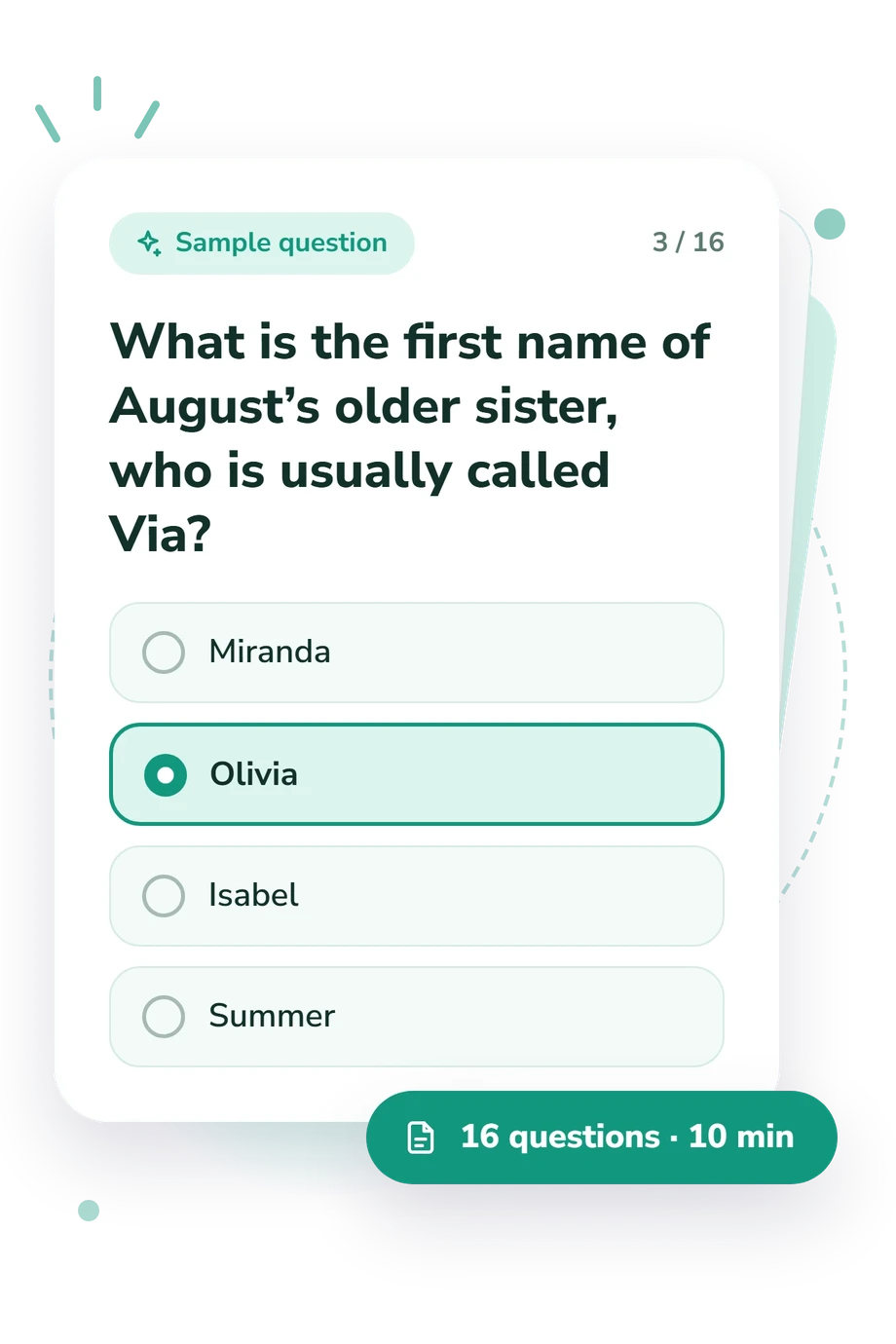
- Miranda
- Olivia
- Isabel
- Summer
Wonder Quiz - Description and methodology of the test
Readers who want to check how closely they followed Palacio’s story can use the Wonder Quiz to assess recall and interpretation. This quiz about the Wonder book suits readers revisiting the novel for personal reflection, a discussion, or a classroom activity. The result shows the reader’s level of knowledge of the novel and can help identify which parts of the story deserve closer discussion.
What This Assessment Explores
Across the assessment, quiz questions about Wonder cover characters, school settings, relationships, turning points, event order, and choices made by August and those around him. Several also address the novel’s shifting narrators, asking how perspective changes what readers know and how one event can look different to different people.
The activity suits readers who have completed Wonder and want a text-specific check of story and structure. It examines remembered details alongside connections among motives, consequences, and viewpoints, so the result reflects more than isolated name recognition.
The reported scale is Wonder Knowledge, scored 0-16. Displayed bands:
- Foundation (0-6) indicates recognition of key elements, with a reread likely to clarify characters and sequence.
- Developing (7-12) shows knowledge of the main story and relationships, while finer details and perspectives remain to revisit.
- Strong (13-16) reflects command of characters, turning points, narration, and themes.
Methodology and Evidence Base
Each of the 16 items uses a multiple-choice format with four answer options. Some ask for literal recall of names, settings, outcomes, or quotations; others require links among events, motives, and viewpoints. Responses are combined into one displayed total, so the result describes performance across this questionnaire rather than separate scores for each comprehension process.
Viewed as a Wonder novel quiz, the activity draws its content from R.J. Palacio’s novel, which supplies the characters, events, narrators, and themes being checked. Its mix of recall and inference is conceptually consistent with distinctions discussed by Basaraba and colleagues, but the questionnaire is not an adaptation or validation of that measure.
The displayed bands describe performance on this online questionnaire, showing how well the respondent recognizes and connects details from the novel. Recent reading, attention, memory, familiarity with the story, and guessing can affect performance, while accurate recall does not capture every kind of literary response. The result is therefore best read as a focused check of knowledge of one novel, not as a general measure of reading ability.
- Palacio, R. J. Wonder. New York: Alfred A. Knopf Books for Young Readers, 2012. ISBN 9780375869020.
- Basaraba, Deni, Paul Yovanoff, Julie Alonzo, and Gerald Tindal. "Examining the Structure of Reading Comprehension: Do Literal, Inferential, and Evaluative Comprehension Truly Exist?" Reading and Writing 26, no. 3 (2013): 349-379. 10.1007/s11145-012-9372-9
Updated: