
Martin Luther King Jr. Quiz
How the Scales are Structured
Who Usually Takes This Test?
See How You Compare
Below is a preview of how scores are typically distributed across each scale.
Example Questions From the Test
- Only elected officials could legitimately lead labor campaigns
- Economic demands should remain separate from civil rights
- Local protests should avoid attracting national attention
- Black workers deserved dignity, recognition, and fair treatment
- Freedom Riders challenging segregation in interstate travel
- Students integrating Central High School in Little Rock
- Striking sanitation workers in Memphis
- Tenant farmers organizing in the Mississippi Delta
- Restricting civil rights organizing to court challenges
- Building a multiracial movement for economic justice
- Ending federal anti-poverty programs in favor of private charity
- Concentrating exclusively on desegregating interstate buses
Martin Luther King Jr. Quiz - Description and methodology of the test
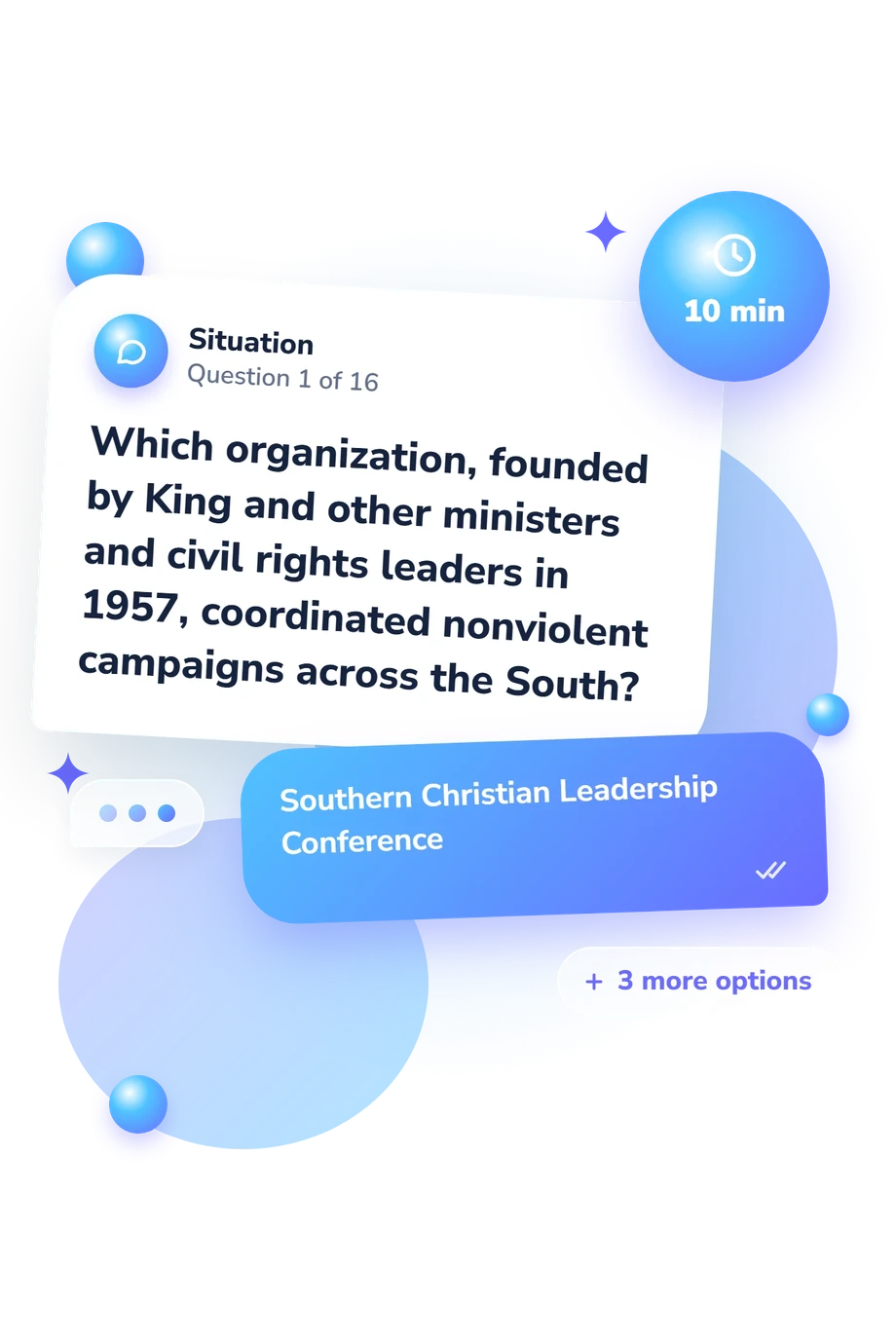
Designed for students, educators, and readers who want a focused way to check their historical understanding, the Martin Luther King Jr Quiz examines how well you recognize the people, campaigns, speeches, and ideas connected with King’s public work. This Martin Luther King quiz can be useful before a lesson, after reading, or during personal review because the result indicates overall knowledge and how well the covered facts and ideas connect.
What This Assessment Explores
Questions connect events, organizations, speeches, and arguments rather than isolated facts. The assessment suits readers reviewing the civil rights movement or checking how securely its major ideas fit together. The result indicates overall knowledge and how well facts and ideas connect.
Questions represent these thematic areas:
- Organizations and campaigns cover protest groups, desegregation, voting rights, labor, and economic justice.
- Speeches and writings address direct action, nonviolent tension, moral responsibility, and hope.
- Democratic ideals and historical context connect national promises with events, honors, and late-life campaigns.
Together, these areas form the Martin Luther King Jr. Knowledge scale, scored from 0-16. Its displayed bands are Foundation to build (0-6), Developing knowledge (7-12), and Strong knowledge (13-16). An MLK quiz result in the higher band indicates stronger overall knowledge and a connected understanding of King’s public words, nonviolent strategy, and historical context.
Methodology and Evidence Base
Each of the Martin Luther King quiz questions uses four answer choices. Some test facts, such as the 1963 speech’s setting or the campaign behind the Selma footage; others ask about purpose, comparison, or moral reasoning. This structured multiple-choice format checks historical understanding, not simple date recall.
Historical work on King’s movement provides context for the organizations, campaigns, speeches, and ideas represented in the questions. King’s 1964 and 1967 books address justice, nonviolence, economic opportunity, and communal responsibility; one question also considers how a speech moves from injustice toward hope. The quiz is conceptually consistent with that historical record, but those sources do not establish its scoring or validation.
The displayed 0-16 score summarizes performance on this online multiple-choice knowledge check. No external norms or validation are stated, so interpret it as an indication of overall knowledge rather than a population percentile. When younger learners use it as a Martin Luther King quiz for kids, guided discussion can help with unfamiliar terms and context; several items require close reading of speeches and historical arguments. Prior exposure can affect performance.
- Clayborne Carson, Tenisha Armstrong, Susan Carson, Erin Cook, and Susan Englander, eds. The Martin Luther King, Jr., Encyclopedia. Greenwood, 2008.
- Martin Luther King, Jr. Why We Can't Wait. Harper & Row, 1964.
- Martin Luther King, Jr. Where Do We Go from Here: Chaos or Community? Harper & Row, 1967.
- Mouhamed Diop. Martin Luther King, Jr.'s Pulpit Rhetoric of Freedom: An Exegesis of His Discourse Mechanism. Creative Education, 2024, 15(2), 310-324. 10.4236/ce.2024.152019
Updated: