
Roleplay Quiz
How the Scales are Structured
Who Usually Takes This Test?
See How You Compare
Below is a preview of how scores are typically distributed across each scale.
Example Questions From the Test
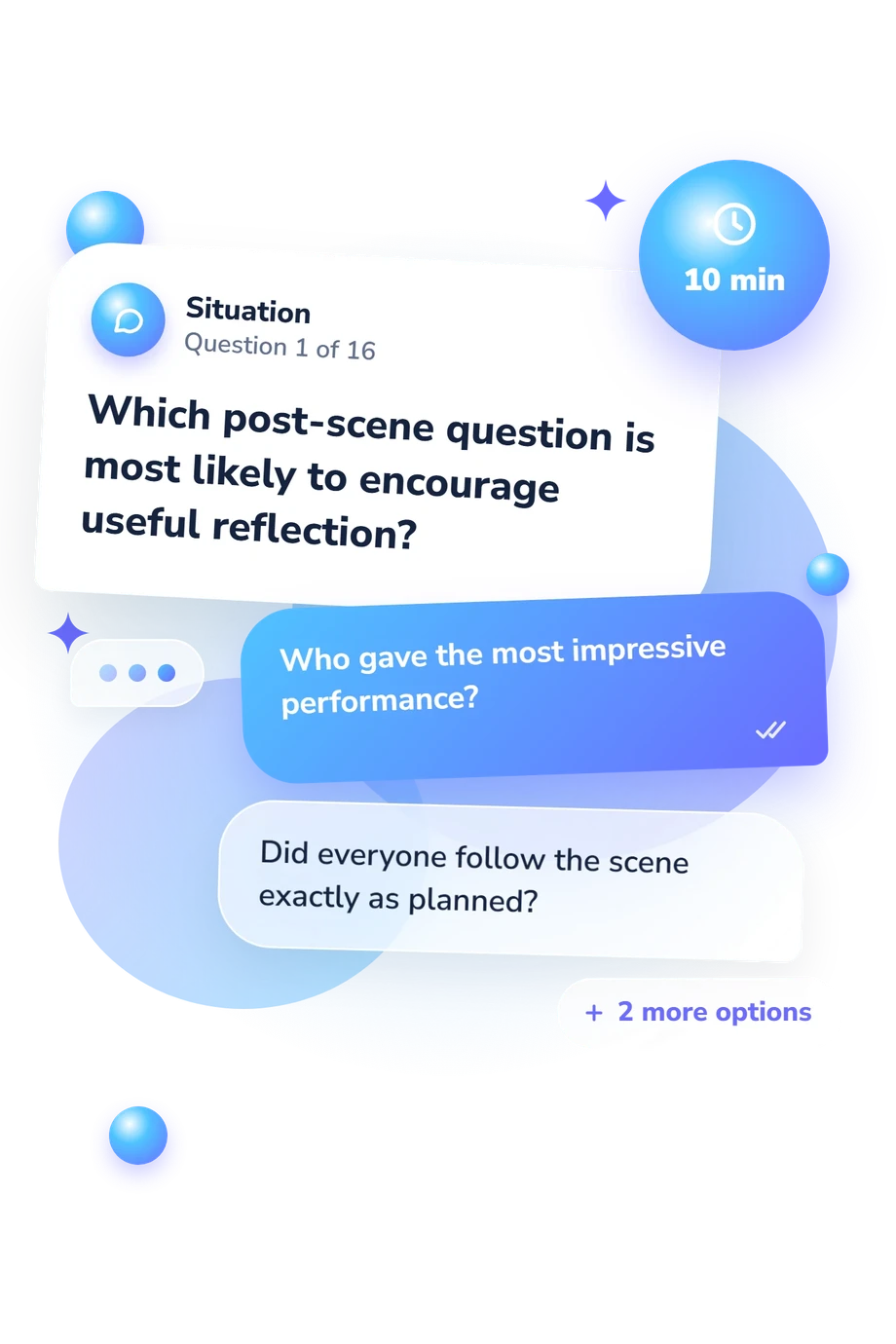
- Who gave the most impressive performance?
- Did everyone follow the scene exactly as planned?
- Was the roleplay realistic in every detail?
- What influenced your choices, and what might you try differently next time?
- “Your character had the right kind of personality.”
- “You were good at the whole thing.”
- “When you summarized the concern before proposing a solution, the other person became more willing to talk.”
- “I would simply have handled it better.”
- A rating of the participant’s acting ability
- The character’s relevant context, objective, and constraints
- A full transcript of everything the character must say
- The correct ending that all participants must produce
Roleplay Quiz - Description and methodology of the test
Designed for learners, facilitators, and educators, this assessment checks whether you can recognize the choices that make structured roleplay purposeful, safe, and transferable. The roleplay quiz focuses on practical judgment rather than acting talent, so the result can point to concepts worth revisiting before you lead or join a scene. Built around structured learning, this rp quiz tests recognition of principles across varied scenes.
What This Assessment Explores
The questions treat roleplay as structured learning, not a contest for performance. They ask you to recognize reflection, actionable feedback, gradual scaffolding, clear objectives, active listening, perspective-taking, improvisational cooperation, and boundaries. The intended reader may be a participant, facilitator, or educator reviewing how roleplay supports learning.
Learning through action gives this role playing quiz a focus on overall knowledge rather than performance. Its themes are:
- Reflection and transfer show whether you connect a scene with learning and future choices.
- Facilitation and feedback show whether you can structure participation and describe behavior usefully.
- Boundaries and perspective show whether you can protect the shared frame and consider another viewpoint.
Roleplay Knowledge is scored from 0-16: Foundations to build (0-6), Developing knowledge (7-12), and Strong knowledge (13-16).
Methodology and Evidence Base
The questions mix short educational, workplace, and tabletop situations with conceptual prompts, and each offers four answer choices. You select the response that best fits effective roleplay practice, and one point is awarded for each correct answer. The total reflects recognition of principles across the item set, not charisma, creativity, or theatrical skill. The result therefore works as a roleplay knowledge test for guided self-review.
The framework is conceptually consistent with Nestel and Tierney (2007), who emphasize preparation, purposeful participation, feedback, and reflection in role-play learning. It also aligns with Winardy and Septiana’s distinction between role-playing games and role-play used for educational objectives. Kolbe, Grande, and Spahn support attention to briefing, debriefing, attitude, structure, and psychological conditions around simulation-based learning. The questionnaire is conceptually consistent with these works and is not claimed here to be an adaptation of them.
Interpret the displayed bands as the questionnaire’s descriptive categories and as guides to practice. Results may vary with prior training, scenario familiarity, careful reading, and the wish to choose the socially desirable answer; live behavior also depends on context, self-awareness, and rehearsal.
- Nestel, Debra, and Tanya Tierney. "Role-play for medical students learning about communication: Guidelines for maximising benefits." BMC Medical Education 7 (2007): 3. 10.1186/1472-6920-7-3
- Winardy, Gary Collins Brata, and Eva Septiana. "Role, play, and games: Comparison between role-playing games and role-play in education." Social Sciences & Humanities Open 8, no. 1 (2023): 100527. 10.1016/j.ssaho.2023.100527
- Kolbe, Michaela, Bastian Grande, and Donat R. Spahn. "Briefing and debriefing during simulation-based training and beyond: Content, structure, attitude and setting." Best Practice & Research Clinical Anaesthesiology 29, no. 1 (2015): 87-96. 10.1016/j.bpa.2015.01.002
Updated: